

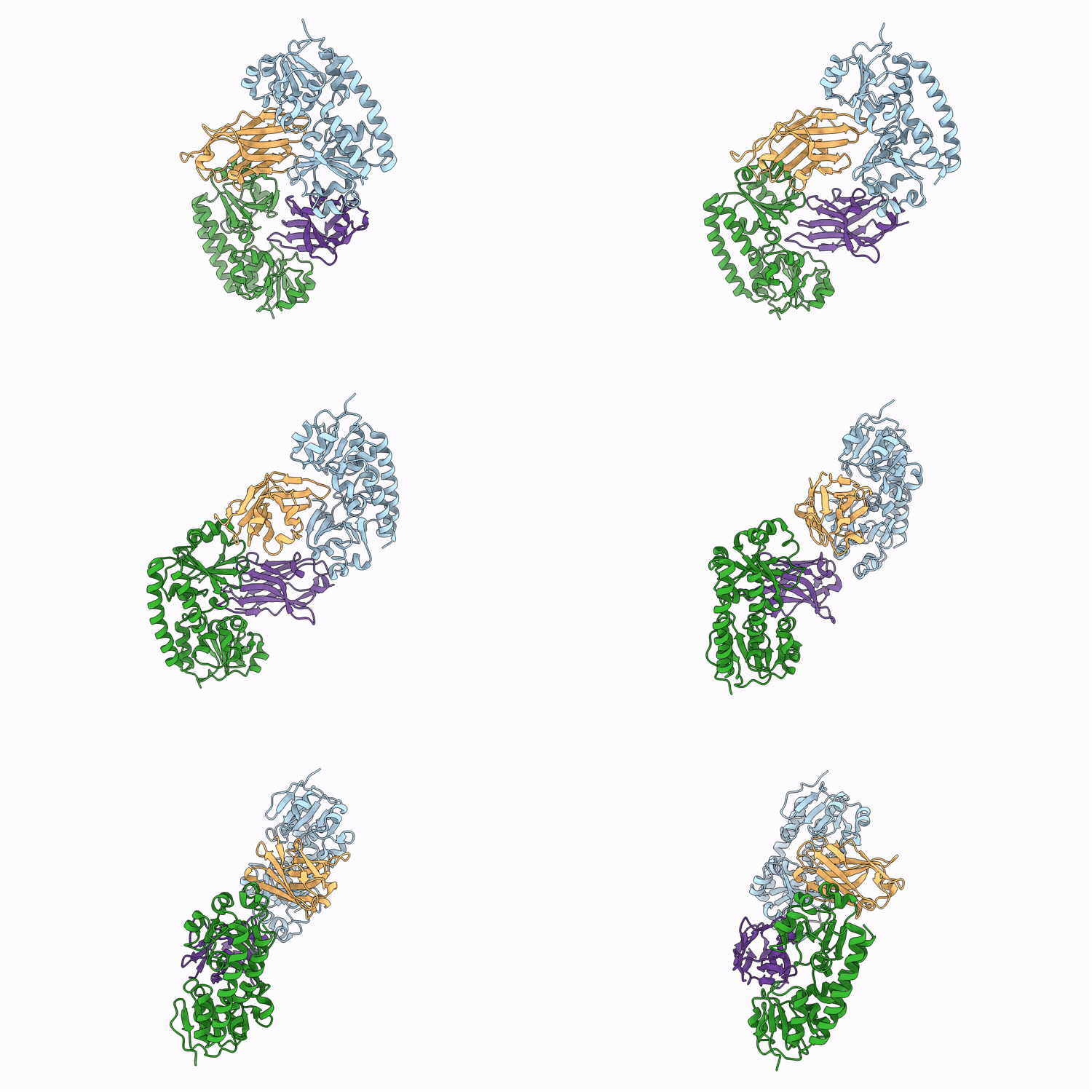
9ULP image
Deposition Date 2025-04-20
Release Date 2026-03-25
Last Version Date 2026-03-25
Entry Detail
PDB ID:
9ULP
Keywords:
Title:
Crystal structure of FtsB from Streptococcus pyogenes in complex with Nb1 nanobody
Biological Source:
Source Organism(s):
Expression System(s):
Method Details:
Experimental Method:
Resolution:
2.55 Å
R-Value Free:
0.30
R-Value Work:
0.25
R-Value Observed:
0.25
Space Group:
P 21 21 21

Macromolecular Entities
Structures with similar UniProt ID
Protein Blast
Polymer Type:polypeptide(L)
Molecule:Iron-hydroxamate ABC transpor
Gene (Uniprot):E0F66_02370
Chain IDs:A, C (auth: B)
Chain Length:283
Number of Molecules:2
Biological Source:Streptococcus pyogenes
Protein Blast
Polymer Type:polypeptide(L)
Molecule:VHH
Chain IDs:B (auth: C), D
Chain Length:124
Number of Molecules:2
Biological Source:Vicugna pacos
Primary Citation
Development of an inhibitory monoclonal nanobody targeting Streptococcus pyogenes siderophore binding protein FtsB.
J. Biol. Chem. 302 111224 111224 (2026)
PMID: 41651419 DOI: 10.1016/j.jbc.2026.111224

Abstact

Due to the limited availability of metals inside the human body, pathogenic bacteria must produce multiple highly specialized metal transporters to cause infection. These transporters constitute attractive targets for developing novel antibacterial strategies. Streptococcus pyogenes possesses three iron transporters, of which the FtsABCD system is specialized in the uptake of ferric hydroxamates. The role of this transporter in infection remains unclear. In this study, we developed a monoclonal alpaca VHH, or nanobody, Nb1, targeting FtsB. Nb1 binds to FtsB with sub-nM affinity, in an enthalpy-driven manner, and with a characteristically slow dissociation rate. Solvent accessibility analysis by hydrogen/deuterium exchange coupled with mass spectrometry, mutational analyses, and X-ray crystallography revealed that the epitope of Nb1 is in the binding pocket of FtsB. The nanobody competitively inhibited the binding of multiple hydroxamate siderophores and partially inhibited the uptake of siderophores in S. pyogenes cells. The inhibitory activity of Nb1 on siderophore transport represents a new tool to study the role of the FtsABCD transporter and can be used as a potential inhibitor of S. pyogenes growth under iron-limited conditions.

Legend

Protein

Chemical

Disease

Primary Citation of related structures
Feedback Form
Name
Email
Institute
Feedback