

9UJI image
Deposition Date 2025-04-17
Release Date 2025-10-22
Last Version Date 2026-05-06
Entry Detail
PDB ID:
9UJI
Keywords:
Title:
Crystal structure of the BTB domain mouse Keap1 in complex with CDDO-Im
Biological Source:
Source Organism(s):
Mus musculus (Taxon ID: 10090)
Expression System(s):
Method Details:
Experimental Method:
Resolution:
2.44 Å
R-Value Free:
0.25
R-Value Work:
0.20
Space Group:
P 1 21 1
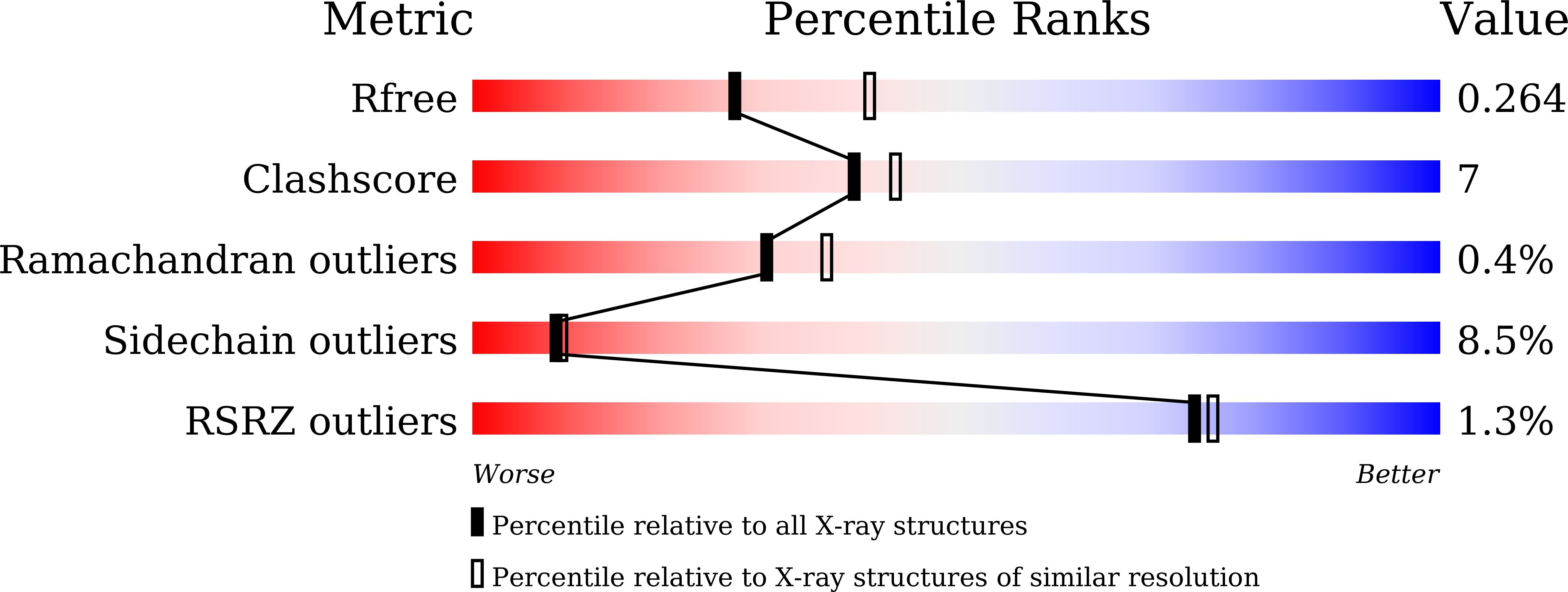
Macromolecular Entities
Structures with similar UniProt ID
Protein Blast
Polymer Type:polypeptide(L)
Molecule:Kelch-like ECH-associated pro
Gene (Uniprot):Keap1
Mutagens:S172A
Chain IDs:A, B, C, D, E, F, G, H
Chain Length:130
Number of Molecules:8
Biological Source:Mus musculus
Primary Citation
Bidirectional regulation of KEAP1 BTB domain-based sensor activity.
Redox Biol 87 103885 103885 (2025)
PMID: 41092551 DOI: 10.1016/j.redox.2025.103885

Abstact

The KEAP1-CUL3 ubiquitin ligase regulates protein stability of transcriptional factor NRF2 and plays critical roles in cellular stress response. The BTB domain of KEAP1 functions as a sensor for electrophilic chemicals. However, the precise mechanisms by which electrophiles are recognized and inhibit BTB activity remain unclear. Here, we show that electrophilic modification alters the spatial arrangement of the BTB homodimer, regulating its ligase activity. Co-crystal structural analyses and functional studies using potent NRF2-inducing CDDO-derivatives, synthetic electrophilic compounds structurally related to clinically approved molecules such as Omaveloxolone, revealed that the key sensor residue, Cys151, resides in a structurally elaborate environment within the BTB domain. Modification of Cys151 by NRF2 inducers changes the spatial configuration of the CUL3-binding sites in the BTB homodimer, reducing KEAP1-CUL3 complex affinity. In contrast, a Cys151-targeting NRF2 inhibitor induces an opposite rearrangement of the BTB homodimer. This study elucidates the molecular mechanism by which the BTB domain finely regulates KEAP1-CUL3 ubiquitin ligase activity.

Legend

Protein

Chemical

Disease

Primary Citation of related structures
Feedback Form
Name
Email
Institute
Feedback