

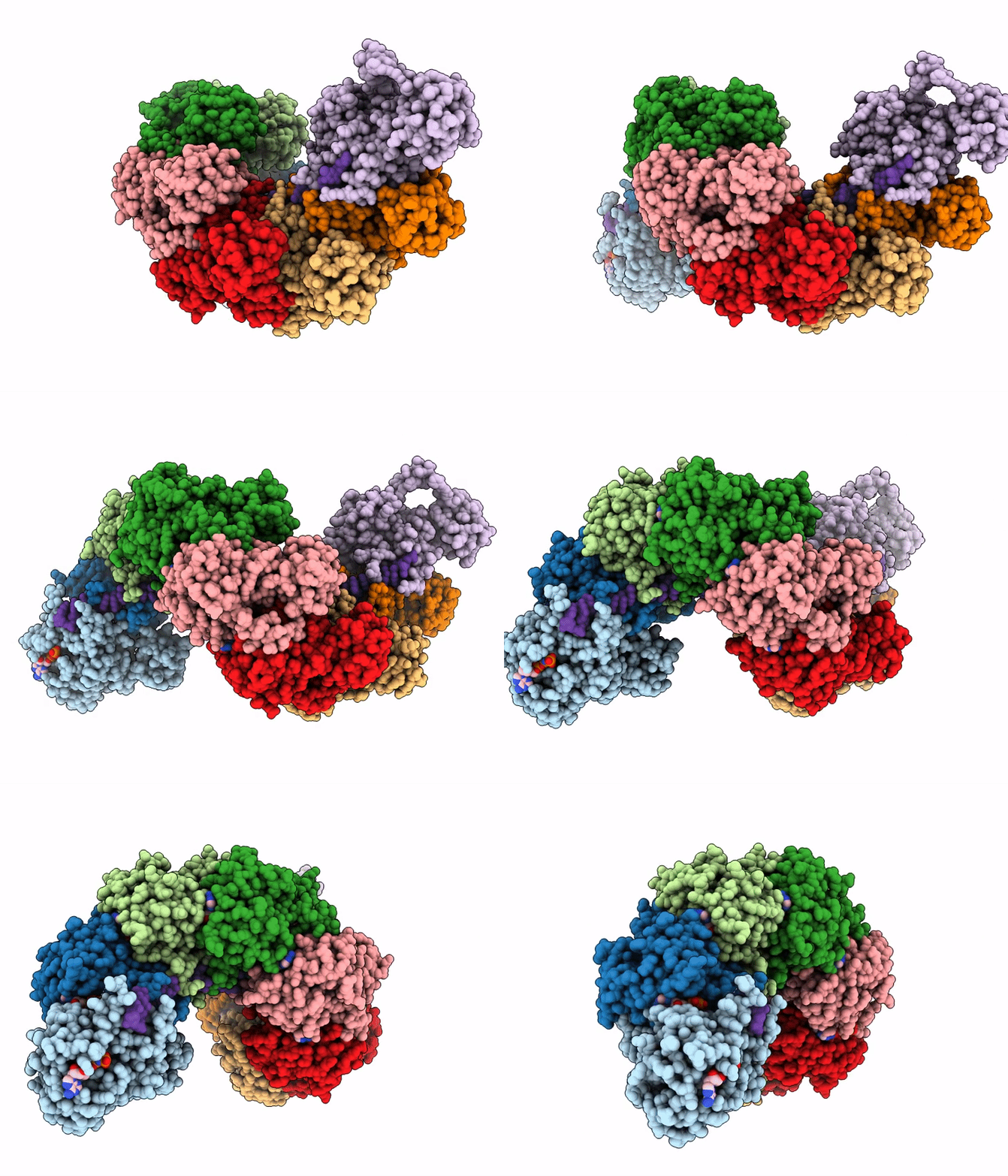
9UI4 image
Deposition Date 2025-04-15
Release Date 2025-09-10
Last Version Date 2026-03-25
Entry Detail
PDB ID:
9UI4
Title:
Rad51 presynaptic complex
Biological Source:
Source Organism(s):
Mus musculus (Taxon ID: 10090)
Expression System(s):
Method Details:
Experimental Method:
Resolution:
2.91 Å
Aggregation State:
FILAMENT
Reconstruction Method:
SINGLE PARTICLE
Macromolecular Entities
Structures with similar UniProt ID
Protein Blast
Polymer Type:polypeptide(L)
Molecule:DNA repair protein RAD51 homo
Gene (Uniprot):Rad51
Mutagens:S208E/A209D
Chain IDs:B (auth: C), C (auth: B), D (auth: A), E (auth: F), F (auth: I), G (auth: E), H, I (auth: D), J (auth: G)
Chain Length:361
Number of Molecules:9
Biological Source:Mus musculus
Polymer Type:polydeoxyribonucleotide
Molecule:DNA (27-MER)
Chain IDs:A (auth: L)
Chain Length:27
Number of Molecules:1
Biological Source:Mus musculus
Primary Citation
RAD51 D-loop structures reveal the mechanism of eukaryotic RAD51-mediated strand exchange.
Nat Commun 17 243 243 (2025)
PMID: 41326376 DOI: 10.1038/s41467-025-66925-z

Abstact

Strand exchange is a key step in homologous recombination, enabling template-based repair of DNA double-strand breaks. Eukaryotic RAD51 forms an ATP-dependent helical presynaptic filament on single-stranded DNA (ssDNA), which then searches for homologous double-stranded DNA (dsDNA), and catalyzes the strand exchange to form a D-loop in an ATP hydrolysis-independent manner. The molecular mechanism by which RAD51 facilitates dsDNA unwinding and pairing remains unclear. Here, we present cryo-EM structures of RAD51 mini-filaments bound to homologous dsDNA, capturing five intermediates from dsDNA recruitment to D-loop formation. These structures, together with molecular dynamics simulations, suggest a stepwise mechanism: the conserved N-terminal domain (NTD) recruits and bends the dsDNA, weakening base pairing near the exchange site. Subsequent engagement with positively-charged regions, including the loop L2 and loop Arg303-Arg306, further bends the homologous dsDNA, thereby not only positioning it closer to the strand exchange site but also inducing local base-pair opening. Additionally, the loop L2 (Met278 and Phe279) inserts between strands, and the secondary DNA binding sites (S2 sites) capture the displaced strand to prevent strand reannealing. Together, our findings provide detailed insight into a spatially coordinated mechanism of strand exchange by RAD51.

Legend

Protein

Chemical

Disease

Primary Citation of related structures
Feedback Form
Name
Email
Institute
Feedback