

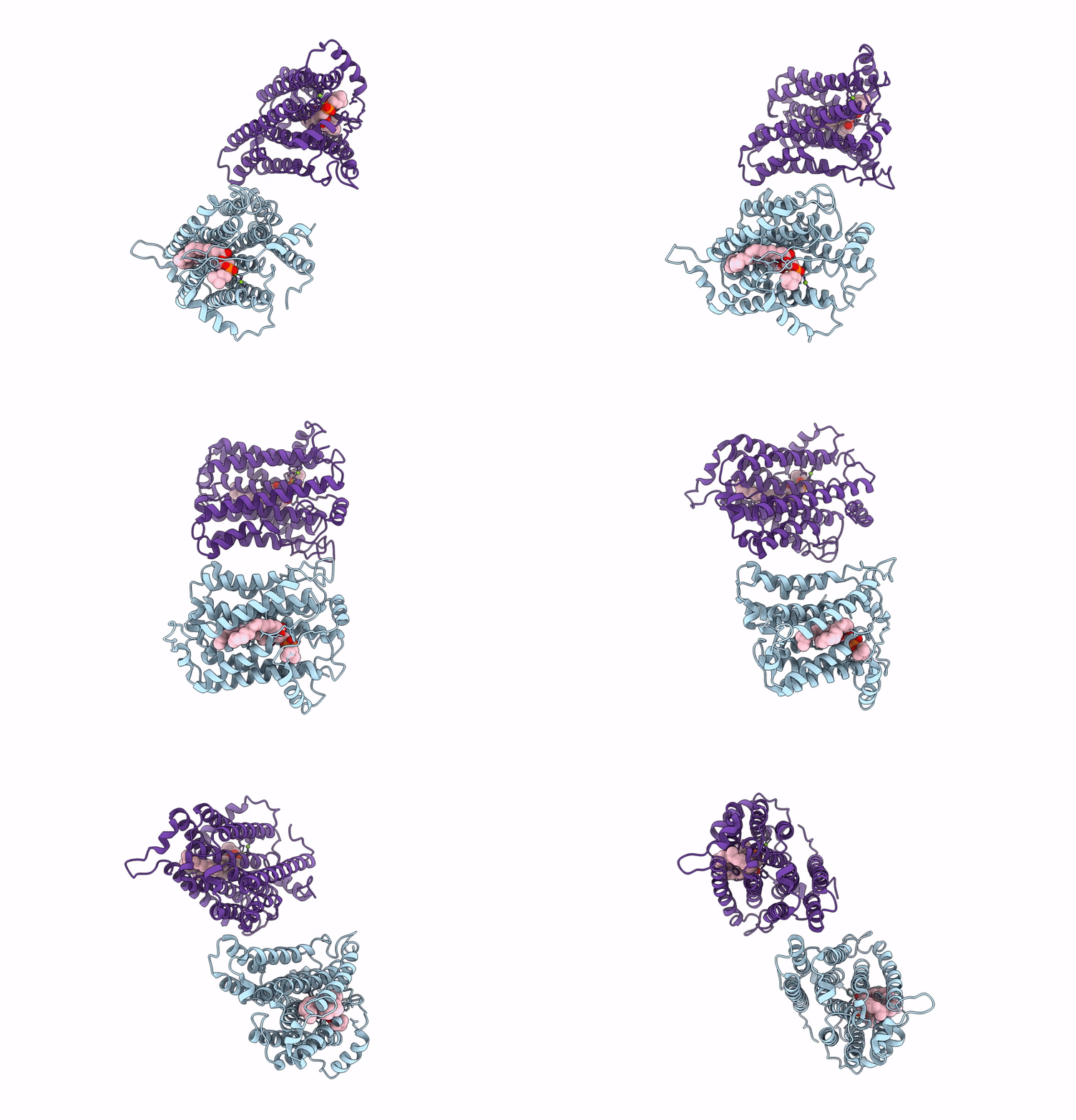
9UET image
Deposition Date 2025-04-09
Release Date 2025-06-18
Last Version Date 2026-07-01
Entry Detail
PDB ID:
9UET
Title:
Cryo-EM structure of human choline-phosphotransferase 1
Biological Source:
Source Organism(s):
Homo sapiens (Taxon ID: 9606)
Expression System(s):
Method Details:
Experimental Method:
Resolution:
3.68 Å
Aggregation State:
PARTICLE
Reconstruction Method:
SINGLE PARTICLE
Macromolecular Entities
Polymer Type:polypeptide(L)
Molecule:Cholinephosphotransferase 1
Gene (Uniprot):CHPT1
Chain IDs:A, B
Chain Length:406
Number of Molecules:2
Biological Source:Homo sapiens
Primary Citation
Structural basis for substrate selectivity and evolutionary insights into human choline phosphotransferase 1.
Biochem.Biophys.Res.Commun. 773 152082 152082 (2025)
PMID: 40435706 DOI: 10.1016/j.bbrc.2025.152082

Abstact

Phosphatidylcholine (PC) and phosphatidylethanolamine (PE), the core phospholipids maintaining eukaryotic membrane structure and function, are predominantly synthesized through the Kennedy pathway. The final step of this pathway is catalyzed by choline phosphotransferase 1 (CHPT1) and choline ethanolamine phosphotransferase 1 (CEPT1). Notably, although these enzymes show high sequence homology, CHPT1 specifically synthesizes PC while CEPT1 catalyzes both PC and PE production, and the mechanism of this substrate selectivity remains unclear. Here, we report the 3.7 A cryo-EM structure of human CHPT1 (hCHPT1), revealing a homodimer in which each monomer consists of an N-terminal domain, a catalytic domain, and a dimerization domain. Through structural and sequence analyses, along with biochemical characterizations, we identified important residues in the catalytic domain that regulate substrate selectivity. Moreover, cross-species sequence alignment showed ovipara CHPT1 conserves important substrate selectivity residues with CEPT1. This residues conservation may endow ovipara CHPT1 with catalytic bifunctionality comparable to CEPT1. These findings not only elucidate the structural basis for substrate selectivity between CHPT1 and CEPT1, but also provide novel evolutionary perspectives on phospholipid synthase adaptation.

Legend

Protein

Chemical

Disease

Primary Citation of related structures
Feedback Form
Name
Email
Institute
Feedback