

9U9R image
Deposition Date 2025-03-29
Release Date 2026-03-04
Last Version Date 2026-03-18
Entry Detail
PDB ID:
9U9R
Title:
ARF1(Q71L) bound M4-CTD-undocked AP-4 core
Biological Source:
Source Organism(s):
Homo sapiens (Taxon ID: 9606)
Expression System(s):
Method Details:
Experimental Method:
Resolution:
6.60 Å
Aggregation State:
PARTICLE
Reconstruction Method:
SINGLE PARTICLE
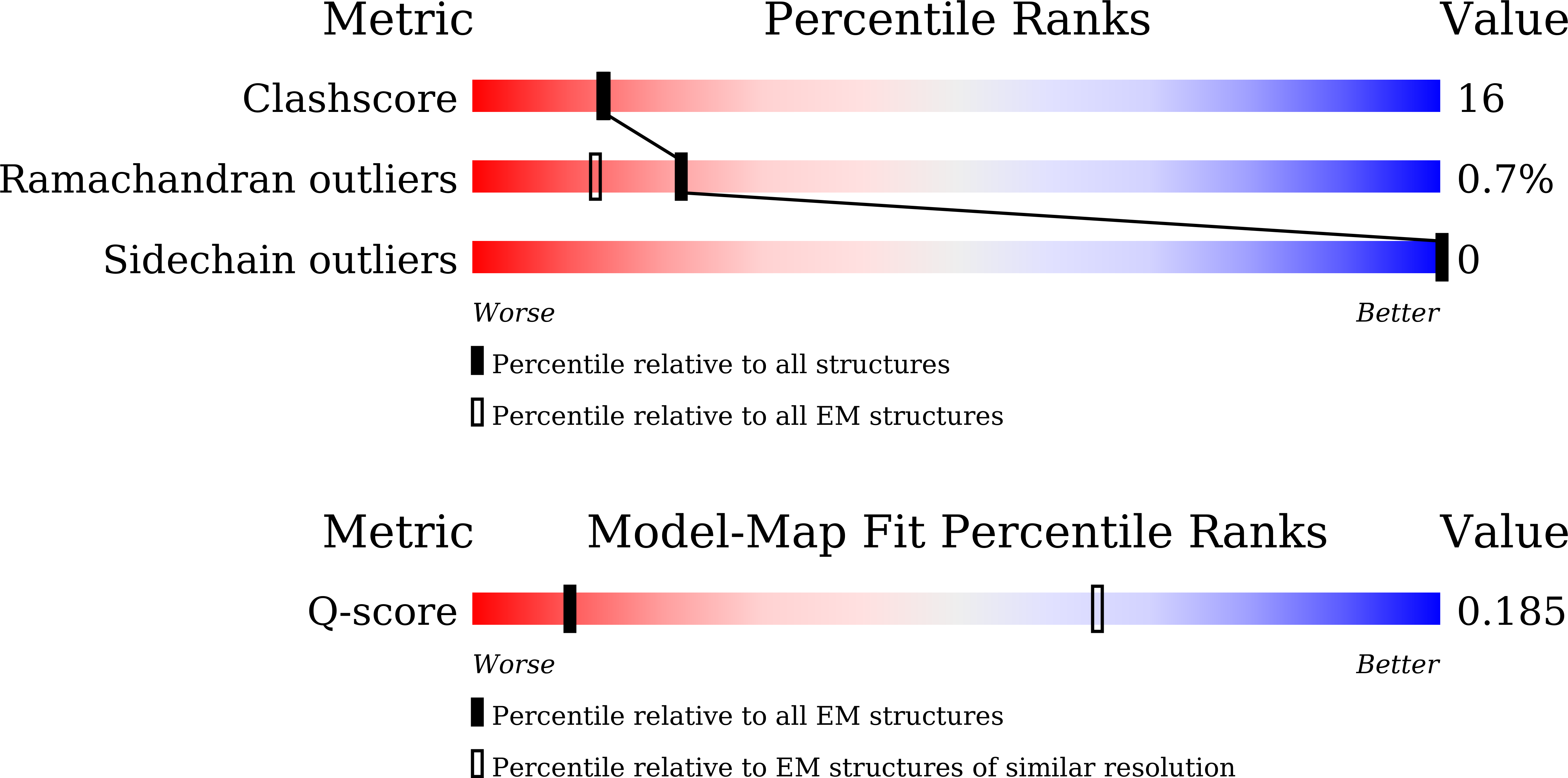
Macromolecular Entities
Structures with similar UniProt ID
Protein Blast
Polymer Type:polypeptide(L)
Molecule:AP-4 complex subunit beta-1
Gene (Uniprot):AP4B1
Chain IDs:A (auth: B)
Chain Length:576
Number of Molecules:1
Biological Source:Homo sapiens
Structures with similar UniProt ID
Protein Blast
Polymer Type:polypeptide(L)
Molecule:AP-4 complex subunit epsilon-
Gene (Uniprot):AP4E1
Chain IDs:B (auth: E)
Chain Length:612
Number of Molecules:1
Biological Source:Homo sapiens
Structures with similar UniProt ID
Protein Blast
Polymer Type:polypeptide(L)
Molecule:AP-4 complex subunit mu-1
Gene (Uniprot):AP4M1
Chain IDs:D (auth: M)
Chain Length:453
Number of Molecules:1
Biological Source:Homo sapiens
Structures with similar UniProt ID
Protein Blast
Polymer Type:polypeptide(L)
Molecule:ADP-ribosylation factor 1
Gene (Uniprot):ARF1
Chain IDs:C (auth: R)
Chain Length:164
Number of Molecules:1
Biological Source:Homo sapiens
Structures with similar UniProt ID
Protein Blast
Polymer Type:polypeptide(L)
Molecule:AP-4 complex subunit sigma-1
Gene (Uniprot):AP4S1
Chain IDs:E (auth: S)
Chain Length:144
Number of Molecules:1
Biological Source:Homo sapiens
Ligand Molecules
Primary Citation
Structural basis for the dynamic conformations of AP-4 and its association with ARF1.
Nat Commun 17 ? ? (2026)
PMID: 41565640 DOI: 10.1038/s41467-026-68679-8

Abstact

Among the distinct adaptor protein (AP) complexes, AP-4 primarily functions as a non-clathrin-coated vesicle machinery essential for intracellular membrane trafficking. ARF1 is a master regulator of AP-4 membrane recruitment, but the underlying mechanism remains elusive. Here, we present the cryo-EM structures of soluble AP-4 and the AP-4/ARF1 complex. Unexpectedly, AP-4 adopts a dynamic equilibrium between closed and open conformations, caused by loose contacts between its medium subunit and central core. ARF1 binding induces only subtle changes in AP-4, which retains its conformational equilibrium. Mutations at the AP-4/ARF1 interface disrupt complex formation and impair ARF1-dependent membrane recruitment. Efficient membrane recruitment of AP-4 likely requires the synergistic engagement of ARF1 and cargoes. Disrupting the conformational flexibility of AP-4 interferes with this synergistic effect and compromises AP-4-mediated membrane trafficking. Our findings may redefine AP-4 as a conformationally dynamic complex modulated by cooperative interactions, providing insights into neurodevelopmental disorders associated with AP-4 dysfunction.

Legend

Protein

Chemical

Disease

Primary Citation of related structures
Feedback Form
Name
Email
Institute
Feedback