

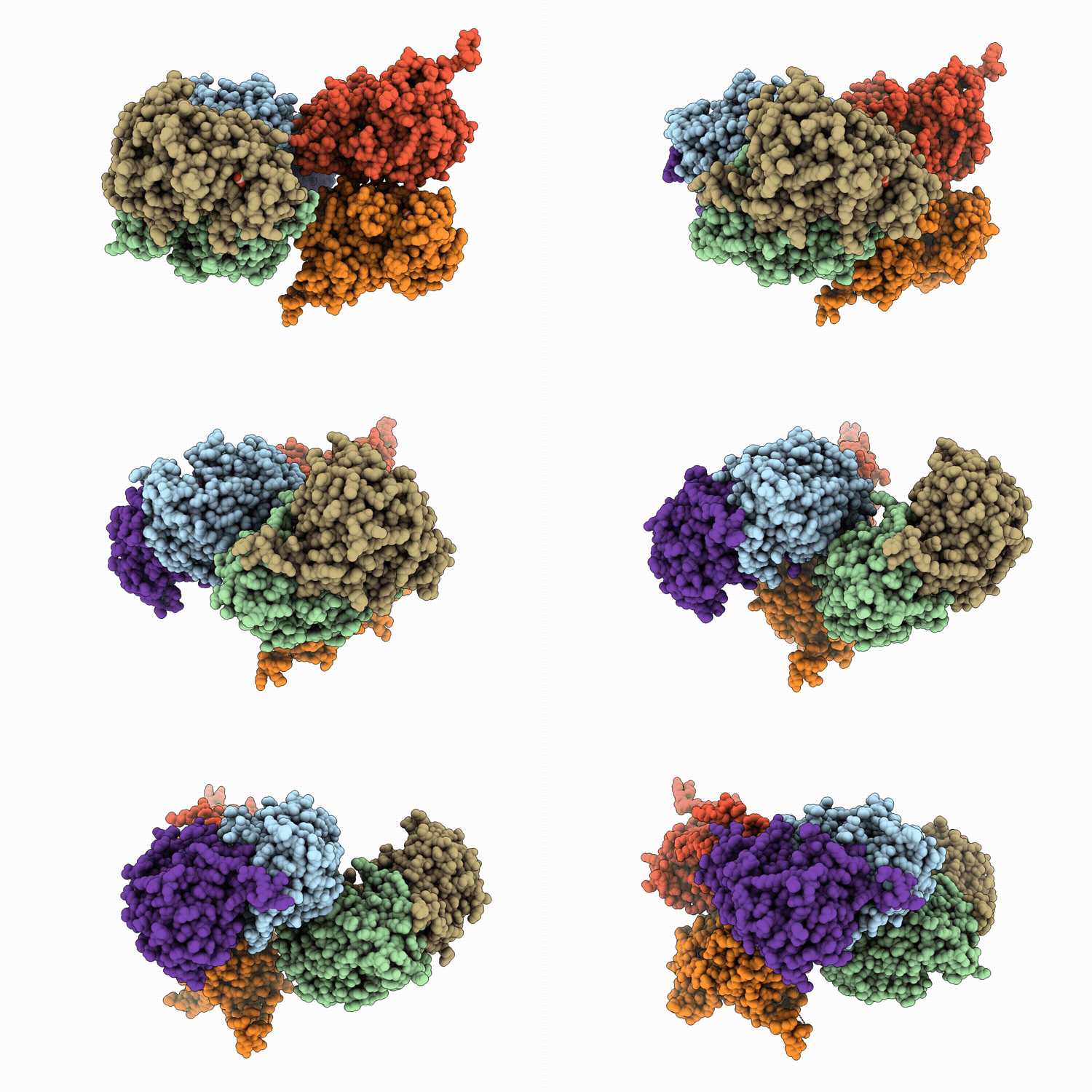
9U2X image
Deposition Date 2026-01-30
Release Date 2026-06-24
Last Version Date 2026-06-24
Entry Detail
PDB ID:
9U2X
Keywords:
Title:
Crystal structure of N244L variant from Bacillus subtilis
Biological Source:
Source Organism(s):
Expression System(s):
Method Details:
Experimental Method:
Resolution:
2.67 Å
R-Value Free:
0.34
R-Value Work:
0.29
R-Value Observed:
0.29
Space Group:
C 1 2 1

Macromolecular Entities
Structures with similar UniProt ID
Protein Blast
Polymer Type:polypeptide(L)
Molecule:Deferrochelatase
Gene (Uniprot):efeB
Chain IDs:A, B, C, D, E, F
Chain Length:359
Number of Molecules:6
Biological Source:Bacillus subtilis
Ligand Molecules
Primary Citation
A Single Amino Acid Substitution Reprograms ROS Selectivity and Catalytic Function in DyP Peroxidases.
Inorg.Chem. ? ? ? (2026)
PMID: 42295056 DOI: 10.1021/acs.inorgchem.6c02237

Abstact

Dye-decolorizing peroxidases (DyPs) are heme enzymes with broad substrate scope and increasing biotechnological relevance, yet the structural determinants governing their activation by reactive oxygen species (ROS) remain incompletely understood. Here, we identify dynamic ROS gating as a mechanism controlling activation and catalytic efficiency through a comparative study of two class I DyPs from Bacillus subtilis (BsDyP) and Thermobifida fusca (TfuDyP), together with the BsDyP N244L variant. By combining steady-state kinetics, ROS-selective electroreductive activation assays, UV-vis and resonance Raman spectroscopy, X-ray crystallography, and molecular dynamics simulations, we establish a direct structure-function relationship linking distal heme pocket organization and access-tunnel architecture to enzyme-specific ROS preferences. BsDyP WT is preferentially activated via (*)OH, whereas TfuDyP relies mainly on H(2)O(2). Remarkably, the single N244L substitution shifts the catalytic, structural, and dynamical properties of BsDyP toward those of TfuDyP, making both enzymes nearly indistinguishable in ROS usage and catalytic efficiency. This convergence arises from a reorganization of distal hydrogen-bonding networks and loop-mediated reshaping of the access tunnels, which together bias ROS accessibility and lower the barrier for compound I formation. These findings establish ROS gating as the principal determinant of DyP activation and provide a mechanistic framework for tuning ROS selectivity through protein engineering.

Legend

Protein

Chemical

Disease

Primary Citation of related structures
Feedback Form
Name
Email
Institute
Feedback