

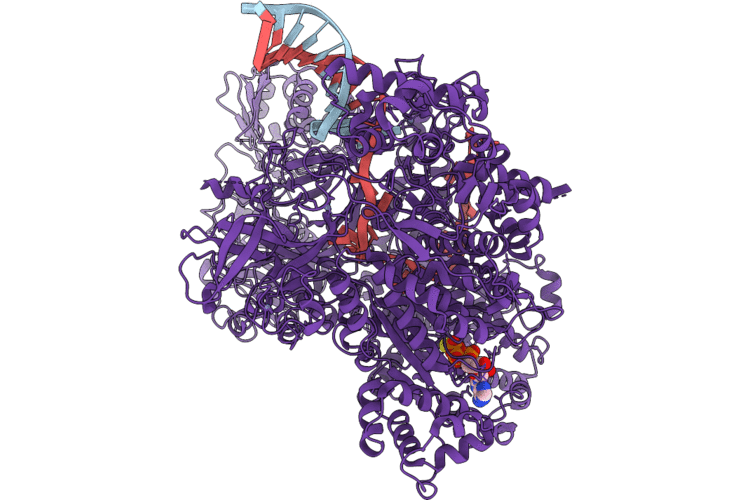
9TU7 image
Deposition Date 2026-01-08
Release Date 2026-08-26
Last Version Date 2026-09-30
Entry Detail
PDB ID:
9TU7
Keywords:
Title:
CryoEM structure of DruE:ATPgammaS:DNA from Druantia type III - monomer
Biological Source:
Source Organism(s):
Expression System(s):
Method Details:
Experimental Method:
Resolution:
2.90 Å
Aggregation State:
PARTICLE
Reconstruction Method:
SINGLE PARTICLE
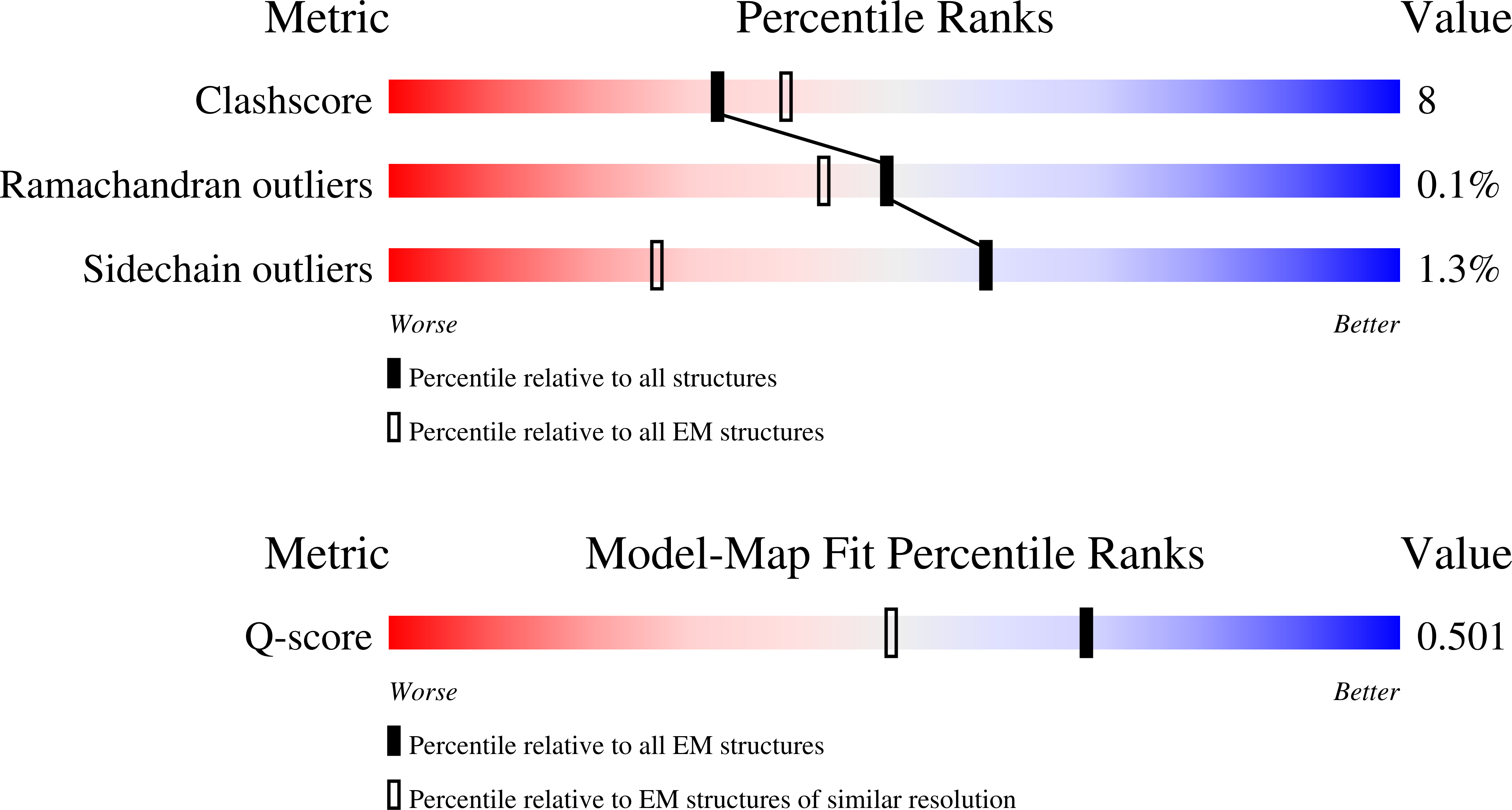
Macromolecular Entities
Polymer Type:polydeoxyribonucleotide
Molecule:DNA (5'-D(P*AP*GP*AP*GP*AP*CP
Chain IDs:C (auth: G)
Chain Length:30
Number of Molecules:1
Biological Source:synthetic construct
Polymer Type:polydeoxyribonucleotide
Molecule:DNA (30-MER)
Chain IDs:A (auth: I)
Chain Length:30
Number of Molecules:1
Biological Source:synthetic construct
Polymer Type:polypeptide(L)
Molecule:DEAD/DEAH box helicase
Chain IDs:B (auth: Y)
Chain Length:2108
Number of Molecules:1
Biological Source:Escherichia coli O157:H7 str. EDL933
Primary Citation
A compact Druantia defense clears phage infections via single-stranded DNA recognition and directional duplex unwinding.
Cell Rep 45 118021 118021 (2026)
PMID: 42771523 DOI: 10.1016/j.celrep.2026.118021

Abstact

Bacteria encode diverse anti-phage defense systems triggered by invader-specific molecular cues. Here, we report that the compact type III-A Druantia system recognizes exposed single-stranded DNA to block phage replication and drive phage clearance. Using representative systems from Escherichia coli, we show that the two encoded proteins, DruE and DruH, together clear restriction-sensitive or recombination-prone phages without affecting cell growth or viability. DruE dimerizes and engages DNA at exposed single-stranded regions to unwind DNA with 3'-to-5' directionality, resorting to unique molecular lock, wedge, and clamp elements that aid strand separation and processive translocation. DruH is a monomer in isolation and indirectly interacts with DruE and other host proteins under uninfected conditions, with an infection resulting in the dissociation of the complex. Taken together, our results reveal that exposed single-stranded DNA can trigger bacterial immunity through the directional helicase activity of type III-A Druantia.

Legend

Protein

Chemical

Disease

Primary Citation of related structures
Feedback Form
Name
Email
Institute
Feedback