

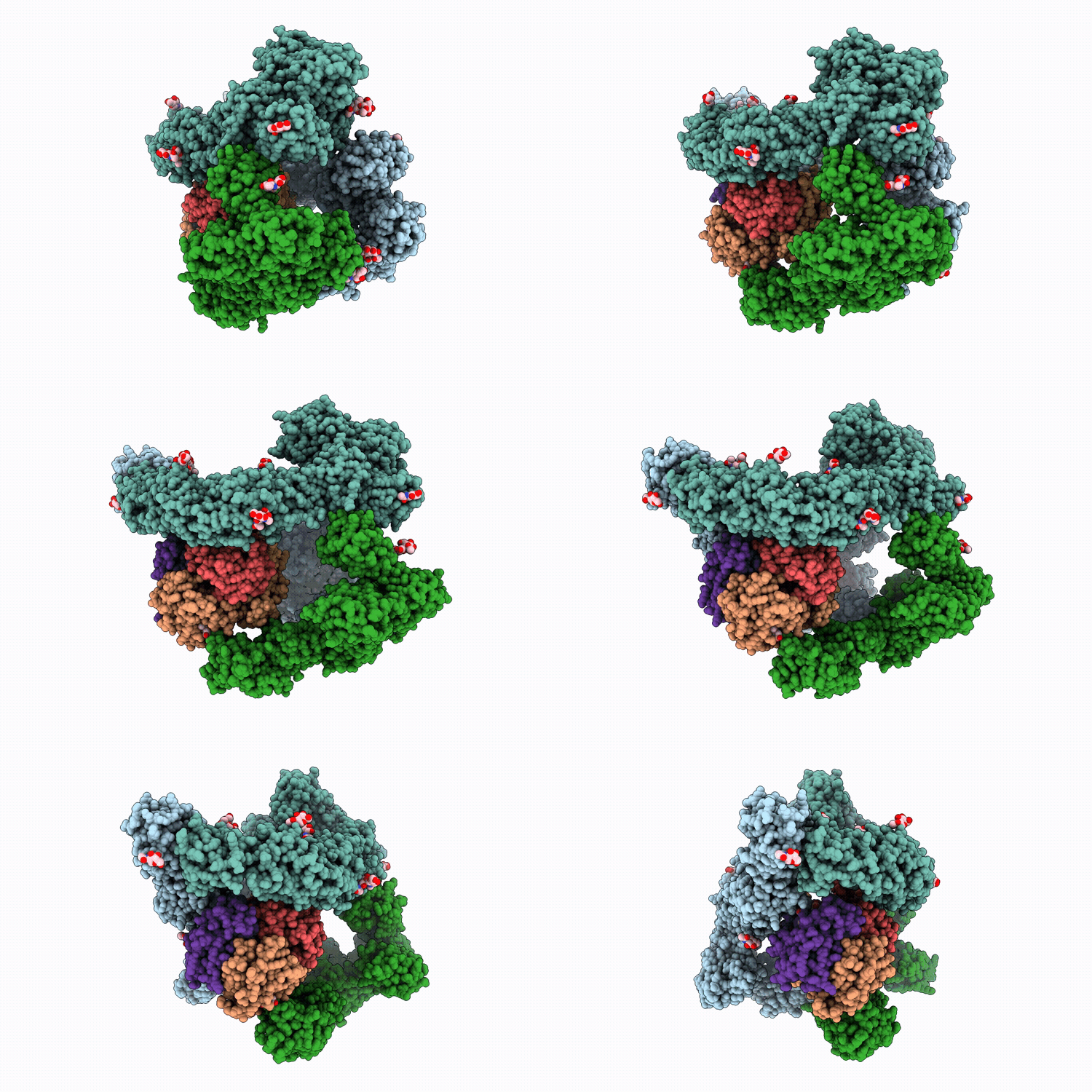
9TQD image
Deposition Date 2025-12-20
Release Date 2026-04-15
Last Version Date 2026-05-27
Entry Detail
PDB ID:
9TQD
Keywords:
Title:
CD163 bound to haemoglobin
Biological Source:
Source Organism(s):
Homo sapiens (Taxon ID: 9606)
Expression System(s):
Method Details:
Experimental Method:
Resolution:
2.80 Å
Aggregation State:
PARTICLE
Reconstruction Method:
SINGLE PARTICLE
Macromolecular Entities
Structures with similar UniProt ID
Protein Blast
Polymer Type:polypeptide(L)
Molecule:Scavenger receptor cysteine-r
Gene (Uniprot):CD163
Chain IDs:A, B, C
Chain Length:1156
Number of Molecules:3
Biological Source:Homo sapiens
Structures with similar UniProt ID
Protein Blast
Polymer Type:polypeptide(L)
Molecule:Hemopressin
Gene (Uniprot):HBA1, HBA2
Chain IDs:D, F
Chain Length:142
Number of Molecules:2
Biological Source:Homo sapiens
Structures with similar UniProt ID
Protein Blast
Polymer Type:polypeptide(L)
Molecule:Spinorphin
Gene (Uniprot):HBB
Chain IDs:E, G
Chain Length:147
Number of Molecules:2
Biological Source:Homo sapiens
Primary Citation
Structural basis for hemoglobin scavenging by CD163 reveals mechanism of ligand promiscuity.
Plos Biol. 24 e3003788 e3003788 (2026)
PMID: 42133656 DOI: 10.1371/journal.pbio.3003788

Abstact

The scavenger receptor CD163 detoxifies free hemoglobin released on erythrocyte lysis to prevent oxidative damage. The best understood route for hemoglobin detoxification involves the formation of haptoglobin-hemoglobin complexes that bind CD163 and are internalized into macrophages, resulting in hemoglobin degradation. However, during conditions such as sickle cell anemia or malaria, haptoglobin is depleted. CD163 can then act as a lower-affinity receptor for free hemoglobin. Previous studies revealed that CD163 forms a multimeric "base," which presents "arms" that form a binding site for haptoglobin-hemoglobin. In this study, we use cryogenic electron microscopy to reveal how human CD163 binds hemoglobin tetramers in a process that, unlike haptoglobin-hemoglobin uptake, requires a full trimeric CD163 assembly to achieve sufficient binding. We reveal how flexibility at the calcium-mediated base, combined with a hinge between receptor domains 2 and 3, allows the arms to wrap around diverse ligands. This brings together multiple small binding surfaces from different domains to form cradles for different ligands. These adaptations allow the scavenger receptor to be promiscuous, protecting us from oxidative damage caused by hemoglobin release in various pathological conditions.

Legend

Protein

Chemical

Disease

Primary Citation of related structures
Feedback Form
Name
Email
Institute
Feedback