

9TQ6 image
Deposition Date 2025-12-19
Release Date 2026-05-27
Last Version Date 2026-05-27
Entry Detail
PDB ID:
9TQ6
Keywords:
Title:
Antibody-antigen complex
Biological Source:
Source Organism(s):
Homo sapiens (Taxon ID: 9606)
Mus musculus (Taxon ID: 10090)
Method Details:
Experimental Method:
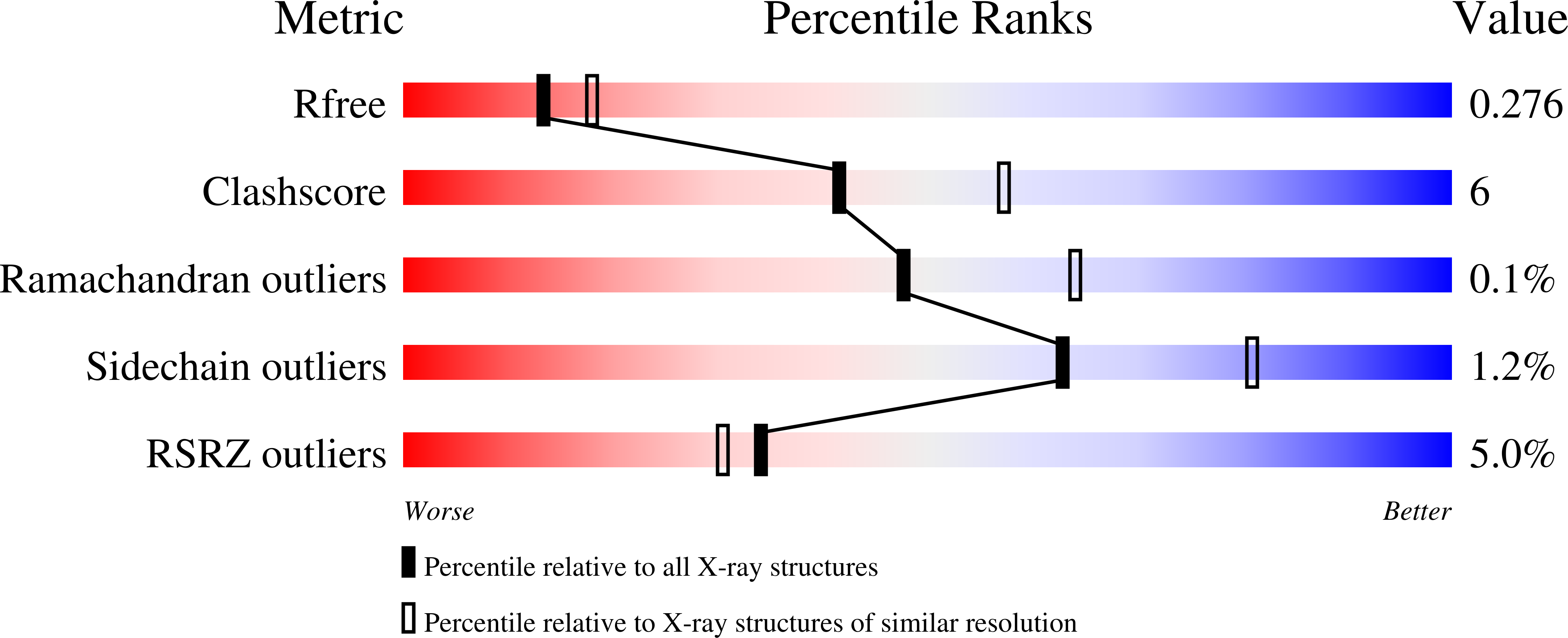
Resolution:
2.40 Å
R-Value Free:
0.27
R-Value Work:
0.23
R-Value Observed:
0.23
Space Group:
P 21 21 21
Macromolecular Entities
Protein Blast
Polymer Type:polypeptide(L)
Molecule:Antibody Fab fragment heavy c
Chain IDs:A, C (auth: H)
Chain Length:239
Number of Molecules:2
Biological Source:Mus musculus
Protein Blast
Polymer Type:polypeptide(L)
Molecule:Antibody Fab fragment light c
Chain IDs:B, D (auth: L)
Chain Length:239
Number of Molecules:2
Biological Source:Mus musculus
Structures with similar UniProt ID
Protein Blast
Polymer Type:polypeptide(L)
Molecule:Beta-nerve growth factor
Gene (Uniprot):NGF
Chain IDs:E (auth: P), F (auth: Q)
Chain Length:11
Number of Molecules:2
Biological Source:Homo sapiens
Modified Residue
Compound ID Chain ID Parent Comp ID Details 2D Image
NIY E TYR modified residue
Primary Citation
Monoclonal antibodies against nitrated nerve growth factor reveal an oxidation-dependent pathogenic hallmark in ALS.
Proc.Natl.Acad.Sci.USA 123 e2536562123 e2536562123 (2026)
PMID: 42030149 DOI: 10.1073/pnas.2536562123

Abstact

Nerve growth factor (NGF) is a member of the neurotrophin family, essential for neuronal survival and phenotypic maintenance. However, in vitro, its function can be disrupted by oxidative posttranslational modifications such as tyrosine nitration. Nitrated NGF (NO(2)NGF) has been shown to have a gain-of-toxic, pro-apoptotic, activity in motoneuron cultures. Herein, we report the generation and characterization of monoclonal antibodies (mAbs) that specifically recognize NO(2)NGF to unravel its formation in vivo. Using hybridoma technology, we produced mAbs with high affinity and selectivity for NO(2)NGF, as demonstrated immunochemically and by surface plasmon resonance. The antibodies elicit neutralizing capacity to NO(2)NGF in neuronal cells. Nitrated Tyr52 within the NGF(48-58) sequence was identified as the primary antigenic determinant by crystallographic analysis of antibody:peptide complexes at atomic resolution, peptide-based epitope mapping and molecular dynamics simulations, whereas local sequence NGF motifs around the nitrated tyrosine are important for protein specificity. The antibodies revealed NO(2)NGF accumulation in amyotrophic lateral sclerosis (ALS) rodent models and human subjects. Indeed, immunofluorescence showed selective accumulation of NO(2)NGF in spinal cord regions undergoing motor neuron degeneration, as well as in sciatic nerves and neuromuscular junctions. Our findings establish NGF nitration as an oxidative hallmark in ALS and demonstrate that monoclonal antibodies targeting this chemical modification are powerful tools for both mechanistic studies and biomarkers development. This work proposes a link between neurotrophin nitration and neurodegenerative disease progression and opens avenues for therapeutic exploration along the peroxynitrite-tyrosine nitration pathway.

Legend

Protein

Chemical

Disease

Primary Citation of related structures
Feedback Form
Name
Email
Institute
Feedback