

9TDZ image
Deposition Date 2025-11-24
Release Date 2026-04-08
Last Version Date 2026-04-29
Entry Detail
PDB ID:
9TDZ
Keywords:
Title:
Crystal structure of beta-TrCP bound by diphosphorylated claspin degron peptide
Biological Source:
Source Organism(s):
Homo sapiens (Taxon ID: 9606)
Method Details:
Experimental Method:
Resolution:
1.35 Å
R-Value Free:
0.20
R-Value Work:
0.17
R-Value Observed:
0.17
Space Group:
P 21 21 21
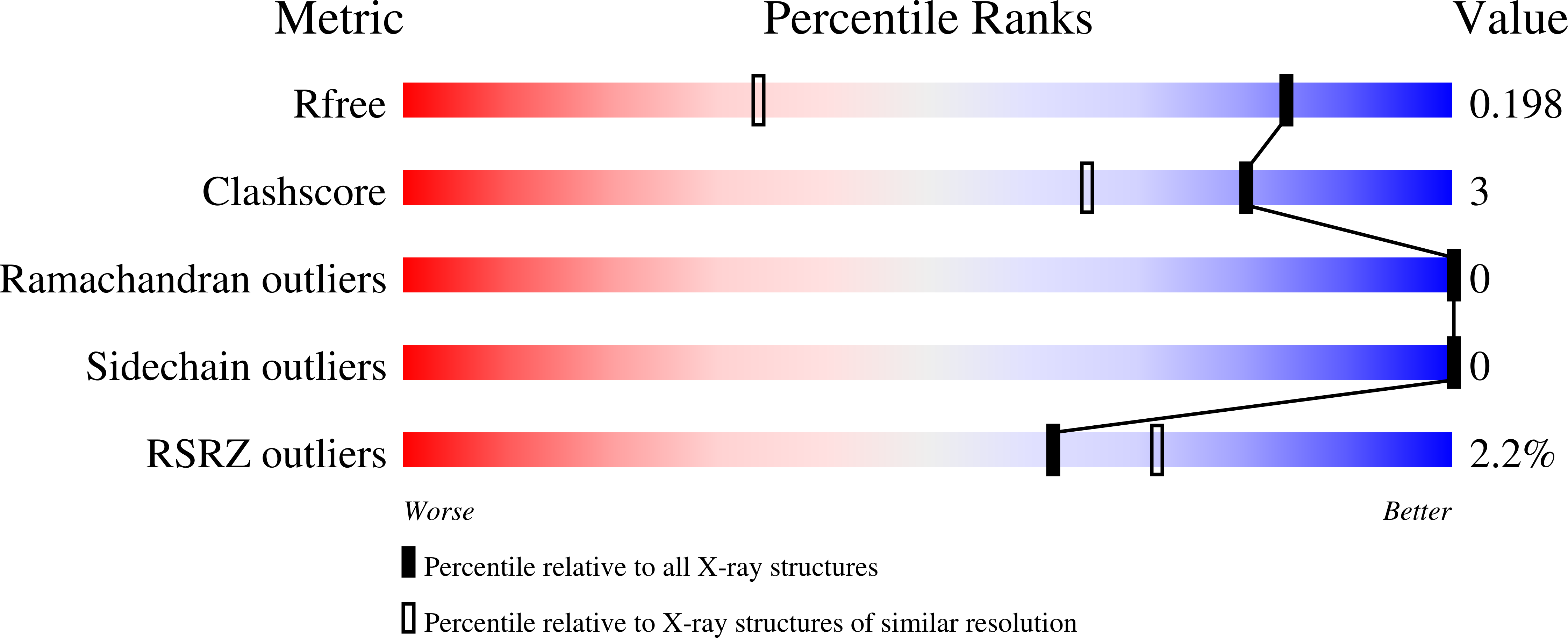
Macromolecular Entities
Structures with similar UniProt ID
Protein Blast
Polymer Type:polypeptide(L)
Molecule:F-box/WD repeat-containing pr
Gene (Uniprot):BTRC
Mutagens:L188E, L192E
Chain IDs:A
Chain Length:365
Number of Molecules:1
Biological Source:Homo sapiens
Structures with similar UniProt ID
Protein Blast
Polymer Type:polypeptide(L)
Molecule:Claspin
Gene (Uniprot):CLSPN
Chain IDs:B
Chain Length:12
Number of Molecules:1
Biological Source:Homo sapiens
Modified Residue
Compound ID Chain ID Parent Comp ID Details 2D Image
SEP B SER modified residue
Primary Citation
Structural Studies of beta TrCP Reveal Plasticity in Binding Modes of Consensus and Nonconsensus Degrons.
Acs Chem.Biol. 21 744 750 (2026)
PMID: 41891920 DOI: 10.1021/acschembio.5c01007

Abstact

The E3 ligase betaTrCP regulates a significant number of important cytosolic proteins by recognizing and binding to a "DSGXXS" consensus phosphodegron sequence, resulting in the ubiquitination and degradation of target proteins. While many of the substrates of betaTrCP have strong disease links, there is high-resolution structural data available for just one of these proteins in complex with betaTrCP. Here, we describe the development of a robust crystallographic system for betaTrCP and report high-resolution crystal structures for betaTrCP in complex with degrons from five new targets, encompassing the important cancer proteins, WEE1, claspin, ATF4, PDCD4, and IkappaBalpha. Interestingly, these structures reveal the molecular basis by which betaTrCP can recognize and bind both consensus and nonconsensus degron peptides and reveal an overall general plasticity in degron binding mode. We also provide a biochemical assessment of the binding affinities of these peptides for betaTrCP, adding further insight into the molecular interactions observed in the crystal structures. Finally, computational analyses of the betaTrCP complexes identify opportunities for potential molecular glue approaches.

Legend

Protein

Chemical

Disease

Primary Citation of related structures
Feedback Form
Name
Email
Institute
Feedback