

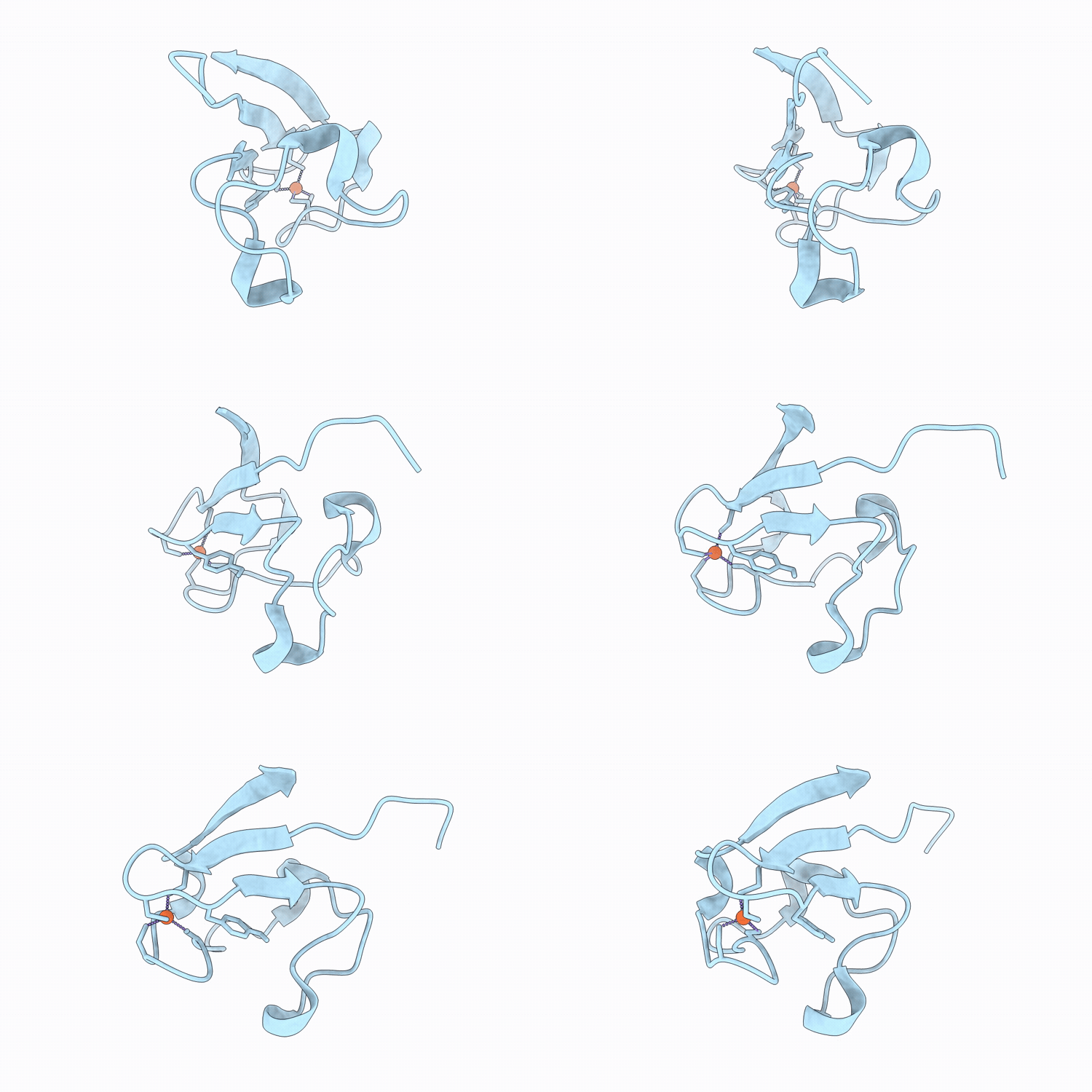
9TA4 image
Deposition Date 2025-11-18
Release Date 2026-04-22
Last Version Date 2026-05-13
Entry Detail
PDB ID:
9TA4
Title:
Pyrococcus abyssi Rubredoxin @ 0.55 Angstrom resolution, 50 kGy structure
Biological Source:
Source Organism(s):
Expression System(s):
Method Details:
Experimental Method:
Resolution:
0.55 Å
R-Value Free:
0.08
R-Value Work:
0.07
R-Value Observed:
0.07
Space Group:
P 21 21 21
Macromolecular Entities
Structures with similar UniProt ID
Protein Blast
Polymer Type:polypeptide(L)
Molecule:Rubredoxin
Gene (Uniprot):rub
Chain IDs:A
Chain Length:57
Number of Molecules:1
Biological Source:Pyrococcus abyssi GE5
Ligand Molecules
Primary Citation
Radiation damage in sub- angstrom ngstrom resolution macromolecular crystallography: a low-dose study.
Acta Crystallogr D Struct Biol 82 484 491 (2026)
PMID: 41973447 DOI: 10.1107/S205979832600269X

Abstact

Sub-Angstrom macromolecular crystallography allows the construction of structural models without any prior chemical knowledge and stereochemical restraints, making it possible to visualize deviations from peptide planarity, distortions of the planarity of aromatic ring systems and subtle alternate conformation networks. It also holds the promise of observing aspherical density features and other quantum-mechanical phenomena. However, the degree to which radiation damage might affect the details that can be discerned from biological structures at such resolutions has remained unknown. To address this, we report here the first study of radiation-damage effects at sub-Angstrom resolution on Pyrococcus abyssi rubredoxin. Our data, collected at 100 K, indicate that the oxidized (Fe(3+)) state of the Fe atom is preserved to a large degree at a dose of 50 kGy, whereas at 1 MGy it is partially reduced to the Fe(2+) state. Isomorphous difference maps reveal extensive conformational changes at 1 MGy that are most likely coupled to the reduction of Fe(3+). At 1 MGy, hydrogen densities that are visible at 50 kGy are preserved, but are distinctly blurred by dose. These findings suggest that the ;global' radiation damage in reciprocal space and the associated blurring of electron density in real space proceed through small structural changes that are much more extended than the local damage at specific sites which is normally seen at lower resolution. Thus, the ;global' and ;specific' damage could be viewed as two sides of the same coin. Our study highlights the unique benefits of using low-dose data-collection protocols on large crystals fully bathed in a large ;top-hat' beam with a uniform fluence profile for accurate sub-Angstrom structural investigations on macromolecules, as only this experimental configuration can deliver the uniform spatial distribution of dose necessary to resolve the fine details of progressive radiation damage: a capability for which we propose the term ;resolution in dose'.

Legend

Protein

Chemical

Disease

Primary Citation of related structures
Feedback Form
Name
Email
Institute
Feedback