

9T9P image
Deposition Date 2025-11-24
Release Date 2026-05-27
Last Version Date 2026-05-27
Entry Detail
PDB ID:
9T9P
Title:
Adenosine receptor A2a (A2AR)-beta-lactamase fusion bound to beta-lactamase inhibitory protein II (BLIPII) and ZM241385
Biological Source:
Source Organism(s):
Method Details:
Experimental Method:
Resolution:
3.00 Å
Aggregation State:
PARTICLE
Reconstruction Method:
SINGLE PARTICLE
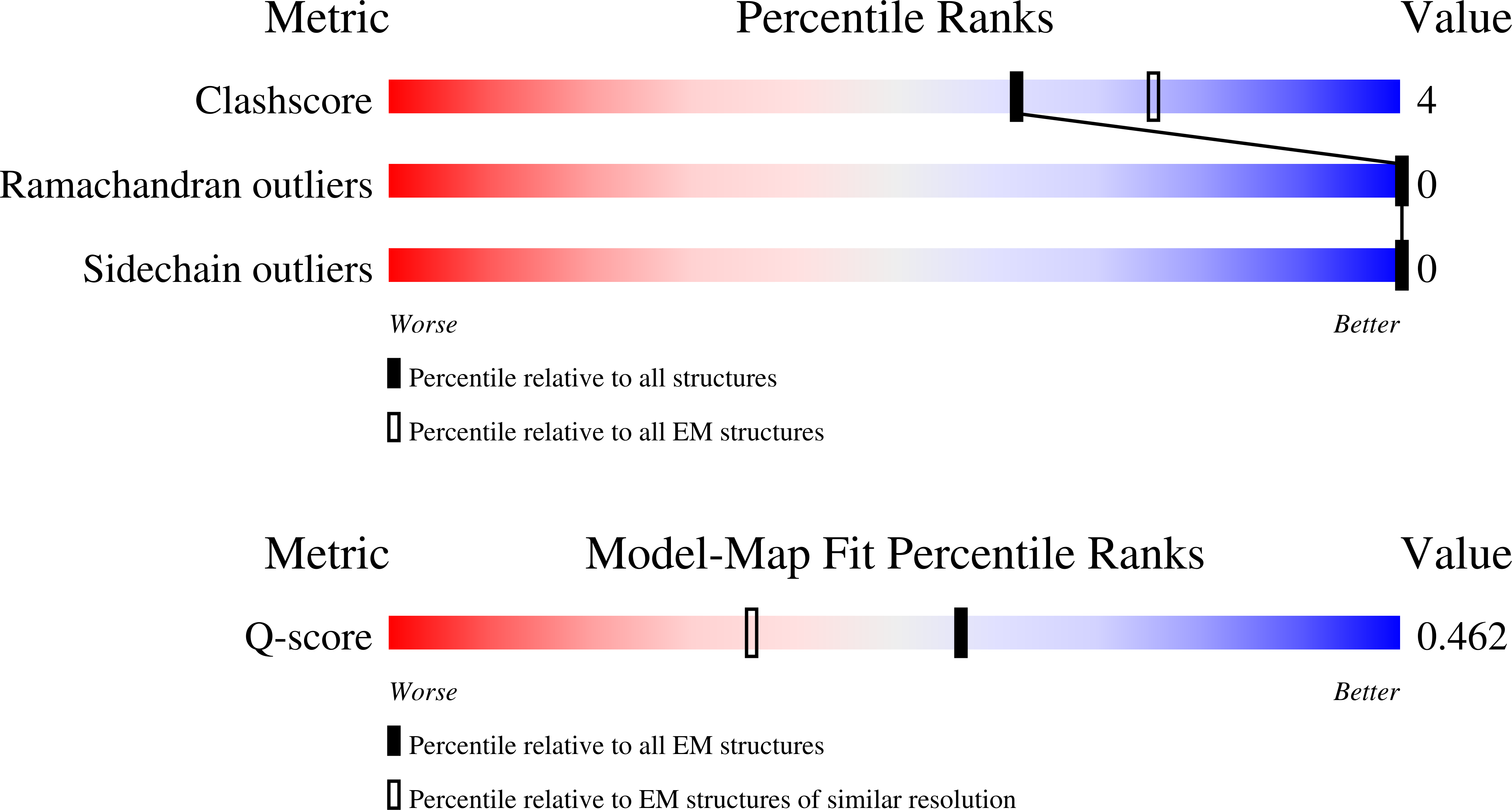
Macromolecular Entities
Structures with similar UniProt ID
Protein Blast
Polymer Type:polypeptide(L)
Molecule:Beta-lactamase inhibitory pro
Gene (Uniprot):bliB
Chain IDs:A
Chain Length:287
Number of Molecules:1
Biological Source:Streptomyces exfoliatus
Protein Blast
Polymer Type:polypeptide(L)
Molecule:Adenosine receptor A2a,Small
Gene (Uniprot):penP, ADORA2A, GFP
Chain IDs:B
Chain Length:846
Number of Molecules:1
Biological Source:Homo sapiens, Bacillus licheniformis, Aequorea victoria
Ligand Molecules
Primary Citation
A novel fusion tool to enable G protein-coupled receptor structure determination.
Acta Crystallogr D Struct Biol ? ? ? (2026)
PMID: 42138221 DOI: 10.1107/S2059798326003785

Abstact

Structure determination of G protein-coupled receptors (GPCRs) plays an important role in accelerating drug development against this medically important protein family. This study outlines the development of a new fusion tool to enable structure determination of GPCRs in inactive conformations by cryo-EM. Initially, a PDB mining approach was applied to select eight naturally occurring proteins with the intention of fusing them into the intracellular loop 3 (ICL3) of GPCRs to create a suitable fiducial marker for cryo-EM workflows. During the selection process, candidates with known high-affinity protein binders were prioritized to enable a further increase in the protein mass of the fiducial marker. Fusion constructs were generated with adenosine receptor A(2A) (A(2A)R) and were assessed for expression and aggregation levels. For the two best-performing new fusion constructs, ligand binding was characterized to ensure that the fusion tag did not significantly affect protein behaviour. A(2A)R with a beta-lactamase fusion in ICL3 and binding partner beta-lactamase inhibitory protein II (BLIPII) was then selected to solve an antagonist-bound structure. The overall map was resolved to an average of 3.2 A resolution with continuous helices connecting the beta-lactamase to helices 5 and 6 of A(2A)R. Focused refinement of the A(2A)R region improved the local resolution and map detail in the orthosteric site, thereby allowing confident modelling of the antagonist ligand, ZM241385, which matches previously described X-ray crystallographic structures. This new fusion provides an alternative option for GPCR structure determination, with several potential benefits compared with existing tools, such as a more favourable position relative to the GPCR to reduce potential clashes.

Legend

Protein

Chemical

Disease

Primary Citation of related structures
Feedback Form
Name
Email
Institute
Feedback