

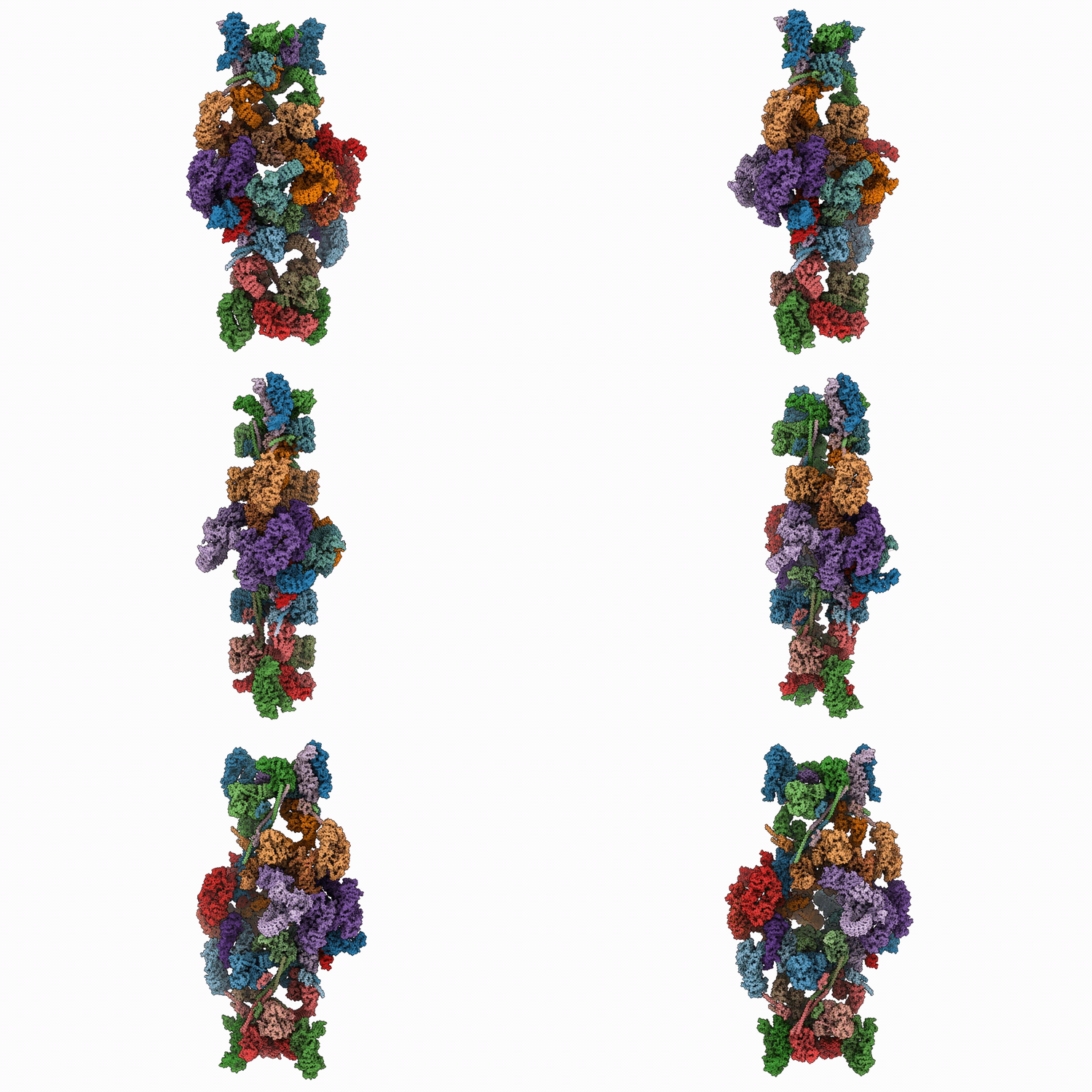
9T68 image
Deposition Date 2025-11-06
Release Date 2026-08-12
Last Version Date 2026-08-26
Entry Detail
PDB ID:
9T68
Title:
Composite structure of the repeat unit of cytoplasmic lattice filament
Biological Source:
Source Organism(s):
Mus musculus (Taxon ID: 10090)
Method Details:
Experimental Method:
Resolution:
8.00 Å
Aggregation State:
FILAMENT
Reconstruction Method:
SUBTOMOGRAM AVERAGING
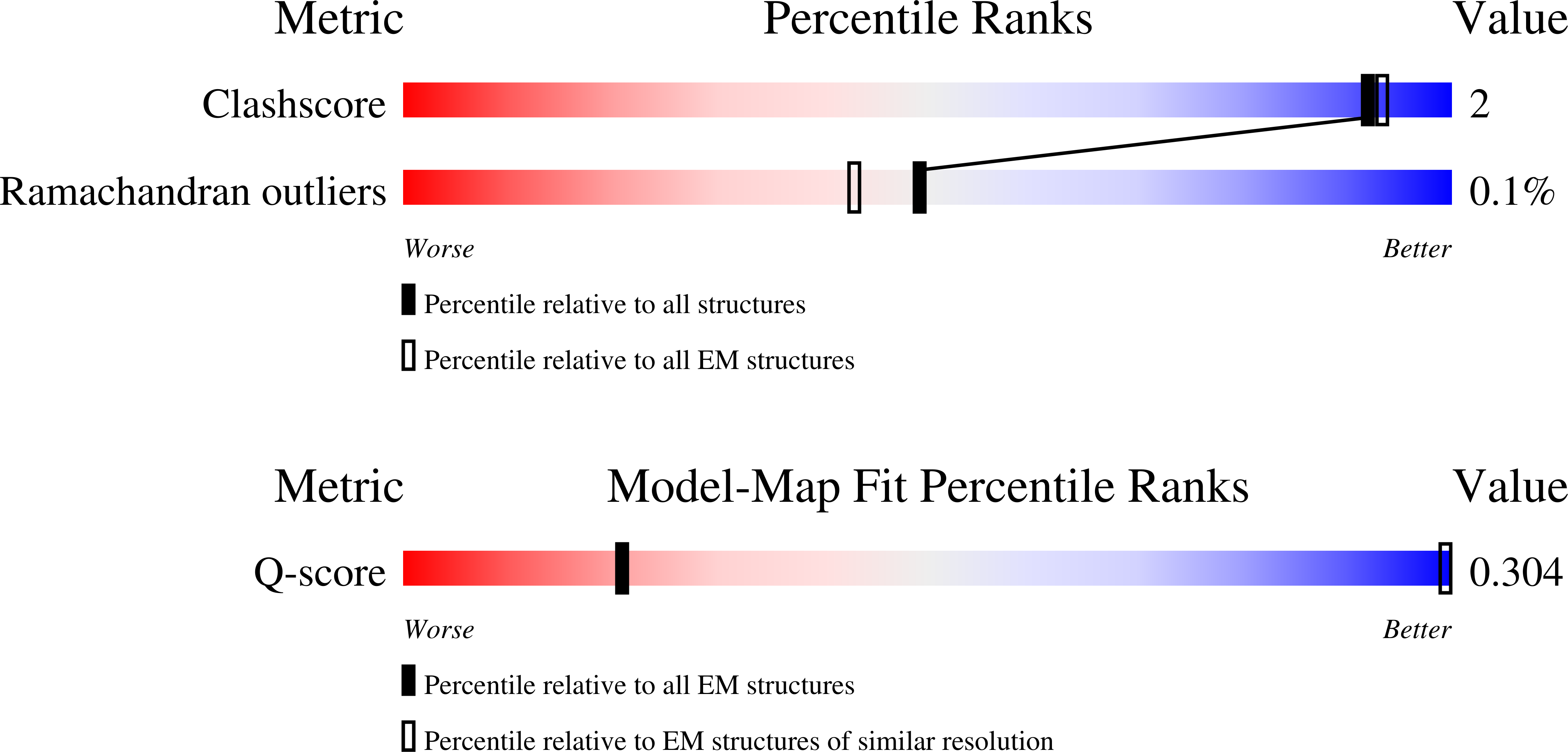
Macromolecular Entities
Polymer Type:polypeptide(L)
Molecule:KH domain-containing protein
Gene (Uniprot):Khdc3
Chain IDs:A (auth: 0), AB (auth: An), EC (auth: S), VC (auth: j)
Chain Length:440
Number of Molecules:4
Biological Source:Mus musculus
Polymer Type:polypeptide(L)
Molecule:Inactive protein-arginine dei
Gene (Uniprot):Padi6
Chain IDs:B (auth: 1), C (auth: 2), D (auth: 3), K (auth: A), O (auth: AB), P (auth: AC), Q (auth: AD), NA (auth: Aa), OA (auth: Ab), PA (auth: Ac), QA (auth: Ad), MB (auth: Az), NB (auth: B), OB (auth: C), PB (auth: D), QB (auth: E), RB (auth: F), SB (auth: G), TB (auth: H), UB (auth: I), VB (auth: J), WB (auth: K), XB (auth: L), XC (auth: l), YC (auth: m), FD (auth: t), GD (auth: u), HD (auth: v), ID (auth: w), JD (auth: x), KD (auth: y), LD (auth: z)
Chain Length:682
Number of Molecules:32
Biological Source:Mus musculus
Polymer Type:polypeptide(L)
Molecule:NACHT, LRR and PYD domains-co
Gene (Uniprot):Nlrp5
Chain IDs:E (auth: 4), H (auth: 7), S (auth: AF), EA (auth: AR), SA (auth: Af), XA (auth: Ak), YB (auth: M), BC (auth: P)
Chain Length:1163
Number of Molecules:8
Biological Source:Mus musculus
Polymer Type:polypeptide(L)
Molecule:Transducin-like enhancer prot
Gene (Uniprot):Tle6
Chain IDs:F (auth: 5), I (auth: 8), FA (auth: AS), UA (auth: Ah), YA (auth: Al), ZB (auth: N), CC (auth: Q), JC (auth: X)
Chain Length:581
Number of Molecules:8
Biological Source:Mus musculus
Polymer Type:polypeptide(L)
Molecule:Oocyte-expressed protein homo
Gene (Uniprot):Ooep
Chain IDs:G (auth: 6), J (auth: 9), DA (auth: AQ), WA (auth: Aj), ZA (auth: Am), AC (auth: O), DC (auth: R), UC (auth: i)
Chain Length:164
Number of Molecules:8
Biological Source:Mus musculus
Polymer Type:polypeptide(L)
Molecule:F-box/WD repeat-containing pr
Chain IDs:L (auth: A1), Y (auth: AL), AA (auth: AN), KA (auth: AX), GB (auth: At), IB (auth: Av), KB (auth: Ax), QC (auth: e), SC (auth: g), ED (auth: s)
Chain Length:466
Number of Molecules:10
Biological Source:Mus musculus
Polymer Type:polypeptide(L)
Molecule:S-phase kinase-associated pro
Gene (Uniprot):Skp1
Chain IDs:M (auth: A2), Z (auth: AM), BA (auth: AO), LA (auth: AY), MA (auth: AZ), HB (auth: Au), JB (auth: Aw), LB (auth: Ay), RC (auth: f), TC (auth: h)
Chain Length:163
Number of Molecules:10
Biological Source:Mus musculus
Polymer Type:polypeptide(L)
Molecule:Zinc finger BED domain-contai
Gene (Uniprot):Zbed3
Chain IDs:N (auth: AA), R (auth: AE), CA (auth: AP), GA (auth: AT), RA (auth: Ae), TA (auth: Ag), BB (auth: Ao), CB (auth: Ap), FC (auth: T), WC (auth: k)
Chain Length:228
Number of Molecules:10
Biological Source:Mus musculus
Polymer Type:polypeptide(L)
Molecule:NACHT, LRR and PYD domains-co
Gene (Uniprot):Nlrp14
Chain IDs:T (auth: AG), LC (auth: Z), ZC (auth: n)
Chain Length:993
Number of Molecules:3
Biological Source:Mus musculus
Polymer Type:polypeptide(L)
Molecule:E3 ubiquitin-protein ligase U
Gene (Uniprot):Uhrf1
Chain IDs:U (auth: AH), MC (auth: a), AD (auth: o)
Chain Length:782
Number of Molecules:3
Biological Source:Mus musculus
Polymer Type:polypeptide(L)
Molecule:Ubiquitin-conjugating enzyme
Gene (Uniprot):Ube2d3
Chain IDs:V (auth: AI), NC (auth: b), BD (auth: p)
Chain Length:147
Number of Molecules:3
Biological Source:Mus musculus
Polymer Type:polypeptide(L)
Molecule:Tubulin alpha-1C chain
Gene (Uniprot):Tuba1c
Chain IDs:W (auth: AJ), IA (auth: AV), EB (auth: Ar), OC (auth: c), CD (auth: q)
Chain Length:449
Number of Molecules:5
Biological Source:Mus musculus
Polymer Type:polypeptide(L)
Molecule:Tubulin beta-4B chain
Gene (Uniprot):Tubb4b
Chain IDs:X (auth: AK), JA (auth: AW), FB (auth: As), PC (auth: d), DD (auth: r)
Chain Length:445
Number of Molecules:5
Biological Source:Mus musculus
Polymer Type:polypeptide(L)
Molecule:NLR family, pyrin domain cont
Gene (Uniprot):Nlrp4f
Chain IDs:HA (auth: AU), VA (auth: Ai), DB (auth: Aq), KC (auth: Y)
Chain Length:937
Number of Molecules:4
Biological Source:Mus musculus
Polymer Type:polypeptide(L)
Molecule:Polyubiquitin-C
Gene (Uniprot):Ubc
Chain IDs:GC (auth: U), HC (auth: V), IC (auth: W)
Chain Length:76
Number of Molecules:3
Biological Source:Mus musculus
Ligand Molecules
Primary Citation
In-situ cryo-ET of mouse embryos reveals cytoplasmic lattices contain ubiquitin-charged E2-E3 ligase assemblies.
Embo J. ? ? ? (2026)
PMID: 42575997 DOI: 10.1038/s44318-026-00895-w

Abstact

Cytoplasmic lattices (CPLs) are filamentous assemblies essential for mammalian embryonic development. They are known to regulate organelle organization, spindle assembly, and protein homeostasis, but their molecular functions remain unclear. Here, we develop a strategy combining cryo-focused ion beam milling and cryo-electron tomography to resolve macromolecular complexes directly in mammalian embryos. Using this approach, we determine the in situ structure of cytoplasmic lattices within 6/8-cell mouse embryos at ~4.7 A resolution. CPL filaments are built from multiple copies of at least fourteen proteins arranged into a ~4.5 MDa repeating unit. The repeat contains a central cavity that is open at the back and lined with multiple FBXW-SKP1 complexes and three modules, each containing the E2 ubiquitin-conjugating enzyme UBE2D and the E3 ligase UHRF1. We resolve two CPL states: one is consistent with a ubiquitin-charged UBE2D, where ubiquitin is held in an open, inactive conformation by binding the scaffold protein PADI6; the second lacks discernible ubiquitin density and shows structural changes compatible with ubiquitin becoming available for transfer. Our findings support a model in which CPLs function as large ubiquitin ligase assemblies during early embryonic development.

Legend

Protein

Chemical

Disease

Primary Citation of related structures
Feedback Form
Name
Email
Institute
Feedback