

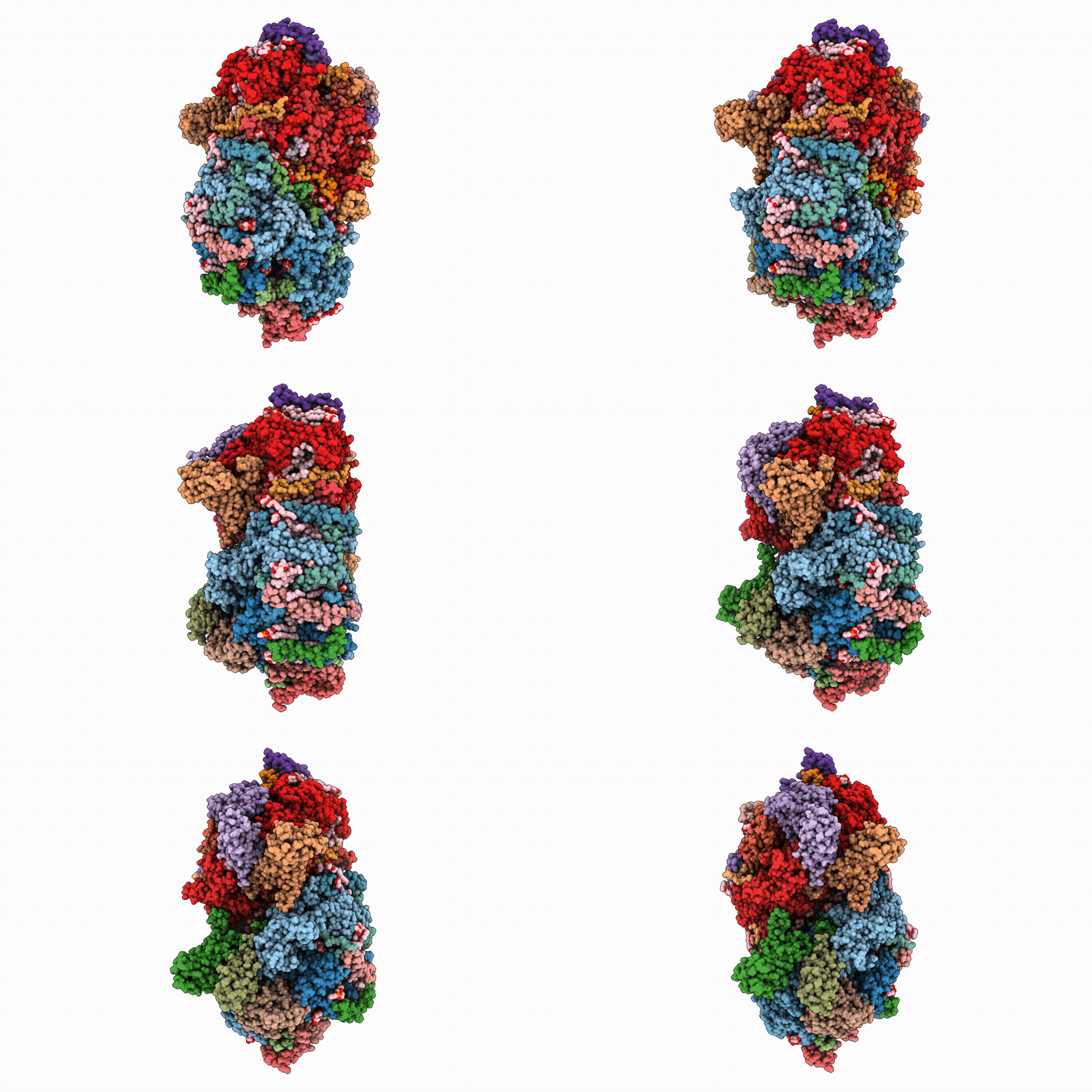
9T5T image
Deposition Date 2025-11-05
Release Date 2026-06-10
Last Version Date 2026-06-17
Entry Detail
PDB ID:
9T5T
Title:
Chlorophyll f-containing dimeric far-red Photosystem II from Chroococcidiopsis thermalis PCC 7203
Biological Source:
Source Organism(s):
Method Details:
Experimental Method:
Resolution:
2.17 Å
Aggregation State:
PARTICLE
Reconstruction Method:
SINGLE PARTICLE
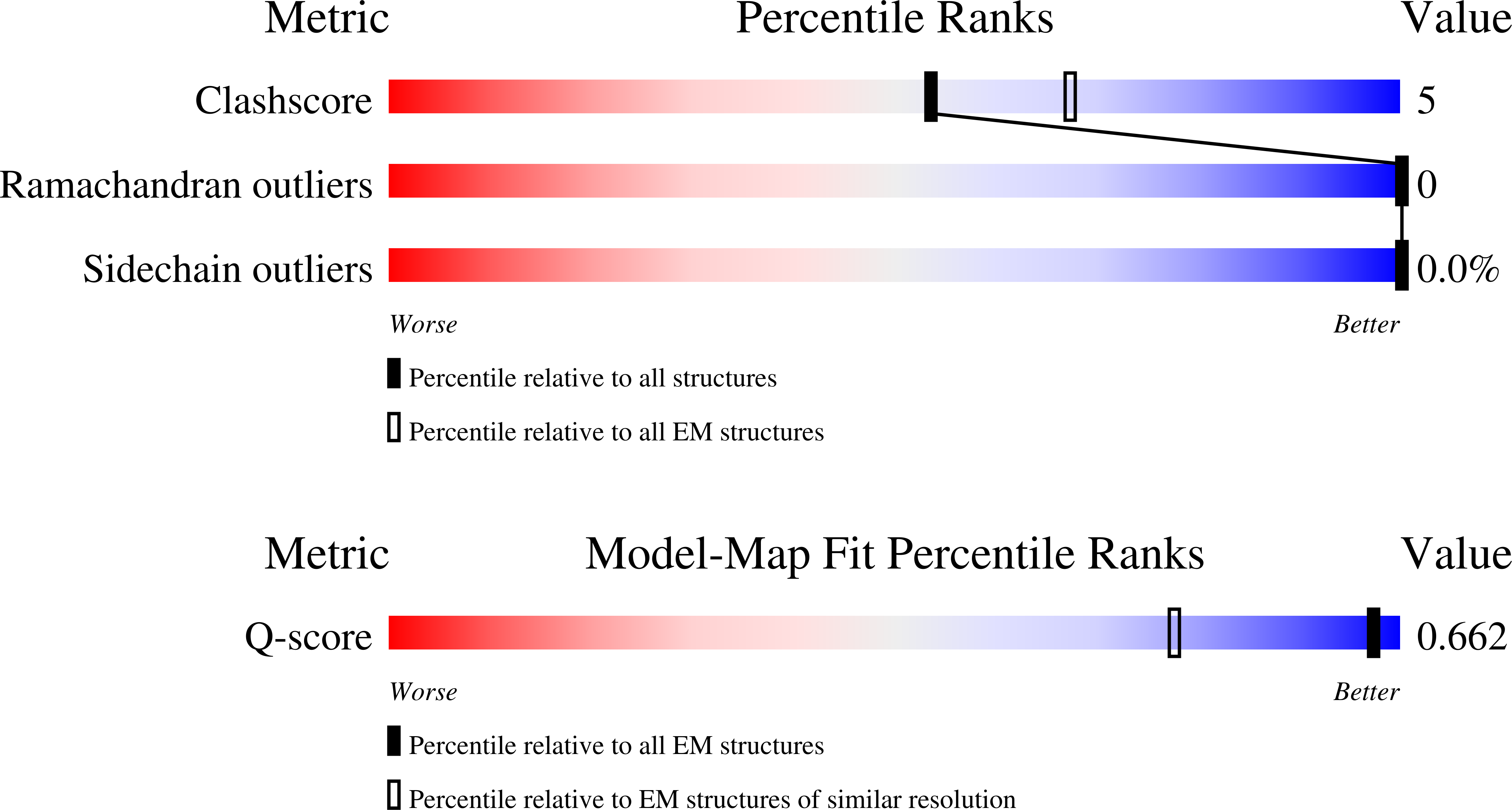
Macromolecular Entities
Polymer Type:polypeptide(L)
Molecule:Photosystem II protein D1
Gene (Uniprot):psbA
Chain IDs:A, V (auth: a)
Chain Length:369
Number of Molecules:2
Biological Source:Chroococcidiopsis thermalis PCC 7203
Polymer Type:polypeptide(L)
Molecule:Photosystem II CP47 reaction
Gene (Uniprot):psbB
Chain IDs:B, W (auth: b)
Chain Length:520
Number of Molecules:2
Biological Source:Chroococcidiopsis thermalis PCC 7203
Polymer Type:polypeptide(L)
Molecule:Photosystem II CP43 reaction
Gene (Uniprot):psbC
Chain IDs:C, X (auth: c)
Chain Length:466
Number of Molecules:2
Biological Source:Chroococcidiopsis thermalis PCC 7203
Polymer Type:polypeptide(L)
Molecule:Photosystem II D2 protein
Gene (Uniprot):psbD
Chain IDs:D, Y (auth: d)
Chain Length:352
Number of Molecules:2
Biological Source:Chroococcidiopsis thermalis PCC 7203
Polymer Type:polypeptide(L)
Molecule:Cytochrome b559 subunit alpha
Gene (Uniprot):psbE
Chain IDs:E, Z (auth: e)
Chain Length:82
Number of Molecules:2
Biological Source:Chroococcidiopsis thermalis PCC 7203
Polymer Type:polypeptide(L)
Molecule:Cytochrome b559 subunit beta
Gene (Uniprot):psbF
Chain IDs:F, AA (auth: f)
Chain Length:44
Number of Molecules:2
Biological Source:Chroococcidiopsis thermalis PCC 7203
Polymer Type:polypeptide(L)
Molecule:PsbH2'
Gene (Uniprot):Chro_1042
Chain IDs:G, BA (auth: g)
Chain Length:48
Number of Molecules:2
Biological Source:Chroococcidiopsis thermalis PCC 7203
Polymer Type:polypeptide(L)
Molecule:Photosystem II phosphoprotein
Gene (Uniprot):Chro_1041
Chain IDs:H, CA (auth: h)
Chain Length:69
Number of Molecules:2
Biological Source:Chroococcidiopsis thermalis PCC 7203
Polymer Type:polypeptide(L)
Molecule:Photosystem II reaction cente
Gene (Uniprot):psbI
Chain IDs:I, DA (auth: i)
Chain Length:38
Number of Molecules:2
Biological Source:Chroococcidiopsis thermalis PCC 7203
Polymer Type:polypeptide(L)
Molecule:Photosystem II reaction cente
Gene (Uniprot):psbJ
Chain IDs:J, EA (auth: j)
Chain Length:39
Number of Molecules:2
Biological Source:Chroococcidiopsis thermalis PCC 7203
Polymer Type:polypeptide(L)
Molecule:Photosystem II reaction cente
Gene (Uniprot):psbK
Chain IDs:K, FA (auth: k)
Chain Length:60
Number of Molecules:2
Biological Source:Chroococcidiopsis thermalis PCC 7203
Polymer Type:polypeptide(L)
Molecule:Photosystem II reaction cente
Gene (Uniprot):psbL
Chain IDs:L, GA (auth: l)
Chain Length:41
Number of Molecules:2
Biological Source:Chroococcidiopsis thermalis PCC 7203
Polymer Type:polypeptide(L)
Molecule:Photosystem II reaction cente
Gene (Uniprot):psbM
Chain IDs:M, HA (auth: m)
Chain Length:37
Number of Molecules:2
Biological Source:Chroococcidiopsis thermalis PCC 7203
Polymer Type:polypeptide(L)
Molecule:Photosystem II extrinsic prot
Gene (Uniprot):Chro_1402
Chain IDs:N (auth: O), IA (auth: o)
Chain Length:274
Number of Molecules:2
Biological Source:Chroococcidiopsis thermalis PCC 7203
Polymer Type:polypeptide(L)
Molecule:Photosystem II reaction cente
Gene (Uniprot):psbY
Chain IDs:O (auth: R), JA (auth: r)
Chain Length:41
Number of Molecules:2
Biological Source:Chroococcidiopsis thermalis PCC 7203
Polymer Type:polypeptide(L)
Molecule:Photosystem II reaction cente
Gene (Uniprot):psbT
Chain IDs:P (auth: T), KA (auth: t)
Chain Length:32
Number of Molecules:2
Biological Source:Chroococcidiopsis thermalis PCC 7203
Polymer Type:polypeptide(L)
Molecule:Photosystem II extrinsic prot
Gene (Uniprot):psbU
Chain IDs:Q (auth: U), LA (auth: u)
Chain Length:153
Number of Molecules:2
Biological Source:Chroococcidiopsis thermalis PCC 7203
Polymer Type:polypeptide(L)
Molecule:Photosystem II extrinsic prot
Gene (Uniprot):psbV
Chain IDs:R (auth: V), MA (auth: v)
Chain Length:163
Number of Molecules:2
Biological Source:Chroococcidiopsis thermalis PCC 7203
Polymer Type:polypeptide(L)
Molecule:Photosystem II reaction cente
Gene (Uniprot):psbX
Chain IDs:S (auth: X), NA (auth: x)
Chain Length:39
Number of Molecules:2
Biological Source:Chroococcidiopsis thermalis PCC 7203
Polymer Type:polypeptide(L)
Molecule:Photosystem II reaction cente
Gene (Uniprot):psb30
Chain IDs:T (auth: Y), OA (auth: y)
Chain Length:43
Number of Molecules:2
Biological Source:Chroococcidiopsis thermalis PCC 7203
Polymer Type:polypeptide(L)
Molecule:Photosystem II reaction cente
Gene (Uniprot):psbZ
Chain IDs:U (auth: Z), PA (auth: z)
Chain Length:63
Number of Molecules:2
Biological Source:Chroococcidiopsis thermalis PCC 7203
Modified Residue
Compound ID Chain ID Parent Comp ID Details 2D Image
FME I MET modified residue
Primary Citation
Mapping the absorption landscape of far-red Photosystem II.
Nat Commun ? ? ? (2026)
PMID: 42248907 DOI: 10.1038/s41467-026-73964-7

Abstact

Far-red light photoacclimation enables some cyanobacteria to survive in white-light-depleted environments by extending the red limit of photosynthesis. In far-red Photosystem II, paralogous subunits replace their canonical counterparts, allowing the incorporation of some chlorophyll f molecules and one chlorophyll d that are red-shifted and spectrally distinct from the chlorophyll a manifold, and from each other. Here, we present a comparative study of far-red Photosystem II from Chroococcidiopsis thermalis PCC 7203 and Calothrix sp. NIES-3974. In C. thermalis, the cryo-electron microscopy structure reveals the far-red-exclusive subunit, PsbH2', which forms part of a chlorophyll f binding site. We also assign four chlorophyll f sites using sequence comparisons and electrostatic potential analyses. In Calothrix, psbH2' is absent, and the same analyses show that only two of these chlorophyll f sites are present. Comparative phylogenetic, structural, and spectroscopic analyses allow the assignment of specific wavelengths to all the red-shifted chlorophylls. This provides the framework needed to model excitation energy transfer in far-red Photosystem II, and to understand the conserved features that allow survival under far-red light.

Legend

Protein

Chemical

Disease

Primary Citation of related structures
Feedback Form
Name
Email
Institute
Feedback