

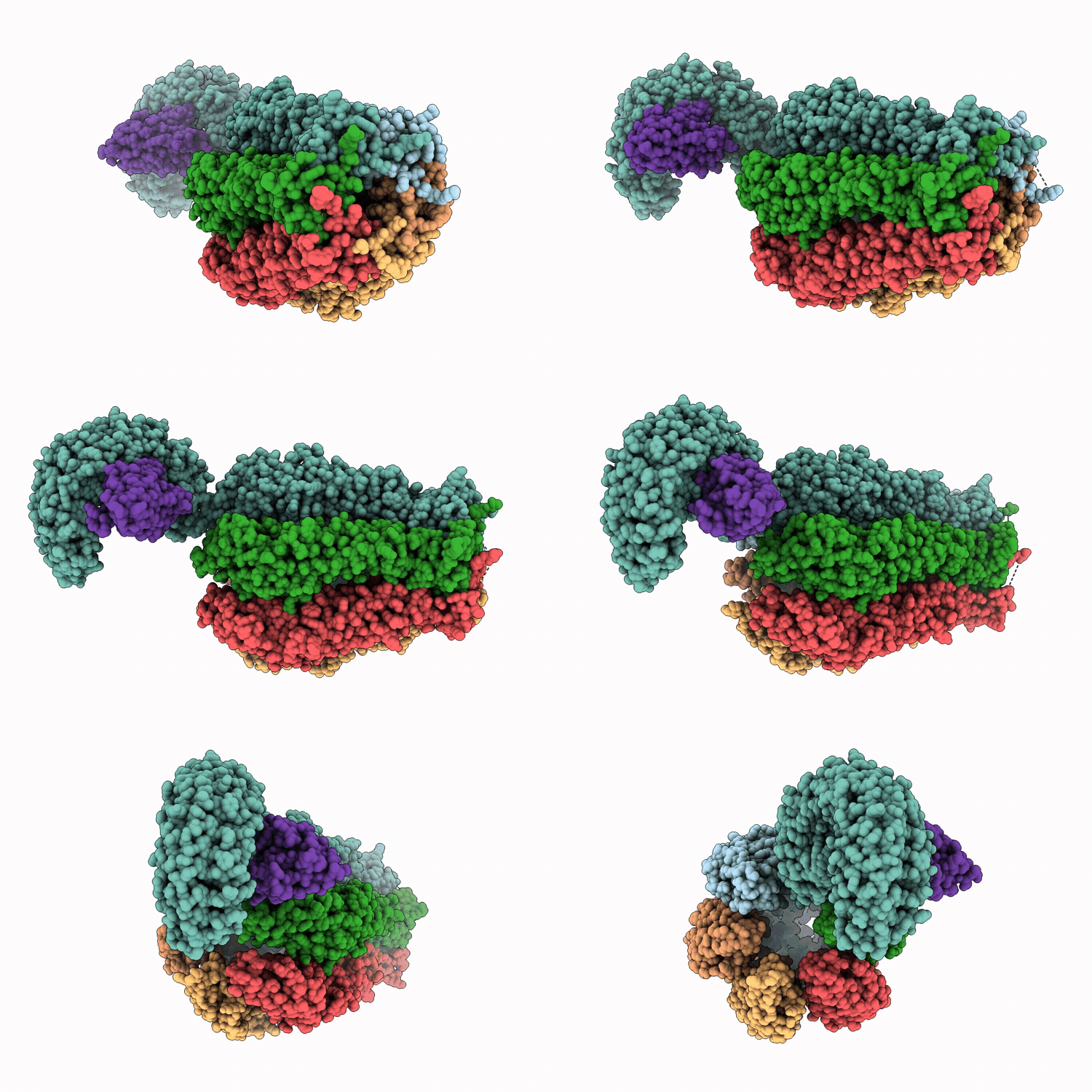
9T5P image
Deposition Date 2025-11-05
Release Date 2026-09-02
Last Version Date 2026-09-30
Entry Detail
PDB ID:
9T5P
Title:
Structure of heteromeric mouse LRRC8A/D Volume-Regulated Anion Channel in complex with synthetic nanobody Sb4
Biological Source:
Source Organism(s):
Expression System(s):
Method Details:
Experimental Method:
Resolution:
3.97 Å
Aggregation State:
PARTICLE
Reconstruction Method:
SINGLE PARTICLE
Macromolecular Entities
Polymer Type:polypeptide(L)
Molecule:Volume-regulated anion channe
Gene (Uniprot):Lrrc8a
Chain IDs:A, B, C, D
Chain Length:806
Number of Molecules:4
Biological Source:Mus musculus
Polymer Type:polypeptide(L)
Molecule:Volume-regulated anion channe
Gene (Uniprot):Lrrc8d
Chain IDs:E, F
Chain Length:458
Number of Molecules:2
Biological Source:Mus musculus
Polymer Type:polypeptide(L)
Molecule:Volume-regulated anion channe
Chain IDs:G (auth: J)
Chain Length:128
Number of Molecules:1
Biological Source:Mus musculus
Ligand Molecules
Primary Citation
Structures of the volume-regulated anion channel LRRC8A/D in activating and inhibiting conditions.
Nat Commun 17 ? ? (2026)
PMID: 42754598 DOI: 10.1038/s41467-026-77508-x

Abstact

Volume-regulated anion channels, which are activated in response to hypotonicity, are heteromers composed of LRRC8 family members. They consist of the obligatory subunit LRRC8A and at least another paralog that determines their substrate preference. Here we investigate heteromeric assemblies composed of LRRC8A and D subunits, the latter of which confer permeability to amino acids, osmolytes and anti-cancer drugs. Using patch-clamp electrophysiology, we show that LRRC8A/D channels are reversibly activated by cell swelling and that their response is modulated by sybodies targeting the A subunits, which either potentiate or repress channel activity. Structures of the LRRC8A/D channel in complex with the inhibitory sybody Sb1 define the channel stoichiometry of four A and two D subunits, with Sb1 stabilizing the A subunits in a similar closed channel conformation as found in homomeric LRRC8A assemblies. In LRRC8A/D heteromers, the two D subunits weaken the arrangement of A subunits and thus enhance the activation properties of the channel. This channel conformation is strongly perturbed upon binding of the potentiating sybody Sb4, which disrupts the packing of the cytoplasmic domains linking their mobility to pore opening.

Legend

Protein

Chemical

Disease

Primary Citation of related structures
Feedback Form
Name
Email
Institute
Feedback