

9T4H image
Deposition Date 2025-10-30
Release Date 2026-06-10
Last Version Date 2026-06-10
Entry Detail
PDB ID:
9T4H
Keywords:
Title:
Human Diphosphoinositol Polyphosphate Phosphohydrolase 1 (DIPP1) R41A mutant in complex with IP6
Biological Source:
Source Organism(s):
Homo sapiens (Taxon ID: 9606)
Expression System(s):
Method Details:
Experimental Method:
Resolution:
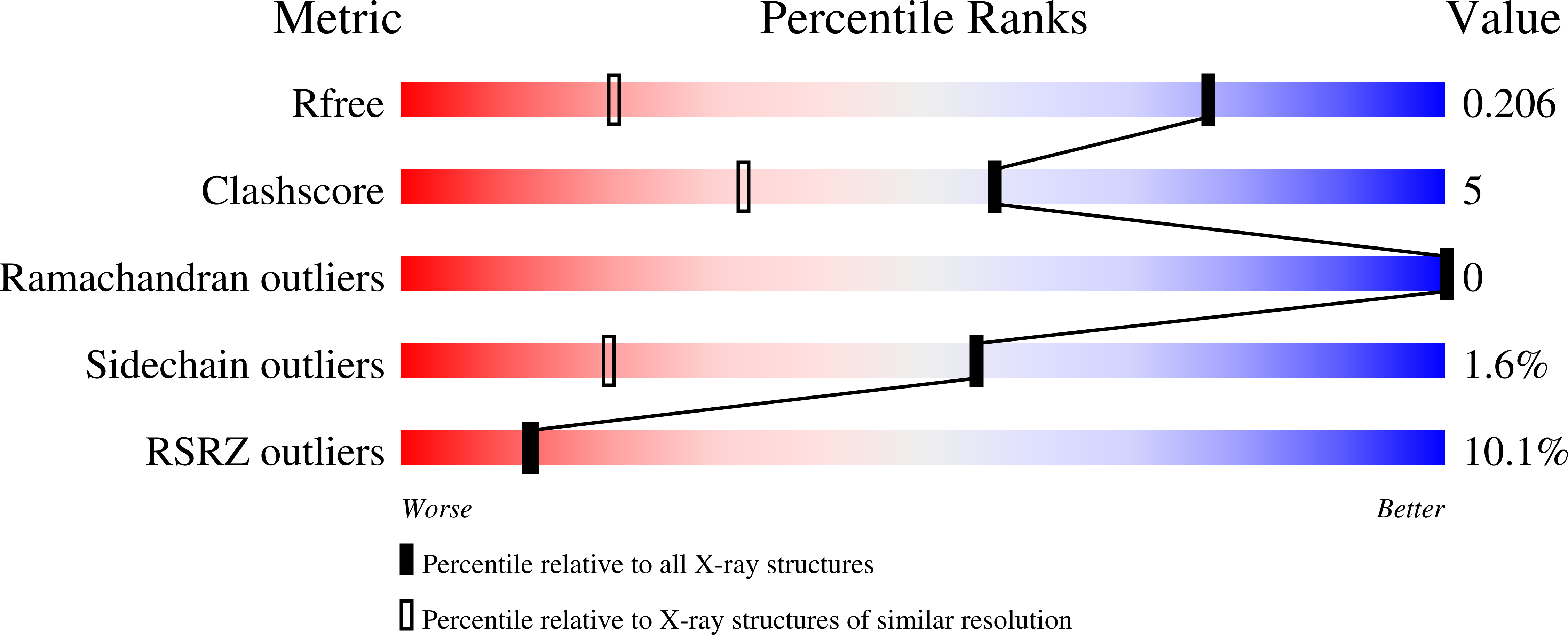
1.24 Å
R-Value Free:
0.20
R-Value Work:
0.16
Space Group:
P 21 21 21
Macromolecular Entities
Structures with similar UniProt ID
Protein Blast
Polymer Type:polypeptide(L)
Molecule:Diphosphoinositol polyphospha
Gene (Uniprot):NUDT3
Mutagens:Deletion of the last 24 C-terminal residues (149-172) and R41A
Chain IDs:A
Chain Length:148
Number of Molecules:1
Biological Source:Homo sapiens
Primary Citation
The DIPP1 family binds IP 8 in catalytically-productive twist-boat and chair conformations and associates in a ligand-dependent manner.
Int.J.Biol.Macromol. ? 152715 152715 (2026)
PMID: 42202926 DOI: 10.1016/j.ijbiomac.2026.152715

Abstact

Diphosphoinositol Polyphosphate Phosphohydrolase 1 (DIPP1) is a Nudix hydrolase involved in inositol pyrophosphate (PP-InsP) metabolism, critical for cellular signaling, energy homeostasis, and stress responses. We report crystallographic and computational studies that reveal 1,5-bis-diphosphoinositol tetrakisphosphate (IP(8)) binds to DIPP1 in two catalytically-productive inositol ring conformations. IP(8) hydrolysis at the 1-position requires a twist-boat conformation, whereas at the 5-position a canonical chair conformation is adopted. Additionally, structural and biophysical characterization shows that the DIPP1 family undergoes ligand-sensitive changes in the association state that might be further modulated by salt concentration and/or phosphate ions. Taken together, these results advance our understanding of DIPP1 in the dynamic regulation of inositol pyrophosphate signaling networks. They provide a detailed view of DIPP1 substrate recognition and suggest oligomerization as a novel regulatory mechanism, with broader implications for phosphate sensing and functional protein-protein interactions.

Legend

Protein

Chemical

Disease

Primary Citation of related structures
Feedback Form
Name
Email
Institute
Feedback