

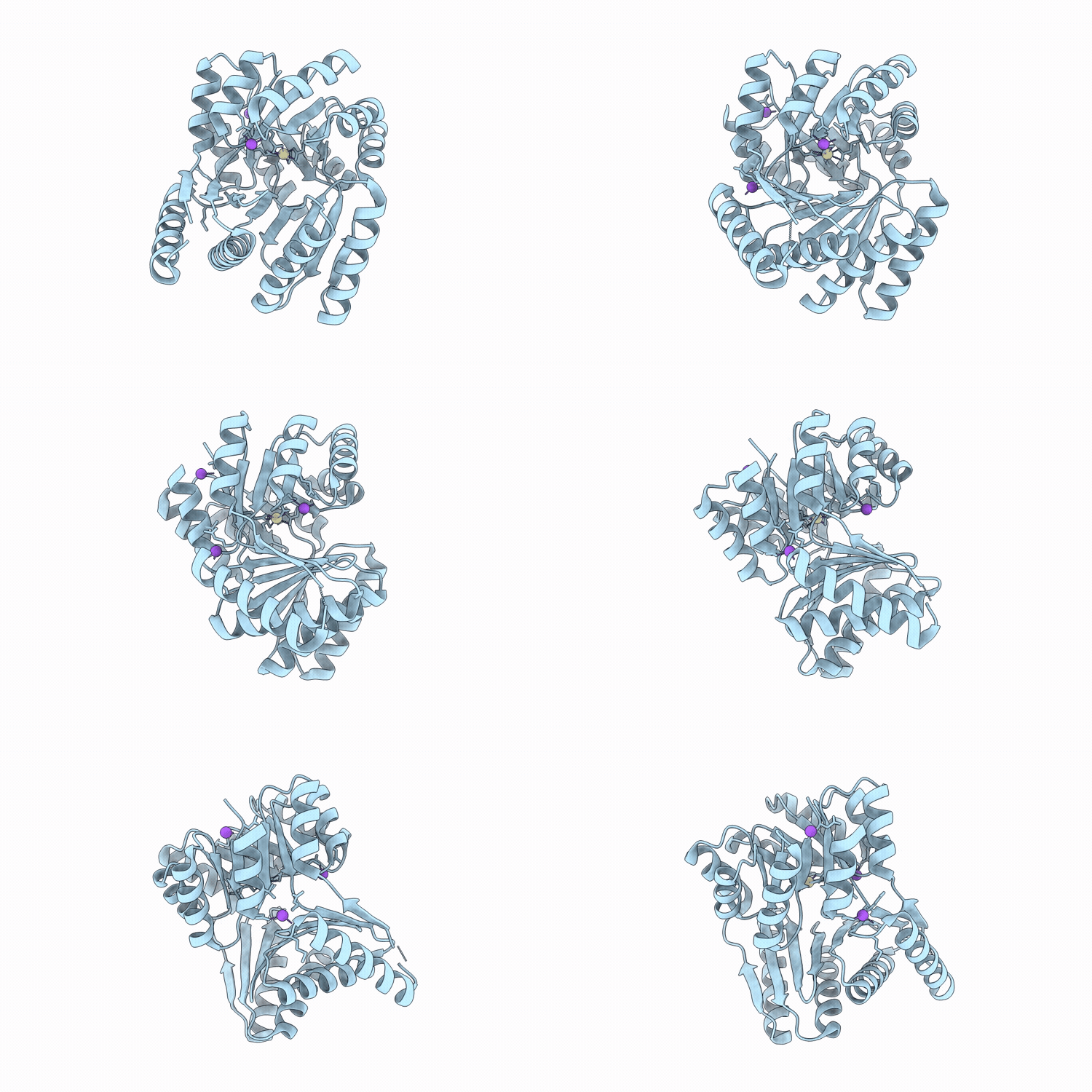
9SZU image
Deposition Date 2025-10-15
Release Date 2026-03-25
Last Version Date 2026-04-08
Entry Detail
PDB ID:
9SZU
Keywords:
Title:
Cerium(III)-bound de novo photoredox enzyme (PLZ2.3)
Biological Source:
Source Organism(s):
Expression System(s):
Method Details:
Experimental Method:
Resolution:
2.10 Å
R-Value Free:
0.24
R-Value Work:
0.17
R-Value Observed:
0.18
Space Group:
P 43

Macromolecular Entities
Protein Blast
Polymer Type:polypeptide(L)
Molecule:PLZ2.3
Chain IDs:A
Chain Length:333
Number of Molecules:1
Biological Source:synthetic construct
Primary Citation
Computational redesign and directed evolution of a lanthanide-dependent photoredox enzyme for enantioselective diol cleavage.
Chem Sci ? ? ? (2026)
PMID: 41883853 DOI: 10.1039/d5sc08010j

Abstact

De novo designed metalloenzymes and photoenzymes are a valuable addition to the biocatalytic toolbox. We previously introduced PhotoLanZymes (PLZ), a family of lanthanide-dependent photoredox enzymes that enable radical carbon-carbon bond cleavages of diol substrates upon Ce(iii/iv) binding and visible-light irradiation. While rational optimization increased their catalytic activity and photostability, the first generation of PLZ variants was limited by slow lanthanide binding and a lack of enantioselectivity. Here, we demonstrate that coupling computational redesign with directed evolution provides an effective strategy to overcome these limitations. First, we reduced the cavity size to enhance substrate interactions with the protein's active site, which facilitated initial enantiocontrol. Simultaneously, the AI-guided redesign approach improved the lanthanide binding kinetics. We then performed directed evolution to selectively accelerate the photocatalytic turnover for one of the substrate enantiomers, yielding a PLZ variant with markedly improved enantioselectivity. These results underscore the value of integrating AI-guided protein design with laboratory evolution to obtain stereoselective de novo metalloenzymes and photoenzymes.

Legend

Protein

Chemical

Disease

Primary Citation of related structures
Feedback Form
Name
Email
Institute
Feedback