

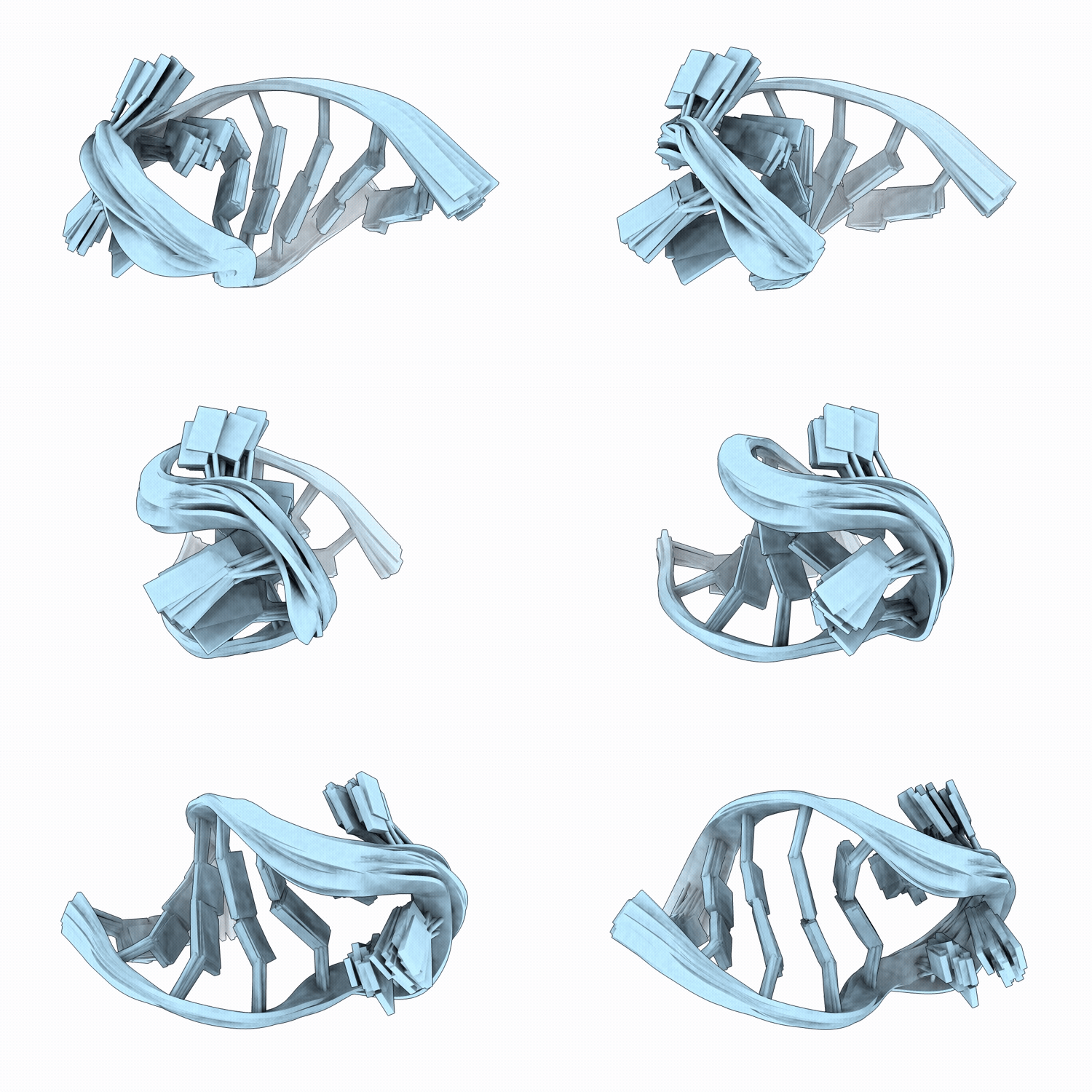
9SYE image
Deposition Date 2025-10-11
Release Date 2026-06-24
Last Version Date 2026-06-24
Entry Detail
PDB ID:
9SYE
Keywords:
Title:
Beyond single-state RNA structural biology: MD/NMR description of temperature-sensitive dynamic RNA ensembles - GCAA ARIA 2+2 motif
Biological Source:
Source Organism(s):
Method Details:
Experimental Method:
Conformers Calculated:
200
Conformers Submitted:
20
Selection Criteria:
structures with the lowest energy

Macromolecular Entities
Polymer Type:polyribonucleotide
Molecule:RNA hairpin with GCAA tetralo
Chain IDs:A
Chain Length:14
Number of Molecules:1
Biological Source:synthetic RNA
Ligand Molecules
Primary Citation
Integrated NMR/MD investigation reveals differences after reweighting in conformational ensembles of GAAG and GCAA tetraloops.
Rna ? ? ? (2026)
PMID: 42215280 DOI: 10.1261/rna.081067.126

Abstact

While the GNRA tetraloops are an extensively studied and common RNA motif, their dynamic NMR structures in solution integrating state-of-the-art NMR parameters such as residual dipolar couplings (RDC) and cross correlated relaxation rates (CCR) have previously not been determined. Given their dominant occurrence among tetraloops in the PDB and the advance of experimentally reweighted MD simulations, the present work aims at investigating the entire conformational space of two known GNRA tetraloops sequences by an extensive NMR investigation of NOEs, J-couplings constants, RDCs and CCRs. As classical structure calculation proved insufficient for the more dynamic tetraloop we turned to Bayesian/maximum entropy reweighting of molecular simulations using our rich set of experiments. The resulting ensembles were clustered and compared to classically restrained structure calculations, structures from the PDB and models predicted by the prediction algorithms FarFar and Alphafold 3. Our results show that GNRA tetraloops can vary in dynamic sampling of conformational space. They highlight the importance of individual experimental validation of computationally obtained dynamic ensembles and model predictions.

Legend

Protein

Chemical

Disease

Primary Citation of related structures
Feedback Form
Name
Email
Institute
Feedback