

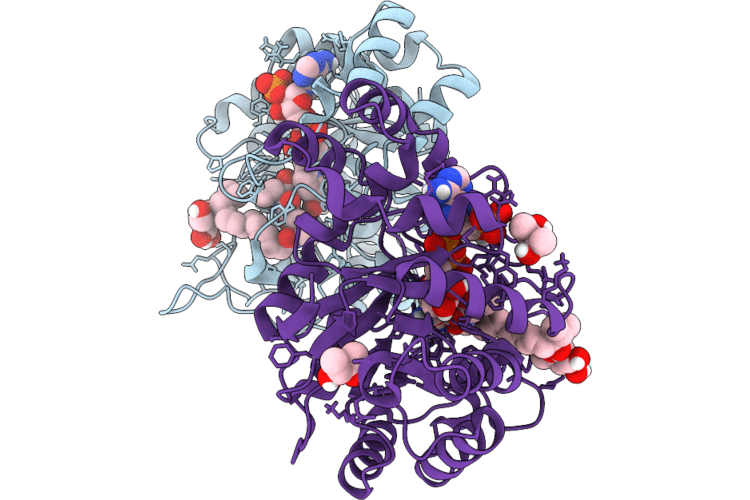
9SWH image
Deposition Date 2025-10-06
Release Date 2026-08-26
Last Version Date 2026-10-14
Entry Detail
PDB ID:
9SWH
Keywords:
Title:
Crystal structure of aldo-keto reductase 1C3 (AKR1C3) in complex with NADP+ and Myxoglucamide A
Biological Source:
Source Organism(s):
Homo sapiens (Taxon ID: 9606)
Expression System(s):
Method Details:
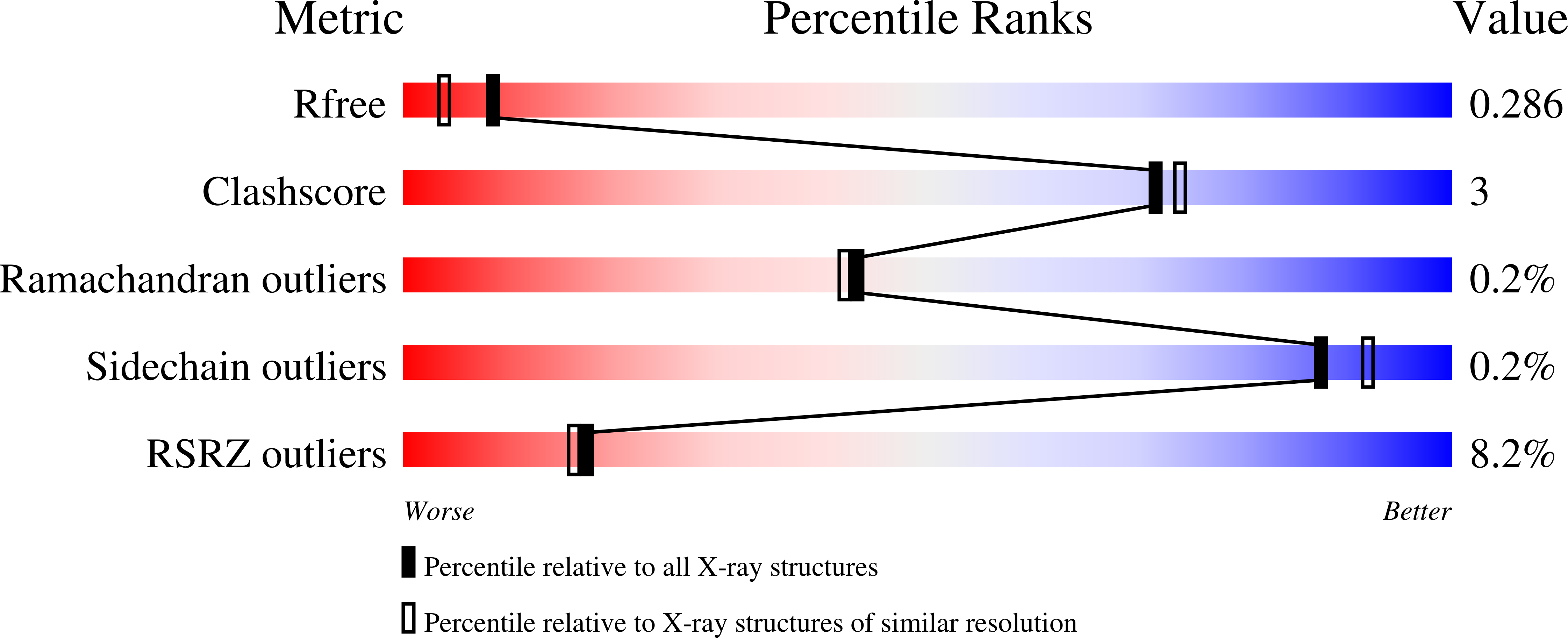
Experimental Method:
Resolution:
1.99 Å
R-Value Free:
0.28
R-Value Work:
0.23
R-Value Observed:
0.23
Space Group:
P 1
Macromolecular Entities
Polymer Type:polypeptide(L)
Molecule:Aldo-keto reductase family 1
Gene (Uniprot):AKR1C3
Chain IDs:A, B
Chain Length:344
Number of Molecules:2
Biological Source:Homo sapiens
Primary Citation
Synthesis and Activity-Based Protein Profiling Identifies Aldo-Keto Reductase 1C3 as Target Protein of Myxoglucamides.
Angew.Chem.Int.Ed.Engl. 65 e6489568 e6489568 (2026)
PMID: 42573019 DOI: 10.1002/anie.6489568

Abstact

Myxoglucamides, natural products recently isolated from Cystobacterineae sp., are featured by an unprecedented vinyl-substituted alpha-keto-gamma-amino acid that is linked to a glycosylated 14-methyl-pentadecanoic acid. Thus, they unite elements from three biomolecular classes in a compact glycolipopeptide. To elucidate the biological relevance of this arrangement, we searched for molecular targets by activity-based protein profiling (ABPP)-although a phenotypic bioactivity has not been reported. An access to the compound class was established through the first total synthesis of myxoglucamide A in 11 steps. A proteome-wide ABPP study led to the identification of aldo-keto reductase 1C3 (AKR1C3) as the primary target of myxoglucamides in human cells. AKR1C3 is an oncogenic factor involved in prostaglandin and steroid synthesis, promoting the growth, proliferation, and metastasis of carcinoma cells. The functional inhibition of AKR1C3 by a competitive mechanism (IC(50) = 1.61 microm) was validated in vitro, and 20 analogs provided structure-activity relationships and more potent analogs (IC(50) = 181 nm). Biophysical interactions were quantified by thermal shift assays, and essential molecular protein-ligand interactions were characterized by X-ray crystallography at 2.0 A resolution. The study implies that the search for targets of natural products is rewarding even in the absence of an initial phenotypic activity.

Legend

Protein

Chemical

Disease

Primary Citation of related structures
Feedback Form
Name
Email
Institute
Feedback