

9SUK image
Deposition Date 2025-09-29
Release Date 2026-05-27
Last Version Date 2026-05-27
Entry Detail
PDB ID:
9SUK
Keywords:
Title:
p53-R282W Core Domain Covalently Bound to a Vinyl-Sulfone Fragment
Biological Source:
Source Organism(s):
Homo sapiens (Taxon ID: 9606)
Expression System(s):
Method Details:
Experimental Method:
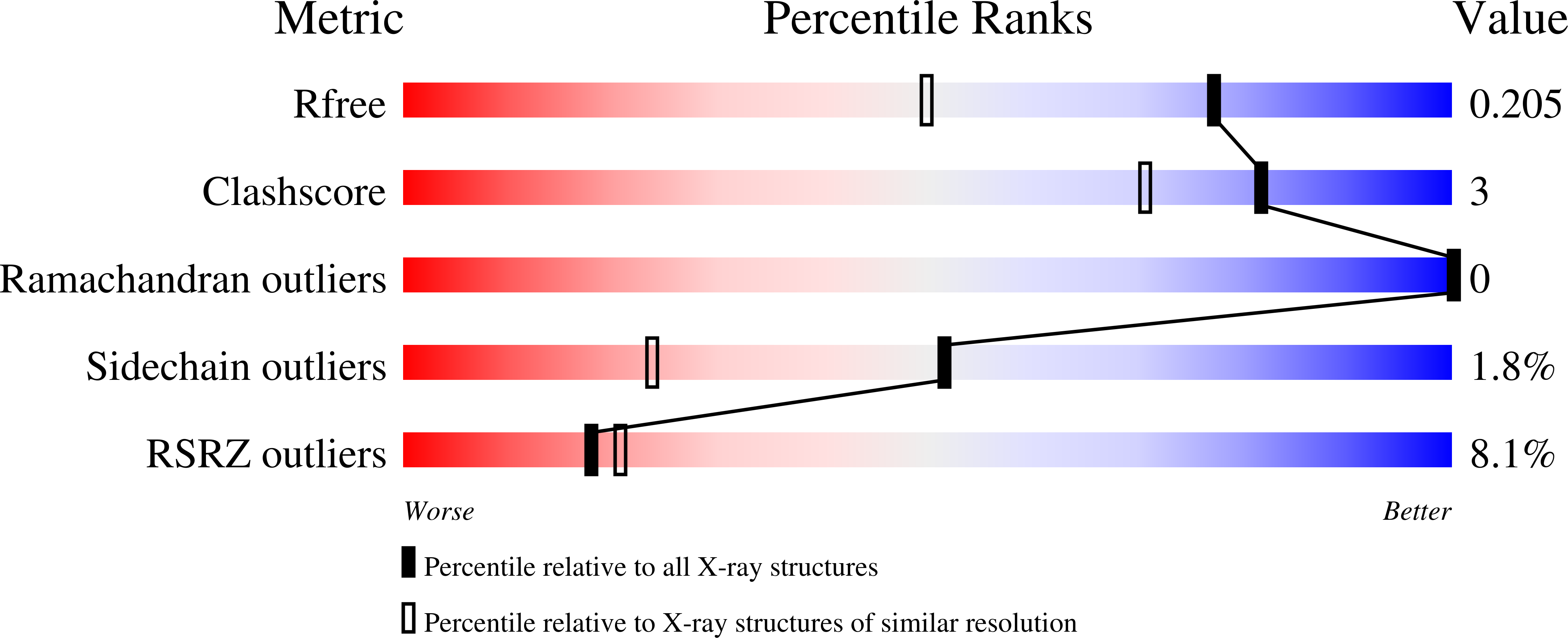
Resolution:
1.56 Å
R-Value Free:
0.20
R-Value Work:
0.15
R-Value Observed:
0.15
Space Group:
P 21 21 21
Macromolecular Entities
Structures with similar UniProt ID
Protein Blast
Polymer Type:polypeptide(L)
Molecule:Cellular tumor antigen p53
Gene (Uniprot):TP53
Mutagens:M133L, V203A, N239Y, N268D, R282W
Chain IDs:A, B
Chain Length:219
Number of Molecules:2
Biological Source:Homo sapiens
Primary Citation
Covalent drug rescue of multiple p53 mutants by stabilizing vinyl sulfone fragments hints to a specific refolding mechanism for R282W.
Protein Sci. 35 e70629 e70629 (2026)
PMID: 42141518 DOI: 10.1002/pro.70629

Abstact

The tumor suppressor protein p53 plays a crucial role in cell cycle regulation. In approximately 50% of all tumors, mutations in p53 are observed. Although the top hot spot mutations impair DNA binding, other mutations affect the thermal stability of the protein, leading to its rapid denaturation in physiological conditions. Previously, we have identified VS004, a vinyl sulfone containing fragment that stabilized p53C-WT by about 5 degrees C. In this study, we screened the CovLib fragments VS002, VS003, VS004, and two VS004 analogs against wild-type p53C, as well as the mutants R273H, Y220C, and R282W. VS004 and its analogs demonstrated stabilizing effects on all tested p53 variants, with the strongest effect (almost 6 degrees C) on R282W. We solved the crystal structures of VS004-2 bound to Y220C and R282W. In the Y220C crystal structure, VS004-2 bound to C277 and stabilized the loop L1. For R282W, we observed binding to C275, which leads to an unexpected structural reorganization of the C-terminal helix H2. Although the arylated cysteines are both near the DNA-binding interface, fluorescence polarization experiments using five different response elements confirm that DNA binding appears not to be compromised. The compounds present an interesting starting point for both general and mutant specific p53 stabilization.

Legend

Protein

Chemical

Disease

Primary Citation of related structures
Feedback Form
Name
Email
Institute
Feedback