

9SOM image
Deposition Date 2025-09-15
Release Date 2026-06-10
Last Version Date 2026-06-10
Entry Detail
PDB ID:
9SOM
Keywords:
Title:
Crystal structure of a designed coiled coil with two distinct Terbium sites
Biological Source:
Source Organism(s):
Method Details:
Experimental Method:
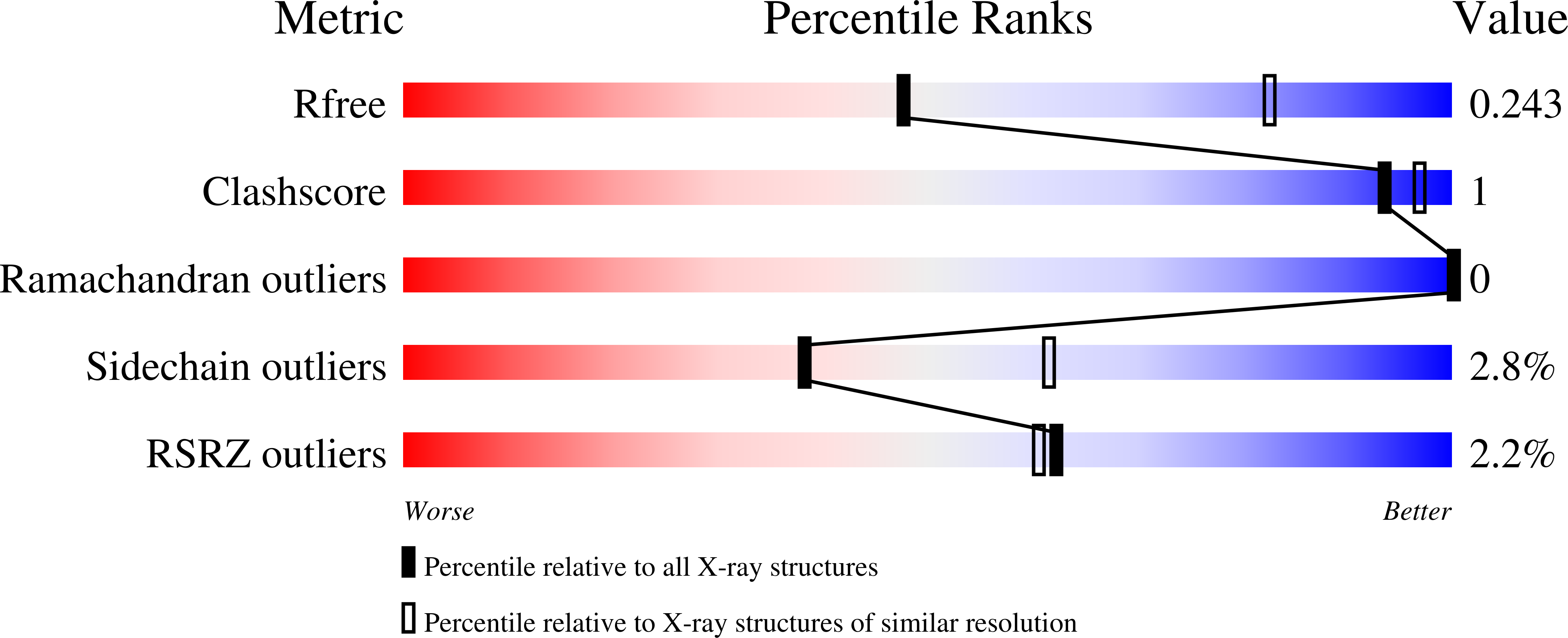
Resolution:
2.76 Å
R-Value Free:
0.24
R-Value Work:
0.22
R-Value Observed:
0.22
Space Group:
P 6
Macromolecular Entities
Protein Blast
Polymer Type:polypeptide(L)
Molecule:Designed coiled coil with two
Chain IDs:A
Chain Length:45
Number of Molecules:1
Biological Source:synthetic construct
Ligand Molecules
Primary Citation
Design of a site selective heterochromic bimetallic lanthanide coiled coil with nanometre-scale control.
Chem Sci ? ? ? (2026)
PMID: 42164438 DOI: 10.1039/d6sc00813e

Abstact

Lanthanide-protein scaffolds hold significant promise for the design of functional biomaterials. Yet the selective incorporation of multiple lanthanide ions with distinct properties into discrete sites at tuneable distances within a single construct remains a key challenge. Here, we report the rational design and structural characterization of the first de novo coiled coil capable of binding two different lanthanide ions at independent, non-equivalent sites with defined intermetallic spacing. By installing orthogonal coordination environments, comprising Asn(3)Asp(3) and Asp(3)-only motifs, at defined positions along the coiled coil axis, we achieve precise, site-specific metal binding across a series of constructs spanning 1 to 5 nm. Site occupancy and intermetallic distances were validated using luminescence, electron paramagnetic resonance (EPR) spectroscopy, mass spectrometry and X-ray crystallography. The latter reveals the first structure of a coiled coil bound to two Tb(3+) ions, and the shortest non-bridged metal-metal distance reported to date in such a scaffold (11.9 A). The chemically distinct coordination sites enable sequential and selective metal loading. Remarkably, this system is capable of binding two different lanthanides, Tb(3+) and Yb(3+), at distinct sites, despite their extremely similar coordination chemistries. These results establish a robust and modular platform for constructing nanometre-scale molecular rulers, and highlight new avenues for the rational design of multifunctional metalloproteins.

Legend

Protein

Chemical

Disease

Primary Citation of related structures
Feedback Form
Name
Email
Institute
Feedback