

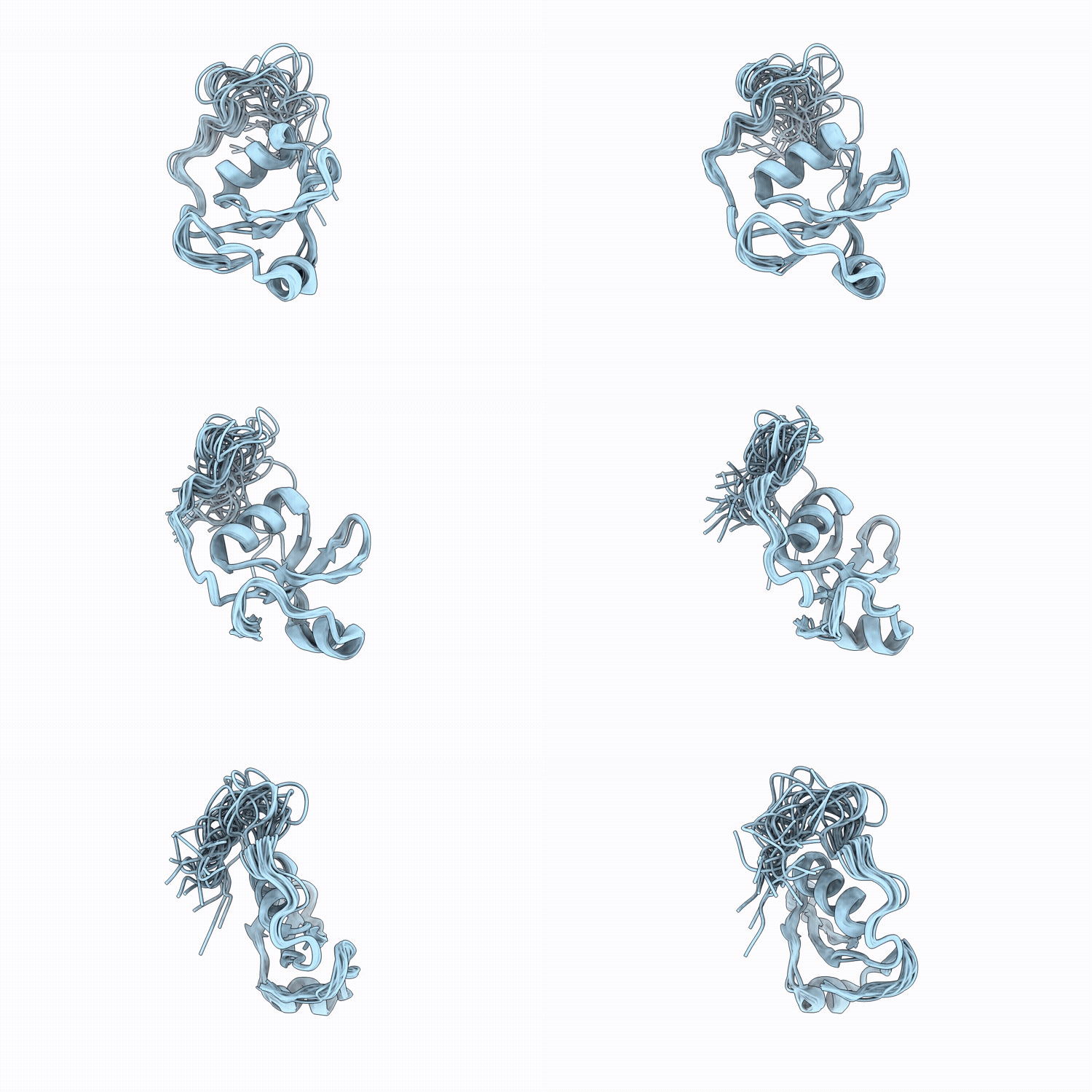
9SLR image
Deposition Date 2025-09-05
Release Date 2026-05-27
Last Version Date 2026-05-27
Entry Detail
PDB ID:
9SLR
Keywords:
Title:
Solution structure of the conotoxin conkazal-M1
Biological Source:
Source Organism(s):
Conus magus (Taxon ID: 6492)
Expression System(s):
Method Details:
Experimental Method:
Conformers Calculated:
100
Conformers Submitted:
20
Selection Criteria:
structures with the lowest energy
Macromolecular Entities
Structures with similar UniProt ID
Protein Blast
Polymer Type:polypeptide(L)
Molecule:Superfamily Pmag-02
Chain IDs:A
Chain Length:73
Number of Molecules:1
Biological Source:Conus magus
Ligand Molecules
Primary Citation
Conkazal-M1 from the MKAVA family of conotoxins: A dual-function protease inhibitor and neuroactive peptide.
Protein Sci. 35 e70580 e70580 (2026)
PMID: 42017756 DOI: 10.1002/pro.70580

Abstact

Marine cone snails produce a diverse array of bioactive peptides, known as conotoxins, in their venom. Given their high target potency and specificity, conotoxins are attractive compounds for the development of precision research tools and pharmacological agents. Here, we provide the first experimental characterization of a conotoxin from the MKAVA superfamily, conkazal-M1, from Conus magus. Using NMR spectroscopy, we show that conkazal-M1 adopts a fold characteristic of the Kazal-type protease inhibitor family, featuring a Glu residue at the inhibitory P1 position. Recombinantly expressed conkazal-M1 inhibits the proteolytic activity of Subtilisin A with an apparent Ki of 1.1 muM. In addition, conkazal-M1 partially inhibits calcium transients in mouse sensory neurons, suggesting a potential role in modulating ion-channel activity, as seen for many other toxins. The dual function of conkazal-M1 in protease inhibition and neuroactivity is analogous to the dual function of several toxins harboring a Kunitz-type fold. The well-conserved sequence of the MKAVAs indicates an evolutionary trajectory in which these proteins face an adaptive conflict, where mutations that enhance one activity compromise the other. Collectively, this work provides new structural and functional insights into a previously uncharacterized toxin superfamily in cone snails, illustrates how structural scaffolds can be repurposed for functions that diverge from the original while retaining their overall structure, and expands our understanding of the toxin arsenal available to venomous animals.

Legend

Protein

Chemical

Disease

Primary Citation of related structures
Feedback Form
Name
Email
Institute
Feedback