

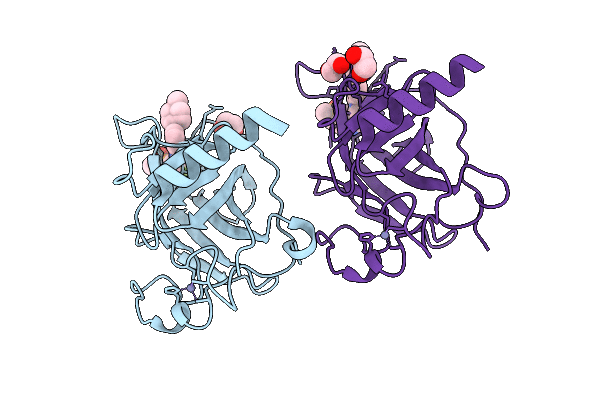
9S9M image
Deposition Date 2025-08-06
Release Date 2026-03-11
Last Version Date 2026-04-01
Entry Detail
PDB ID:
9S9M
Keywords:
Title:
Crystal structure of p53 cancer mutant Y220C in complex with rezatapopt analog 7
Biological Source:
Source Organism(s):
Homo sapiens (Taxon ID: 9606)
Expression System(s):
Method Details:
Experimental Method:
Resolution:
1.83 Å
R-Value Free:
0.22
R-Value Work:
0.19
R-Value Observed:
0.19
Space Group:
P 21 21 21

Macromolecular Entities
Structures with similar UniProt ID
Protein Blast
Polymer Type:polypeptide(L)
Molecule:Cellular tumor antigen p53
Gene (Uniprot):TP53
Chain IDs:A, B
Chain Length:219
Number of Molecules:2
Biological Source:Homo sapiens
Primary Citation
Targeting the p53 cancer mutants Y220C, Y220N, and Y220S with the small-molecule stabilizer rezatapopt.
Cell Death Dis 17 ? ? (2026)
PMID: 41748563 DOI: 10.1038/s41419-026-08492-9

Abstact

The cavity-creating p53 cancer mutation Y220C, which accounts for an estimated 125,000 new cancer cases per year, serves as an excellent paradigm for the development of mutant p53 reactivators. Several molecules that reactivate this thermolabile cancer mutant by targeting the mutation-induced crevice have been developed, and one of them, rezatapopt, is currently in clinical trials. The less frequently occurring Y220N and Y220S mutations are even more destabilizing than Y220C but create a similar surface crevice, raising the question of whether cancer patients with these mutations might also benefit from rezatapopt treatment. Here, we show that rezatapopt also binds to the Y220N and Y220S mutants, with nanomolar affinity, resulting in a full recovery of wild-type-like stability for the latter. High-resolution crystal structures of all three mutants bound to rezatapopt revealed a conserved binding mode, highlighting key interactions, including multipolar interactions of a fluorine substituent at a chiral center with the protein backbone. Consistent with the biophysical and structural data, rezatapopt reactivated p53 signaling in both Y220C and Y220S mutant cells by restoring the folded conformation and transcriptional activity, leading to anti-proliferative effects and apoptosis, albeit requiring higher compound concentrations in Y220S cells. The Y220N mutant, despite exhibiting high-nanomolar affinity for rezatapopt and substantial stabilization, did not show noticeable effects in cells at the concentrations tested, as rezatapopt binding resulted in only partial compensation for the mutation-induced loss of stability, for which we provide a structural explanation. Our data suggest that the development of clinical pan-Y220C/N/S reactivators, which could benefit an additional 10,000 patients per year, is challenging but not impossible.

Legend

Protein

Chemical

Disease

Primary Citation of related structures
Feedback Form
Name
Email
Institute
Feedback