

9S0T image
Deposition Date 2025-07-17
Release Date 2026-03-11
Last Version Date 2026-03-11
Entry Detail
PDB ID:
9S0T
Title:
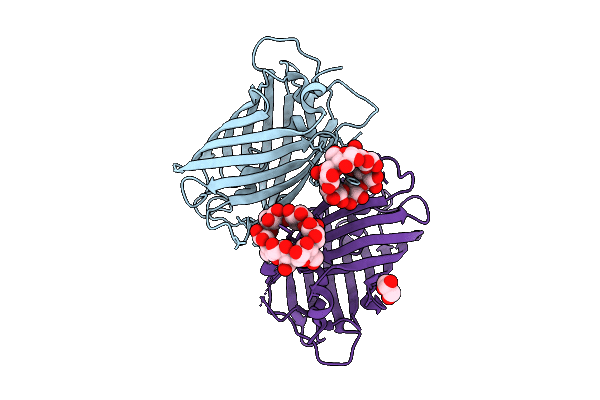
Superfolder green fluorescent protein (sfGFP) exhibiting p-(phenylazo)-L-phenylalanine (Pap) at position 39 in complex with alpha-cyclodextrin
Biological Source:
Source Organism(s):
Expression System(s):
Method Details:
Experimental Method:
Resolution:
2.05 Å
R-Value Free:
0.22
R-Value Work:
0.18
R-Value Observed:
0.19
Space Group:
P 43
Macromolecular Entities
Structures with similar UniProt ID
Protein Blast
Polymer Type:polypeptide(L)
Molecule:Green fluorescent protein
Gene (Uniprot):GFP
Chain IDs:A, B
Chain Length:245
Number of Molecules:2
Biological Source:Aequorea victoria
Modified Residue
Compound ID Chain ID Parent Comp ID Details 2D Image
CRO A GLY chromophore
Ligand Molecules
Primary Citation
Structural Basis of the Light-Switchable Interaction between an Azobenzene Side Chain in a Biosynthetic Protein and alpha-Cyclodextrin.
Chemistryopen 15 e202500471 e202500471 (2026)
PMID: 41255130 DOI: 10.1002/open.202500471

Abstact

Azobenzene derivatives, which show light-induced reversible trans<-->cis isomerization, have gained increasing attention in the area of protein science. p-(Phenylazo)-L-phenylalanine (Pap) was recently employed to enable the light-controlled affinity purification of biosynthetic proteins as part of the Azo-tag. Specific supramolecular complex formation with immobilized alpha-cyclodextrin (alpha-CD) groups is mediated by the Pap side chain in its low-energy trans-configuration, whereas photoisomerization to the cis-state leads to immediate dissociation. Here, we describe the X-ray crystallographic analysis of super-folder green fluorescent protein (sfGFP) displaying Pap at amino acid position 39 on its surface in complex with alpha-CD. While this experimental structure generally confirms the mode of host-guest interaction predicted by molecular modeling, there are two unexpected observations: (i) the conically shaped alpha-CD binds with its narrow end toward the aminoacyl moiety of Pap, despite appearing sterically more demanding, and (ii) the azobenzene side chain shows a considerably twisted conformation of its two phenyl rings, which contrasts with the fully coplanar arrangement usually anticipated for unmodified azobenzene and its chemical derivatives. Thus, this crystal structure of the photoswitchable noncanonical amino acid Pap (also known as AzoF or AzoPhe) provides valuable insight for future molecular engineering endeavors to endow proteins with light-controllable functions.

Legend

Protein

Chemical

Disease

Primary Citation of related structures
Feedback Form
Name
Email
Institute
Feedback