

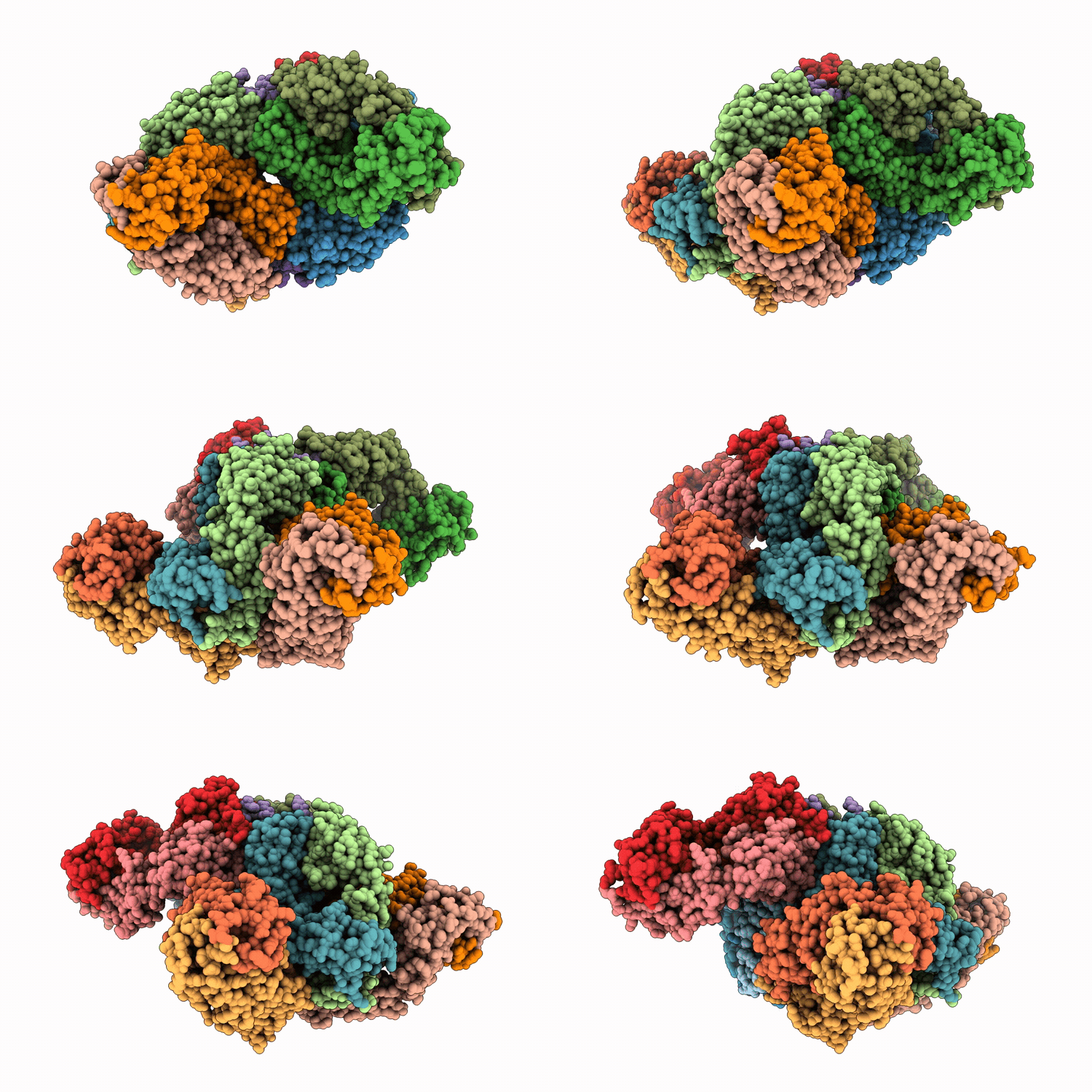
9RTG image
Deposition Date 2025-07-02
Release Date 2026-06-24
Last Version Date 2026-06-24
Entry Detail
PDB ID:
9RTG
Keywords:
Title:
Crystal structure of Ara h 2 immunocomplex with IgE Fab fragment
Biological Source:
Source Organism(s):
Homo sapiens (Taxon ID: 9606)
Arachis hypogaea (Taxon ID: 3818)
Expression System(s):
Method Details:
Experimental Method:
Resolution:
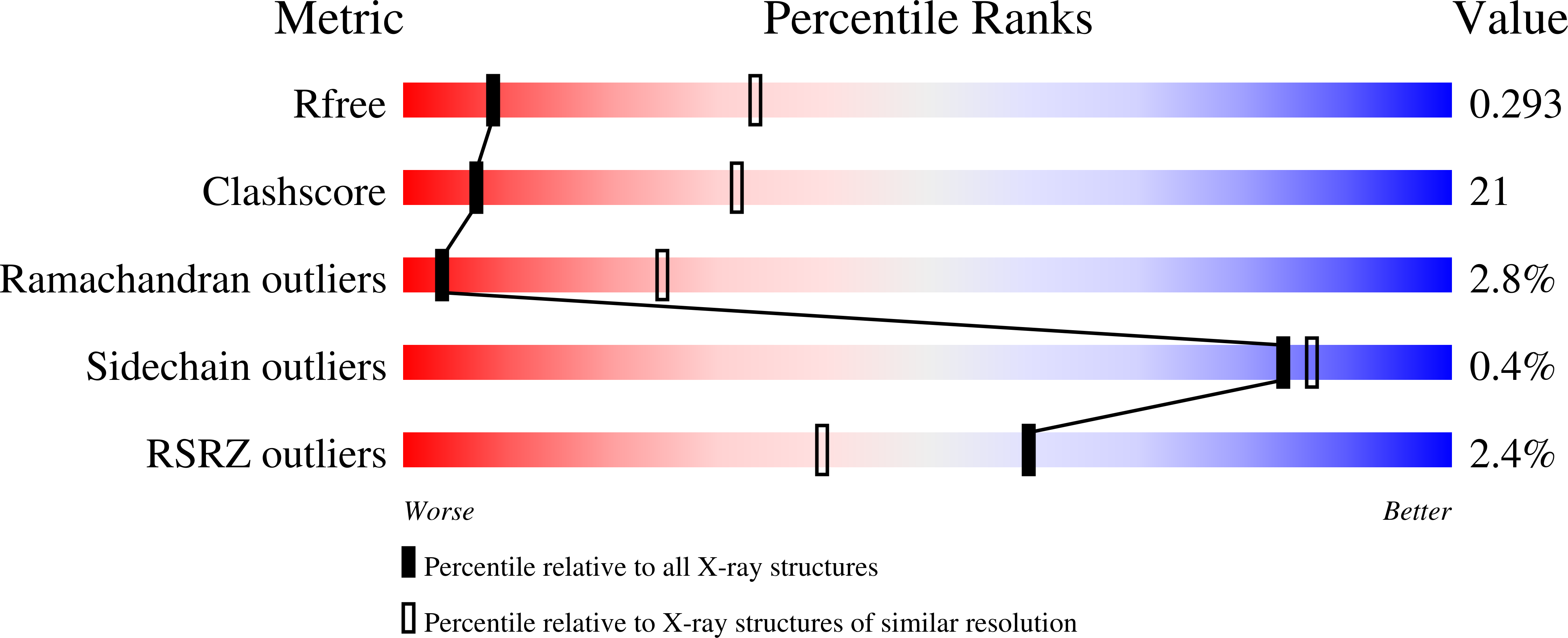
3.19 Å
R-Value Free:
0.29
R-Value Work:
0.22
R-Value Observed:
0.22
Space Group:
P 21 21 21
Macromolecular Entities
Protein Blast
Polymer Type:polypeptide(L)
Molecule:D08 IgE Fab fragment, L-chain
Chain IDs:A, C, E, G, I, K
Chain Length:216
Number of Molecules:6
Biological Source:Homo sapiens
Protein Blast
Polymer Type:polypeptide(L)
Molecule:D08 IgE Fab fragment, H-chain
Chain IDs:B, D, F, H, J, L
Chain Length:233
Number of Molecules:6
Biological Source:Homo sapiens
Structures with similar UniProt ID
Protein Blast
Polymer Type:polypeptide(L)
Molecule:Conglutin-7
Chain IDs:M (auth: X), N (auth: M)
Chain Length:152
Number of Molecules:2
Biological Source:Arachis hypogaea
Ligand Molecules
Primary Citation
Structural Basis for Trivalent Cross-Linking of a Patient-Derived IgE Antibody by the Major Peanut Allergen Ara h 2.0201.
Allergy 81 2036 2046 (2026)
PMID: 41700105 DOI: 10.1111/all.70258

Abstact

BACKGROUND: Peanut allergy is a serious form of food allergy that can lead to anaphylactic reactions. Research has shown that the Ara h 2 allergen is immunodominant and associated with fatal systemic reactions. METHODS: We determined the crystal structure of recombinant Ara h 2.0201 in a complex with the human-derived PA12P3D08 (D08) IgE Fab fragment at 3.2 A resolution. In addition, native mass spectrometry was used to study interactions of D08 with Ara h 2 and its peptides. RESULTS: The structure revealed that D08 Fab binds to a long loop of Ara h 2.0201, which contains three repeated DPYSPS motifs. The immunocomplex structure illustrated how three copies of D08 Fabs can bind simultaneously to Ara h 2.0201 in close proximity. Native mass spectrometry studies of D08 Fab with Ara h 2.0201 and peptides containing 2-3 motifs demonstrated cross-linking of Ara h 2.0201 in solution and the propensity of D08 Fab to self-associate. Motif peptides from Ara h 2.0201 highlighted the importance of proline hydroxylation for binding affinity. D08 Fab also bound to hydroxyproline-containing peptides from Ara h 1 and 3. CONCLUSIONS: The trivalent binding is effective in forming large allergen-IgE complexes on mast cell or basophil surfaces and contributes to the potency of Ara h 2 in triggering allergic reactions and highlighting its role in anaphylaxis. Proline hydroxylation considerably enhances D08 binding affinity and contributes to cross-reactivity among Ara h 1-3 allergens.

Legend

Protein

Chemical

Disease

Primary Citation of related structures
Feedback Form
Name
Email
Institute
Feedback