

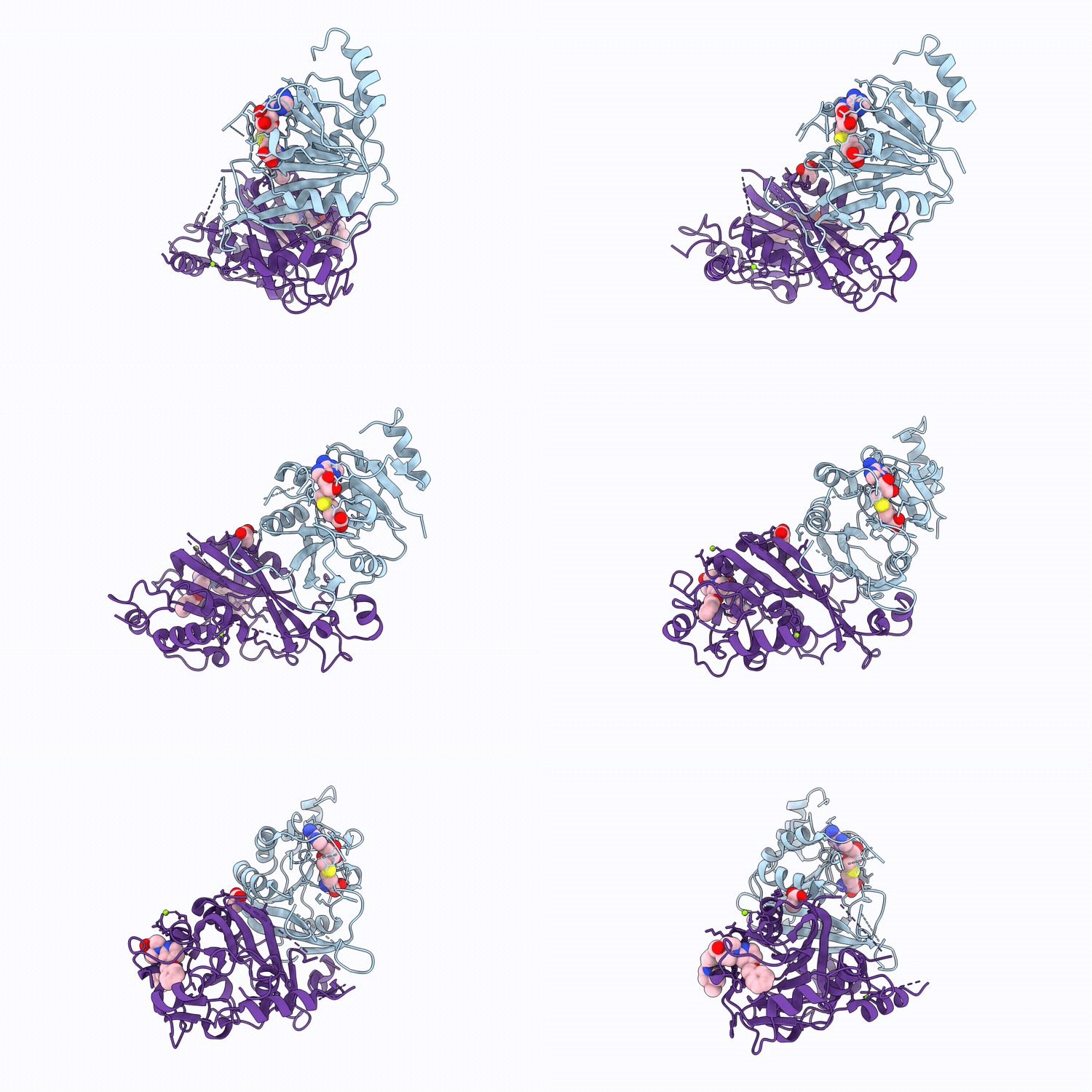
9RS3 image
Deposition Date 2025-06-30
Release Date 2026-03-18
Last Version Date 2026-04-29
Entry Detail
PDB ID:
9RS3
Keywords:
Title:
Crystal structure of the human METTL3-METTL14 in complex with compound 3
Biological Source:
Source Organism(s):
Homo sapiens (Taxon ID: 9606)
Expression System(s):
Method Details:
Experimental Method:
Resolution:
2.11 Å
R-Value Free:
0.23
R-Value Work:
0.20
R-Value Observed:
0.20
Space Group:
P 32 2 1

Macromolecular Entities
Structures with similar UniProt ID
Protein Blast
Polymer Type:polypeptide(L)
Molecule:N6-adenosine-methyltransferas
Gene (Uniprot):METTL3
Chain IDs:A
Chain Length:228
Number of Molecules:1
Biological Source:Homo sapiens
Structures with similar UniProt ID
Protein Blast
Polymer Type:polypeptide(L)
Molecule:N(6)-adenosine-methyltransfer
Gene (Uniprot):METTL14
Chain IDs:B
Chain Length:307
Number of Molecules:1
Biological Source:Homo sapiens
Primary Citation
Ligand-Induced Opening of a Cryptic Pocket in METTL14.
Acs Bio Med Chem Au 6 130 144 (2026)
PMID: 42006252 DOI: 10.1021/acsbiomedchemau.5c00184

Abstact

The complex of methyltransferase-like proteins 3 and 14 (METTL3-14) is the main human enzyme that deposits the most abundant internal mRNA modification, N(6)-methyladenosine (m(6)A). In the heterodimeric complex, METTL3 acts as a catalytic subunit while METTL14 is involved in mRNA binding and complex stabilization. Here, we present the discovery of small-molecule ligands that bind to a cryptic pocket in METTL14 by protein crystallography. A comparative analysis of crystal structures revealed that the METTL14 cryptic pocket is closed in the apo structure of METTL3-14, and in the structures of METTL3-14 in the complex with the cosubstrate S-adenosyl-methionine (SAM) and a large number of SAM-competitive inhibitors. We first discovered compounds 1 and 2 that bind to both the SAM pocket in METTL3 and the cryptic pocket in METTL14. With this structural information, we designed compound 3 that binds only to the METTL14 cryptic pocket. Compound 3 does not inhibit the catalytic activity of METTL3-14 but can be used as an anchor for heterobifunctional molecules. We propose a route for its further development into heterobifunctional ligands, e.g., proteolysis targeting chimeras (PROTACs).

Legend

Protein

Chemical

Disease

Primary Citation of related structures
Feedback Form
Name
Email
Institute
Feedback