

9RMD image
Deposition Date 2025-06-18
Release Date 2026-06-17
Last Version Date 2026-06-24
Entry Detail
PDB ID:
9RMD
Keywords:
Title:
Human MINDY3 deubiquitinase (FAM188A)
Biological Source:
Source Organism(s):
Homo sapiens (Taxon ID: 9606)
Method Details:
Experimental Method:
Resolution:
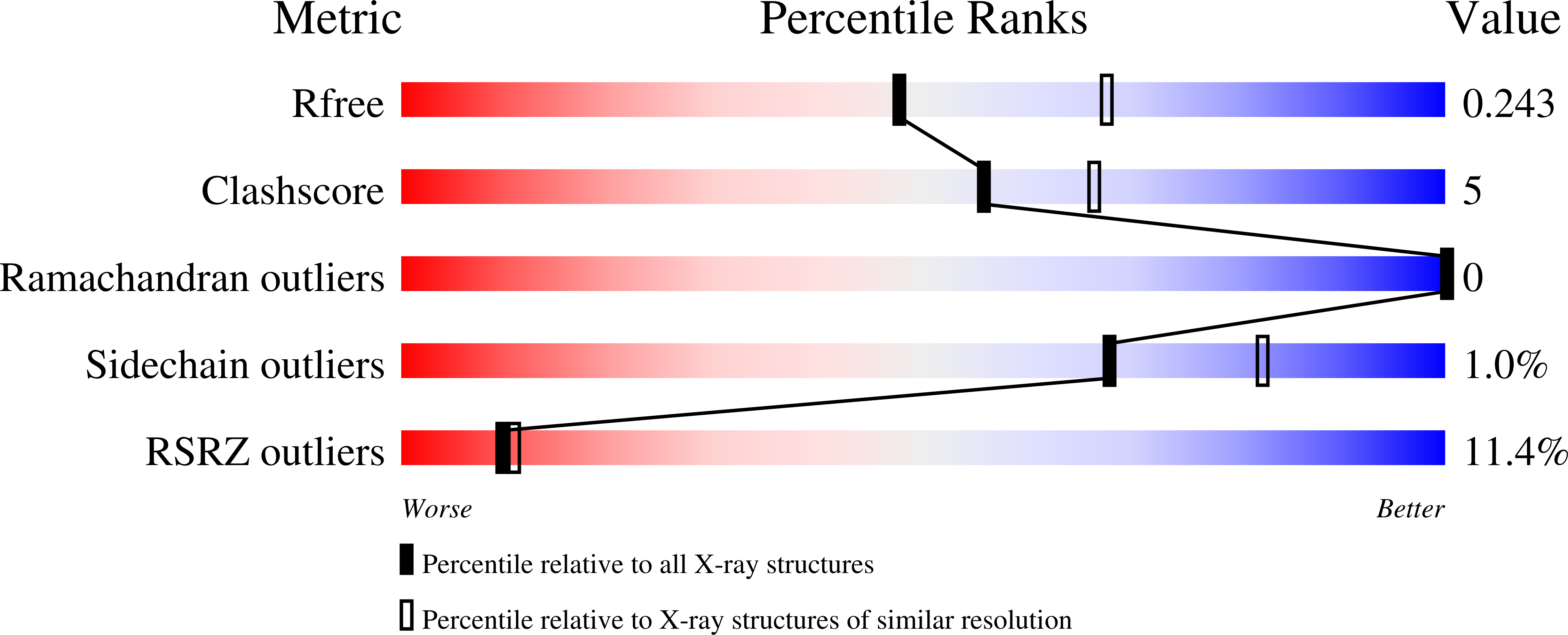
2.30 Å
R-Value Free:
0.26
R-Value Work:
0.23
R-Value Observed:
0.23
Space Group:
P 32 2 1
Macromolecular Entities
Structures with similar UniProt ID
Protein Blast
Polymer Type:polypeptide(L)
Molecule:Ubiquitin carboxyl-terminal h
Gene (Uniprot):MINDY3
Chain IDs:A
Chain Length:447
Number of Molecules:1
Biological Source:Homo sapiens
Primary Citation
The EF-hand domain of MINDY3 is a ubiquitin and RAD23 UBL-binding domain.
Embo Rep. ? ? ? (2026)
PMID: 42265305 DOI: 10.1038/s44319-026-00825-1

Abstact

The MINDY family of deubiquitinases (DUBs) are exemplified by their preference for cleaving K48-linked polyubiquitin. MINDY3 is architecturally distinct from other MINDY DUBs as its catalytic domain spans the entire length of the protein except for an atypical EF-hand insertion. We uncover this EF-hand (MINDY3(EF-hand)) to be a ubiquitin-binding domain with three distinct binding sites, enabling MINDY3 to bind and effectively cleave long polyubiquitin chains. Furthermore, the MINDY3(EF-hand) domain binds not only to polyubiquitin but also to the UBL domain of the proteasome shuttling and DNA repair factors RAD23A and RAD23B. The MINDY3(EF-hand) facilitates this interaction with RAD23s in cells and mediates MINDY3 recruitment to DNA damage sites, establishing this unique DUB as a potential regulator of cellular DNA damage responses. MINDY3 binds specifically to the UBL domain of RAD23s, and none of the other UBLs tested. The crystal structure of the MINDY3(EF-hand):RAD23A(UBL) domain complex reveals the molecular basis for specificity. We find that MINDY3 can form a ternary complex with RAD23A/B and polyubiquitin, and our findings suggest a model wherein MINDY3 can deubiquitylate RAD23A/B-bound clients.

Legend

Protein

Chemical

Disease

Primary Citation of related structures
Feedback Form
Name
Email
Institute
Feedback