

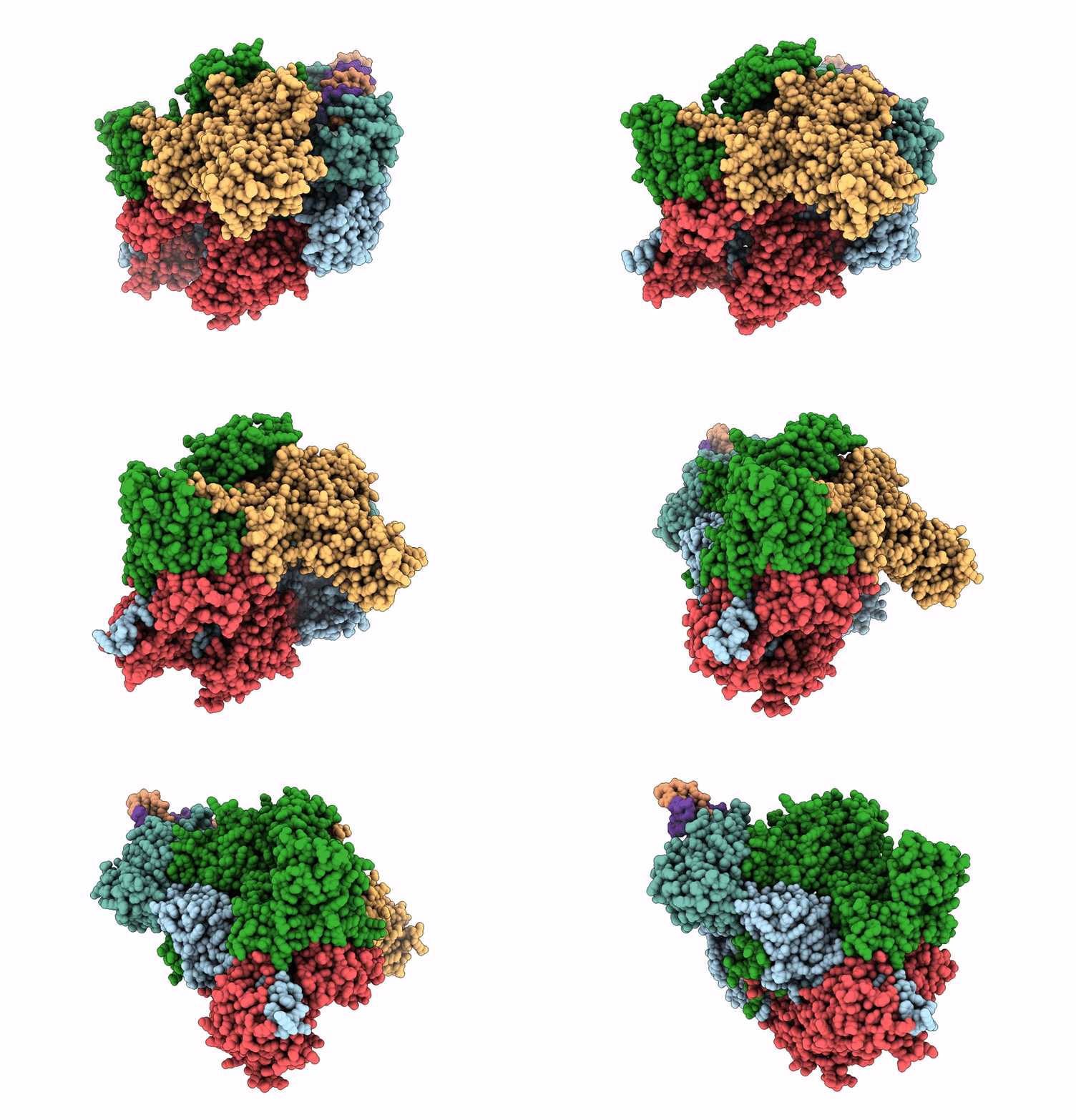
9RJS image
Deposition Date 2025-06-12
Release Date 2025-07-16
Last Version Date 2026-04-01
Entry Detail
PDB ID:
9RJS
Title:
Structure of the Bacteriophage PhiKZ non-virion RNA Polymerase bound to an analogue of its promoter
Biological Source:
Source Organism(s):
Expression System(s):
Method Details:
Experimental Method:
Resolution:
2.59 Å
Aggregation State:
PARTICLE
Reconstruction Method:
SINGLE PARTICLE
Macromolecular Entities
Protein Blast
Polymer Type:polypeptide(L)
Molecule:DNA-directed RNA polymerase,P
Chain IDs:A
Chain Length:508
Number of Molecules:1
Biological Source:Phikzvirus phiKZ
Structures with similar UniProt ID
Protein Blast
Polymer Type:polypeptide(L)
Molecule:PHIKZ068
Chain IDs:B
Chain Length:521
Number of Molecules:1
Biological Source:Phikzvirus phiKZ
Structures with similar UniProt ID
Protein Blast
Polymer Type:polypeptide(L)
Molecule:PHIKZ071
Chain IDs:C
Chain Length:700
Number of Molecules:1
Biological Source:Phikzvirus phiKZ
Structures with similar UniProt ID
Protein Blast
Polymer Type:polypeptide(L)
Molecule:PHIKZ074
Chain IDs:D
Chain Length:677
Number of Molecules:1
Biological Source:Phikzvirus phiKZ
Structures with similar UniProt ID
Protein Blast
Polymer Type:polypeptide(L)
Molecule:PHIKZ123
Chain IDs:E
Chain Length:543
Number of Molecules:1
Biological Source:Phikzvirus phiKZ
Polymer Type:polydeoxyribonucleotide
Molecule:DNA - ATGAGTAATTTTAGTGAATGTAT
Chain IDs:F (auth: X)
Chain Length:75
Number of Molecules:1
Biological Source:Phikzvirus phiKZ
Polymer Type:polydeoxyribonucleotide
Molecule:DNA - CCTATATTGTAACTTTAGGCTTT
Chain IDs:G (auth: Y)
Chain Length:75
Number of Molecules:1
Biological Source:Phikzvirus phiKZ
Ligand Molecules
Primary Citation
Structure of the bacteriophage PhiKZ non-virion RNA polymerase bound to a p119L open promoter analogue.
Iucrj 13 31 43 (2026)
PMID: 41212033 DOI: 10.1107/S2052252525009273

Abstact

Bacteriophage PhiKZ (PhiKZ) was the first identified member of a family of massive bacterial viruses. PhiKZ infects Pseudomonas aeruginosa, which kills tens of thousands every year, and it therefore has potential as a bacteriophage therapy. On infection, PhiKZ forms a ;nucleus' to protect its genome by excluding host immune systems. This barrier means that it has had to become independent of the host transcriptional apparatus; it cannot simply recruit the host RNA polymerase (RNAP) to its promoters as it is excluded from the viral DNA, and therefore it expresses and imports its own non-virion RNA polymerase (nvRNAP). The PhiKZ nvRNAP, and related jumbo-phage RNAPs including that from bacteriophage AR9, are particularly noteworthy. Unlike typical viral RNAPs which are formed as only a single subunit, it is a non-canonical multi-subunit RNAP directly related to those from eubacteria, and more distantly eukaryotes and archaea. It encompasses four proteins representing patchwork homologues of the eubacterial beta/beta' subunits, and a fifth that appears to have evolved from a sigma factor, but no homologues of the alpha or omega subunits required for formation of a catalytically active complex in eubacterial RNAPs. Its mechanism of promoter recognition is also highly divergent; transcription is initiated from a site marked only by a tiny four-base consensus sequence co-located with the start site. We have resolved the structure of the PhiKZ nvRNAP bound to an open analogue of its cognate promoter, p119L, revealing that while the sigma-factor-like subunit GP68 is involved in bubble stabilization, the sequence-specific promoter consensus sequence is bound between the lobe of the beta-subunit homologue GP123 and the enzymatic core of the complex. Our results shed light on the differences between mechanisms of promoter recognition in the PhiKZ nvRNAP and canonical eubacterial RNAPs, and on the uniquely specialized features of bacteriophage transcriptional apparatuses in general.

Legend

Protein

Chemical

Disease

Primary Citation of related structures
Feedback Form
Name
Email
Institute
Feedback