

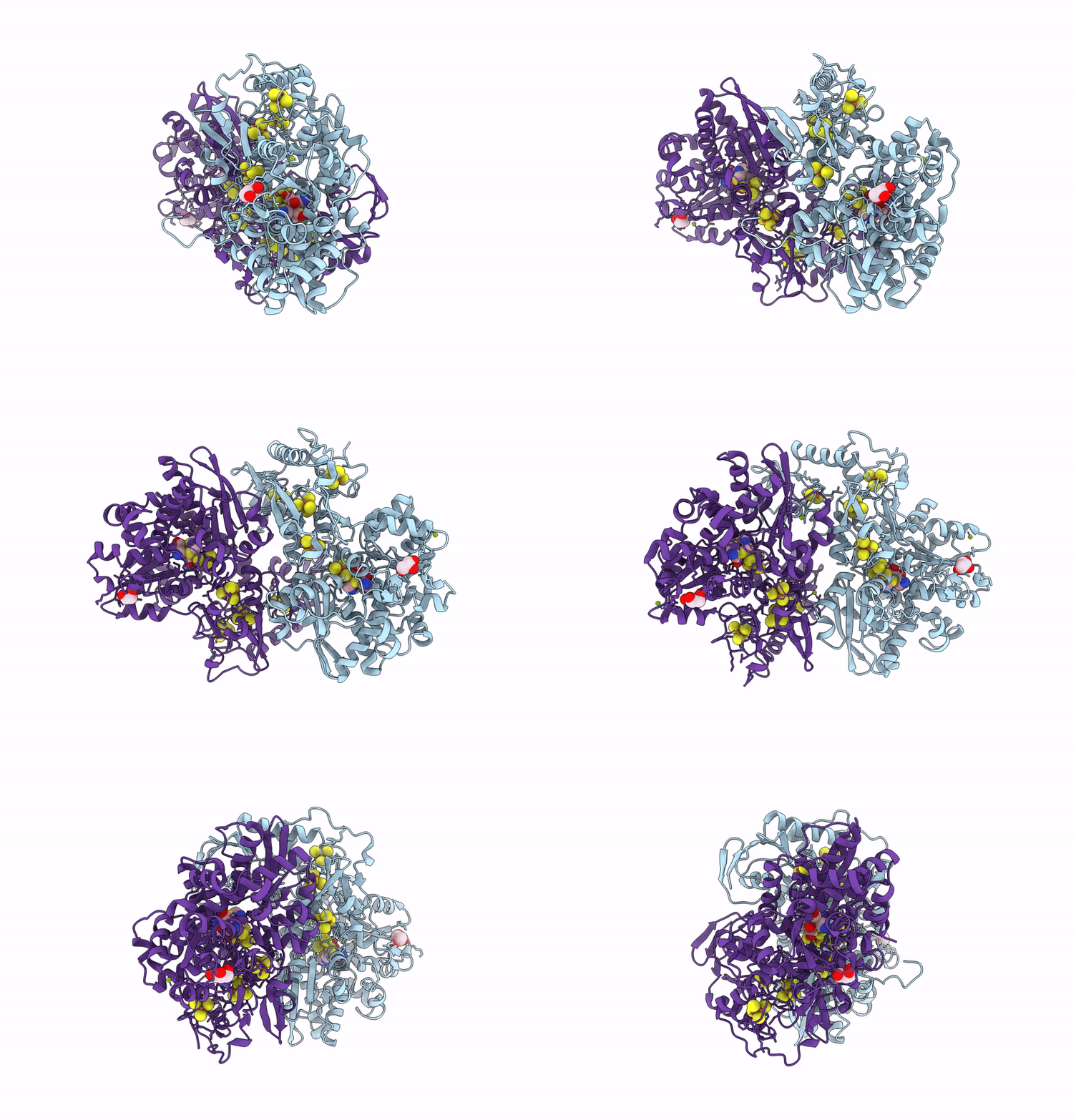
9RJO image
Deposition Date 2025-06-12
Release Date 2026-03-04
Last Version Date 2026-04-01
Entry Detail
PDB ID:
9RJO
Keywords:
Title:
[FeFe]-hydrogenase CpI from Clostridium pasteurianum, variant N160L-Q195L
Biological Source:
Source Organism(s):
Expression System(s):
Method Details:
Experimental Method:
Resolution:
1.67 Å
R-Value Free:
0.20
R-Value Work:
0.17
R-Value Observed:
0.17
Space Group:
P 1 21 1
Macromolecular Entities
Structures with similar UniProt ID
Protein Blast
Polymer Type:polypeptide(L)
Molecule:Iron hydrogenase 1
Chain IDs:A, B
Chain Length:584
Number of Molecules:2
Biological Source:Clostridium pasteurianum
Primary Citation
A Zundel ion in the catalytic proton transfer pathway of [FeFe]-hydrogenase.
Phys Chem Chem Phys 28 7101 7110 (2026)
PMID: 41774038 DOI: 10.1039/d5cp04267d

Abstact

[FeFe]-hydrogenases are metalloenzymes that catalyze the interconversion of protons, electrons, and molecular hydrogen (H(2)). Their active site cofactor consists of a [4Fe-4S] cluster ([4Fe](H)) and a diiron site ([2Fe](H)), forming the so-called H-cluster. In this work, the putative regulatory proton transfer pathway (PTP) toward the [4Fe](H) cluster of [FeFe]-hydrogenase CpI from Clostridium pasteurianum is characterized by X-ray crystallography, infrared spectroscopy, and quantum mechanical (QM) calculations. The trajectory consists of asparagine N160, glutamine Q195, and several protein-bound water molecules that might function as a PTP toward cysteine C499 at the [4Fe](H) cluster. We have hypothesized that protonation of C499 determines the H-cluster intermediate H(ox)H (M. Senger et al., Phys. Chem. Chem. Phys., 2018, 20, 3128-3140). The crystal structures of protein variants N160L and Q195L now confirm that the putative regulatory PTP is disrupted. However, infrared spectroscopy reveals that all variants accumulate the H(ox)H state in a manner comparable to wild-type CpI. In contrast, the CpI variant E279D - previously shown to target the catalytic PTP toward [2Fe](H) - is found to enrich the H(ox)H state independently of reducing agents. This indicates that the determinants of H(ox)H are located in the catalytic PTP, which emphasizes the importance of H(ox)H during catalysis and provides evidence against any involvement of the putative regulatory PTP in hydrogen turnover. Supported by QM calculations, a model is proposed in which a conserved water cluster adjacent to E279 is protonated to form a Zundel ion (H(5)O(2)(+)). Our results paint a new picture of the H-cluster in the H(ox)H state and yield important insight into the catalytic mechanism of [FeFe]-hydrogenases.

Legend

Protein

Chemical

Disease

Primary Citation of related structures
Feedback Form
Name
Email
Institute
Feedback