

9RIW image
Deposition Date 2025-06-11
Release Date 2026-04-08
Last Version Date 2026-10-21
Entry Detail
PDB ID:
9RIW
Keywords:
Title:
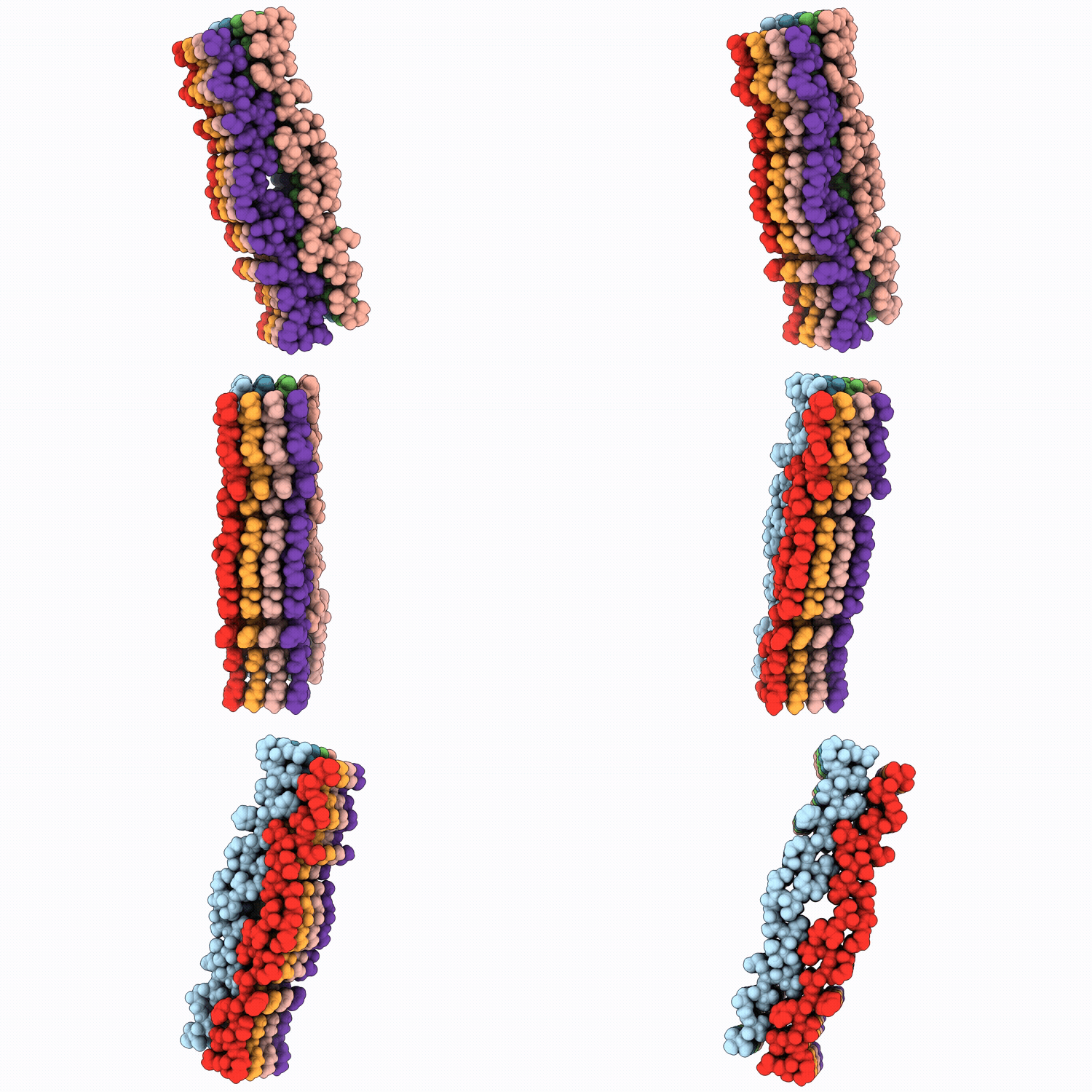
Population A fibril generated from the Heterotypic interaction of Abeta40 and Medin.
Biological Source:
Source Organism(s):
Homo sapiens (Taxon ID: 9606)
Expression System(s):
Method Details:
Experimental Method:
Resolution:
3.10 Å
Aggregation State:
FILAMENT
Reconstruction Method:
HELICAL
Macromolecular Entities
Polymer Type:polypeptide(L)
Molecule:Amyloid-beta protein 40
Gene (Uniprot):APP
Chain IDs:A (auth: B), B (auth: A), C, D, E, F, G, H
Chain Length:40
Number of Molecules:8
Biological Source:Homo sapiens
Ligand Molecules
Primary Citation
Atomic structures of medin and A beta fibrils reveal polymorphic remodeling in mixed amyloid systems.
Nat Commun 17 ? ? (2026)
PMID: 42045275 DOI: 10.1038/s41467-026-72515-4

Abstact

Amyloid assembly in vivo occurs in complex environments where multiple aggregation-prone species coexist. Abeta and medin are prevalent amyloids in ageing humans that co-localize in cerebral amyloid angiopathy (CAA), yet their structural interactions remain poorly understood. Here, using cryo-electron microscopy, we determine high-resolution fibril structures from in vitro mixtures of Abeta40 and medin. From the same reaction, we resolve three distinct fibril populations: (i) a previously characterized Abeta40 polymorph that also forms in isolation, (ii) a Abeta40 polymorph with Abeta42-like features, including ordered N- and C-terminal regions, and (iii) the atomic structure of full-length medin fibrils. Biochemical and immunogold analyses demonstrate Abeta-medin association within mixed assemblies, though medin is not resolved within the ordered Abeta core. These findings support two non-exclusive mechanisms: transient heterotypic interactions redirecting Abeta folding, or partial medin incorporation into fibril architecture. Our data reveal how coexisting amyloids remodel each other's polymorphic landscapes.

Legend

Protein

Chemical

Disease

Primary Citation of related structures
Feedback Form
Name
Email
Institute
Feedback