

9RFN image
Deposition Date 2025-06-04
Release Date 2026-04-29
Last Version Date 2026-04-29
Entry Detail
PDB ID:
9RFN
Keywords:
Title:
Structure of protein kinase CK2alpha mutant E264D associated with the Okur-Chung Neurodevelopmental Syndrome
Biological Source:
Source Organism(s):
Homo sapiens (Taxon ID: 9606)
Expression System(s):
Method Details:
Experimental Method:
Resolution:
2.58 Å
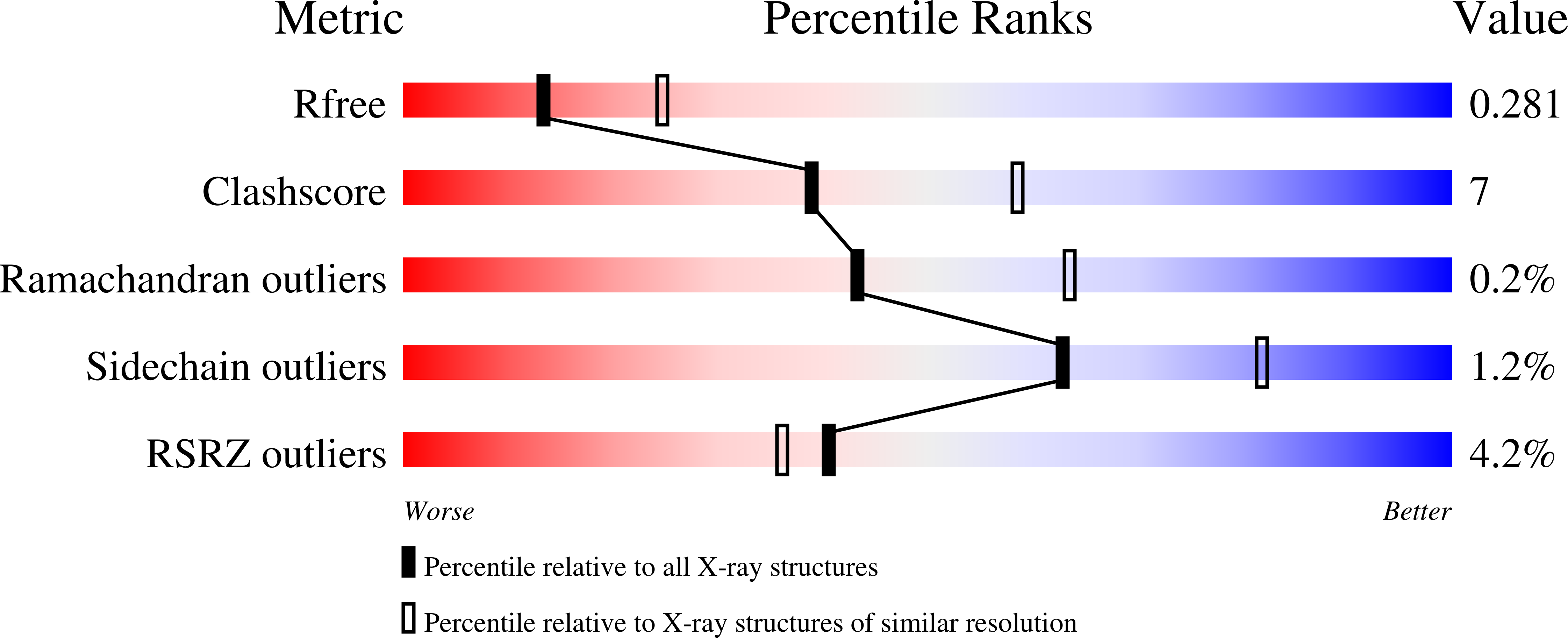
R-Value Free:
0.27
R-Value Work:
0.24
R-Value Observed:
0.24
Space Group:
P 43 21 2
Macromolecular Entities
Structures with similar UniProt ID
Protein Blast
Polymer Type:polypeptide(L)
Molecule:Casein kinase II subunit alph
Gene (Uniprot):CSNK2A1
Mutagens:E264D
Chain IDs:A, B
Chain Length:411
Number of Molecules:2
Biological Source:Homo sapiens
Primary Citation
Functional characterization of 42 CK2 alpha de novo variants associated with Okur-Chung neurodevelopmental syndrome.
Febs J. ? ? ? (2026)
PMID: 41978434 DOI: 10.1111/febs.70538

Abstact

In 2016, CSNK2A1, the gene which encodes the catalytic alpha-subunit of human protein kinase CK2 was linked to an autism spectrum disorder called Okur-Chung neurodevelopmental syndrome (OCNDS) for the first time. Human protein kinase CK2 is a heterotetrameric phosphotransferase with an alpha(2)beta(2) composition. To gain more insight into genotype-phenotype relationships, 42 CK2alpha variants associated with OCNDS were characterized in this study in terms of enzymatic activity using a canonical CK2 peptide substrate. Out of the 42 variants tested, 13 had no detectable enzymatic activity and 12 showed less than 10% of wild-type CK2alpha activity. The addition of the regulatory CK2beta subunit increased the activity of all active variants. Twelve variants that exhibited at least 30% wild-type enzymatic activity were chosen to determine the dissociation constants with CK2beta; highlighting that none of these mutations had an impact on the interaction of CK2alpha with CK2beta. The variants R21Q, T127M, E264D, E282K, and R333* showed no reduced activity in comparison to wild-type CK2alpha. Additionally, affinity to CK2beta and thermostability remained unaltered. K198R is the most frequent missense variant observed in OCNDS patients; thus, we performed a site-saturation mutagenesis at position K198 to elucidate what impact other variants at this position could have on enzymatic activity. Results showed that replacement of K198 by any other amino acid resulted in similar loss of activity as the prevalent K198R variant. The presented results suggest that other parameters beyond enzymatic activity, CK2beta affinity or thermostability may contribute to neurodevelopmental disorders such as OCNDS.

Legend

Protein

Chemical

Disease

Primary Citation of related structures
Feedback Form
Name
Email
Institute
Feedback