

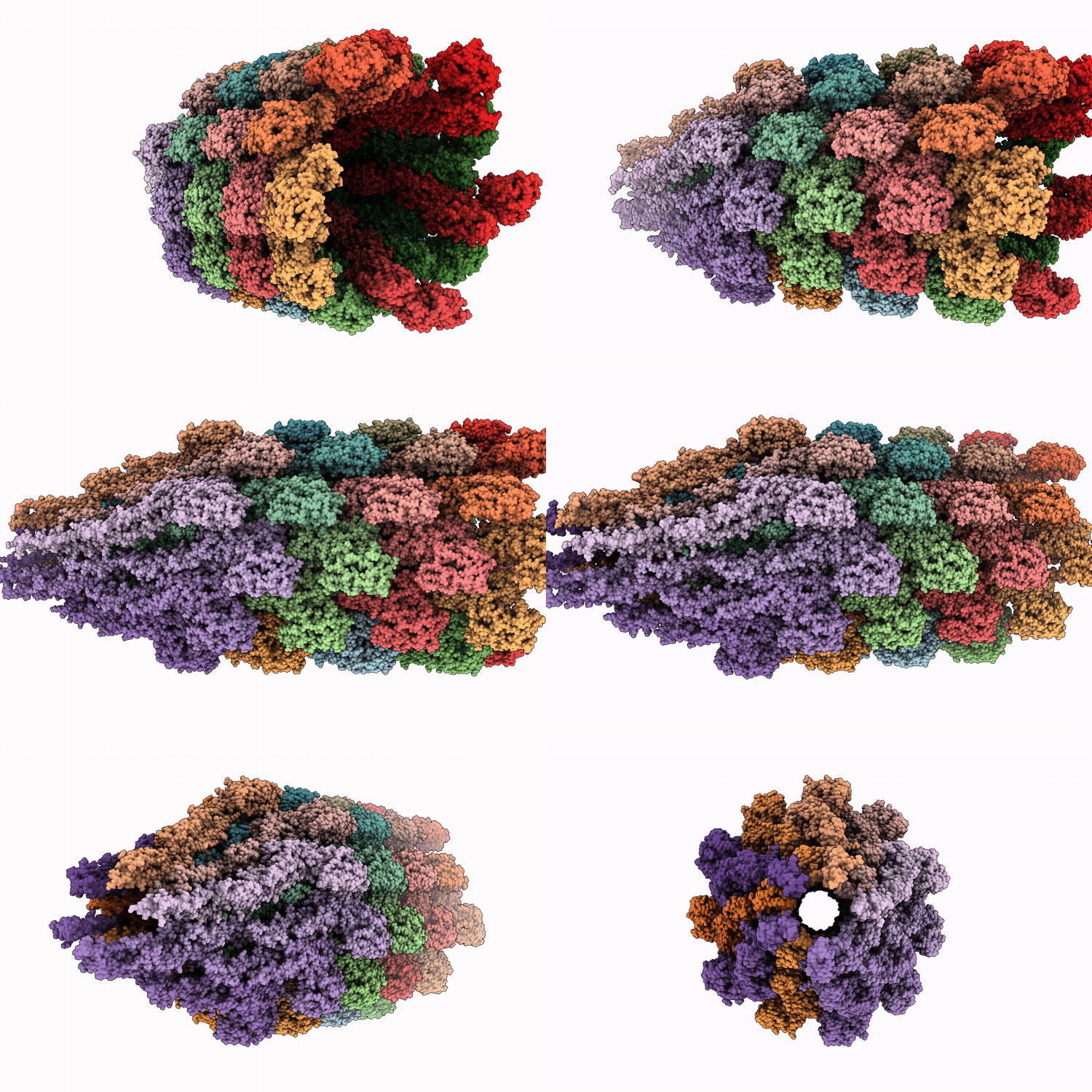
9RCB image
Deposition Date 2025-05-27
Release Date 2026-04-15
Last Version Date 2026-05-06
Entry Detail
PDB ID:
9RCB
Title:
Unsheathed flagellar filament in Vibrio alginolyticus
Biological Source:
Source Organism(s):
Method Details:
Experimental Method:
Resolution:
3.10 Å
Aggregation State:
FILAMENT
Reconstruction Method:
SINGLE PARTICLE

Macromolecular Entities
Structures with similar UniProt ID
Protein Blast
Polymer Type:polypeptide(L)
Molecule:Flagellin
Gene (Uniprot):flaB
Chain IDs:A, B, C, D, E, F, G, H, I, J, K, L, M, N, O, P, Q, R, S, T, U, V, W (auth: X), X (auth: Z), Y (auth: b), Z (auth: c), AA (auth: d), BA (auth: e), CA (auth: f), DA (auth: g), EA (auth: h), FA (auth: i), GA (auth: j), HA (auth: k), IA (auth: l), JA (auth: m), KA (auth: n), LA (auth: o), MA (auth: p), NA (auth: q), OA (auth: r), PA (auth: s), QA (auth: u), RA (auth: w)
Chain Length:377
Number of Molecules:44
Biological Source:Vibrio alginolyticus
Ligand Molecules
Primary Citation
The structure of the Vibrio alginolyticus flagellar filament suggests molecular mechanism for the rotation of sheathed flagella.
Nat Commun 17 ? ? (2026)
PMID: 42026045 DOI: 10.1038/s41467-026-71203-7

Abstact

In several pathogenic bacteria, including Vibrio species, the filament of the bacterial flagellum is encased by a membranous sheath, an extension of the bacterial outer membrane. It has been proposed that having sheathed flagella permit bacteria to evade an immune response against flagellar components, suggesting a role in virulence. However, the molecular details of the interaction between sheath and filament, and how it impacts filament rotation, remain largely uncharacterized. Here, we combine single-particle cryo-electron microscopy, cryo-electron tomography, and genetic analyses to resolve the molecular architecture and biogenesis of the sheathed flagellum in Vibrio alginolyticus. We show that the flagellar filament forms a canonical 11-stranded supercoil made of the flagellin FlaD2 and enveloped by a bilayered sheath. We report that the filament surface is highly electronegative, suggesting that electrostatic repulsion between filament and sheath may reduce friction and supports high-speed flagellar rotation. We also show that the filament cap protein FliD possesses a unique domain in sheathed flagella, that may coordinate sheath assembly with filament elongation. Collectively, this structural insight into the structure of the Vibrio alginolyticus flagellum suggests a molecular mechanism for the rotation of sheathed flagella.

Legend

Protein

Chemical

Disease

Primary Citation of related structures
Feedback Form
Name
Email
Institute
Feedback