

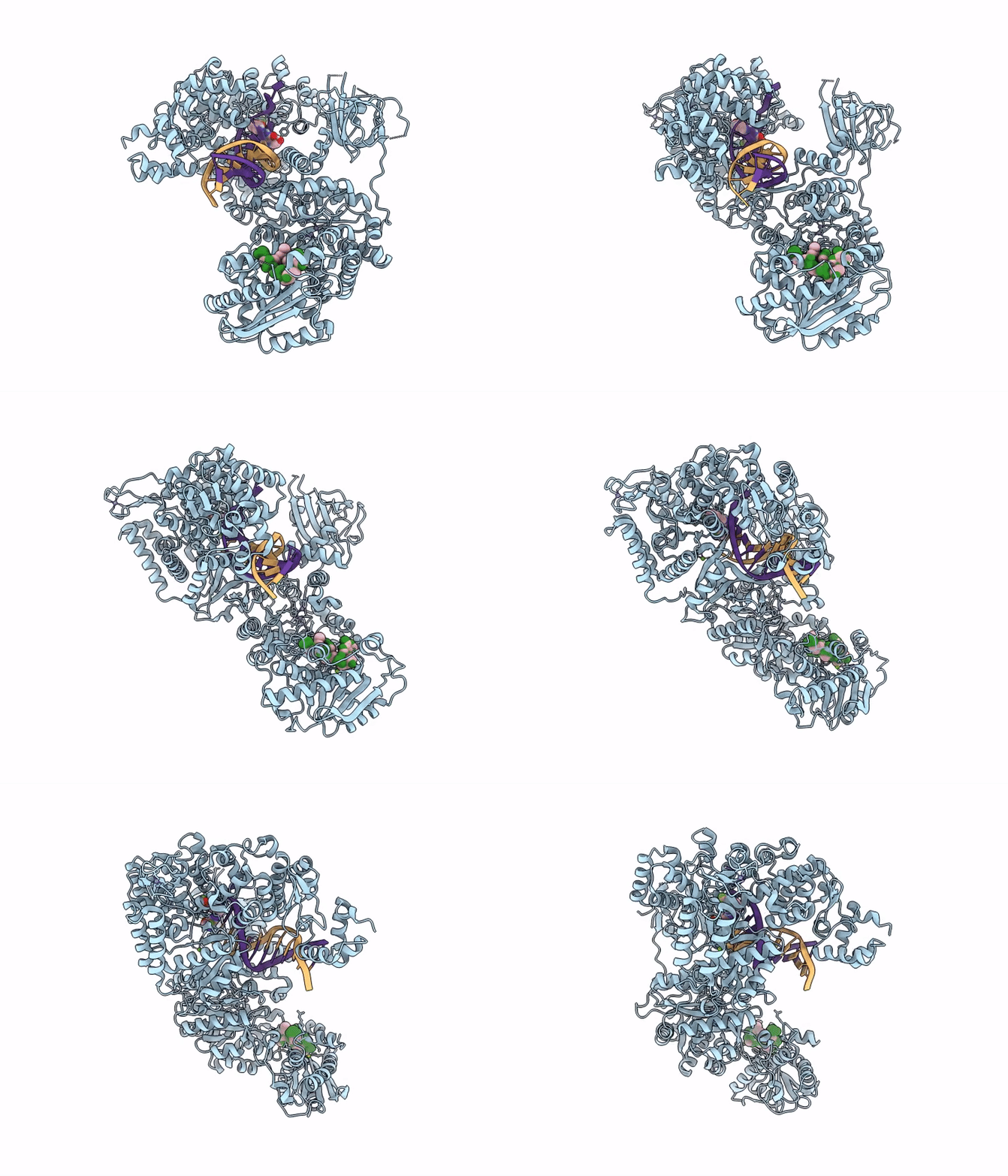
9QPC image
Deposition Date 2025-03-26
Release Date 2025-09-24
Last Version Date 2026-04-08
Entry Detail
PDB ID:
9QPC
Title:
DNA polymerase with inhibitor
Biological Source:
Source Organism(s):
Expression System(s):
Method Details:
Experimental Method:
Resolution:
2.80 Å
Aggregation State:
PARTICLE
Reconstruction Method:
SINGLE PARTICLE

Macromolecular Entities
Structures with similar UniProt ID
Protein Blast
Polymer Type:polypeptide(L)
Molecule:DNA polymerase III PolC-type
Mutagens:D431A, E433A
Chain IDs:A
Chain Length:1474
Number of Molecules:1
Biological Source:Enterococcus faecium
Polymer Type:polydeoxyribonucleotide
Molecule:DNA (5'-D(P*TP*AP*A)-3')
Chain IDs:B (auth: E)
Chain Length:3
Number of Molecules:1
Biological Source:Escherichia coli
Polymer Type:polydeoxyribonucleotide
Molecule:DNA (5'-D(P*TP*AP*GP*GP*TP*GP
Chain IDs:C (auth: P)
Chain Length:33
Number of Molecules:1
Biological Source:Escherichia coli
Polymer Type:polydeoxyribonucleotide
Molecule:DNA (5'-D(P*CP*CP*AP*TP*GP*CP
Chain IDs:D (auth: T)
Chain Length:42
Number of Molecules:1
Biological Source:Escherichia coli
Primary Citation
A unique inhibitor conformation selectively targets the DNA polymerase PolC of Gram-positive priority pathogens.
Nat Commun 16 9784 9784 (2025)
PMID: 41198680 DOI: 10.1038/s41467-025-65324-8

Abstact

Infections with antimicrobial resistant pathogens are a major threat to human health. Inhibitors of the replicative polymerase PolC are a promising novel class of antimicrobials against Gram-positive pathogens, but the structural basis for their activity remains unknown. The first-in-class PolC-targeting antimicrobial, ibezapolstat, is a guanine analogue in late-stage clinical development for the treatment of Clostridioides difficile infections, and related inhibitors are being developed for systemic treatment of infections with methicillin-resistant Staphylococcus aureus (MRSA) and vancomycin-resistant enterococci (VRE). Here, we present the cryo-electron microscopy structures of Enterococcus faecium PolC bound to DNA and in complex with ibezapolstat or the previously-undescribed inhibitor ACX-801. Both inhibitors form base-pairing interactions with the DNA in the active site, thereby competing with incoming dGTP nucleotides. We identify a crucial susceptibility determinant in PolC that is conserved in other organisms, such as C. difficile. This is explained by an unusual non-planar conformation of the inhibitors that induce a binding pocket in PolC. By combining structural, biochemical, bioinformatic and genetic analyses, this work lays the foundation for the rational development of an innovative class of antimicrobials against Gram-positive priority pathogens.

Legend

Protein

Chemical

Disease

Primary Citation of related structures
Feedback Form
Name
Email
Institute
Feedback