

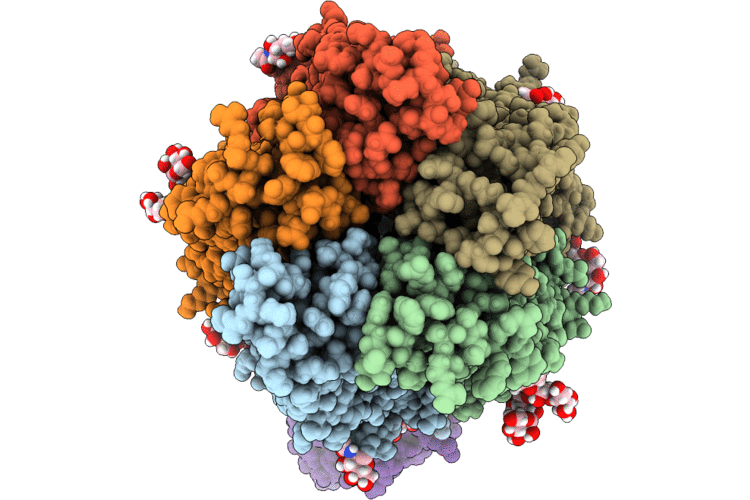
9QJP image
Deposition Date 2025-03-19
Release Date 2026-08-26
Last Version Date 2026-08-26
Entry Detail
PDB ID:
9QJP
Title:
GABA-A receptor a3b3g2 + a3NB83(PAM) + GABA
Biological Source:
Source Organism(s):
Homo sapiens (Taxon ID: 9606)
Escherichia coli (Taxon ID: 562)
Lama glama (Taxon ID: 9844)
Expression System(s):
Method Details:
Experimental Method:
Resolution:
3.22 Å
Aggregation State:
PARTICLE
Reconstruction Method:
SINGLE PARTICLE
Macromolecular Entities
Polymer Type:polypeptide(L)
Molecule:Gamma-aminobutyric acid recep
Gene (Uniprot):GABRA3
Chain IDs:A, D
Chain Length:382
Number of Molecules:2
Biological Source:Homo sapiens
Polymer Type:polypeptide(L)
Molecule:Gamma-aminobutyric acid recep
Gene (Uniprot):GABRB3
Chain IDs:B, E
Chain Length:451
Number of Molecules:2
Biological Source:Homo sapiens, Escherichia coli
Polymer Type:polypeptide(L)
Molecule:Gamma-aminobutyric acid recep
Gene (Uniprot):GABRG2
Chain IDs:C
Chain Length:371
Number of Molecules:1
Biological Source:Homo sapiens
Polymer Type:polypeptide(L)
Molecule:a3NB83
Chain IDs:F
Chain Length:137
Number of Molecules:1
Biological Source:Lama glama
Primary Citation

Abstact

gamma-Aminobutyric acid type-A (GABA(A)) receptors are the principal mediators of inhibitory neurotransmission in the human central nervous system. The alpha(2)- and alpha(3)-containing subtypes have tightly controlled spatial expression profiles, which influence anxiety, nociception, epilepsy, and autism. alpha(2)/alpha(3)-Selective small molecules compromise on strength of effect (efficacy) to avoid off-subtype modulation. To break this pharmacological deadlock, we study here a panel of nanobodies (NBs) raised against alpha(2)- and alpha(3)-containing GABA(A) receptors. We identify subtype selective silent binders, positive allosteric modulators (PAMs), and inhibitors. Cryo-electron microscopy structures explain the binding modes and molecular mechanisms of action of representative NBs. Modulators exhibit distinct synaptic and extrasynaptic functional profiles in brain slices and neuronal networks and can reduce anxiety in vivo. These selective and efficacious NBs (whether inhibitors or positive modulators) enable strong yet precise pharmacological control of alpha(2)/alpha(3)-containing subtypes to advance basic research and as potential therapeutic leads to treat neuropsychiatric disorders.

Legend

Protein

Chemical

Disease

Primary Citation of related structures
Feedback Form
Name
Email
Institute
Feedback