

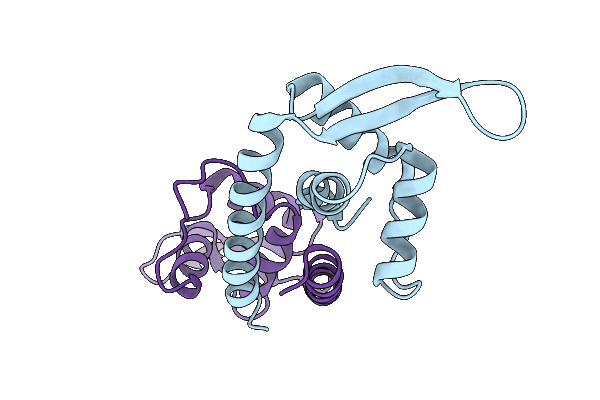
9QBD image
Deposition Date 2025-03-02
Release Date 2026-03-11
Last Version Date 2026-05-13
Entry Detail
PDB ID:
9QBD
Title:
Crystal structure of Brachyspira hampsonii PadR with Leu88 replaced by 3-aminotyrosine
Biological Source:
Source Organism(s):
Expression System(s):
Method Details:
Experimental Method:
Resolution:
2.10 Å
R-Value Free:
0.24
R-Value Work:
0.21
R-Value Observed:
0.21
Space Group:
P 43 21 2

Macromolecular Entities
Structures with similar UniProt ID
Protein Blast
Polymer Type:polypeptide(L)
Molecule:PadR-family transcriptional r
Chain IDs:A, B
Chain Length:124
Number of Molecules:2
Biological Source:Brachyspira hampsonii
Primary Citation
Exploring PadR Proteins for Artificial Enzyme Design.
Chembiochem 27 e70308 e70308 (2026)
PMID: 42047317 DOI: 10.1002/cbic.70308

Abstact

The development of artificial enzymes through incorporation of new-to-nature catalytic functionality into protein scaffolds has emerged as a powerful approach to expand the biocatalytic repertoire. Inspired by the success of Lactococcal multidrug resistance regulator (LmrR), a transcriptional regulator protein, whose unique scaffold has been used for the design of a range of artificial enzymes, we performed a bioinformatics study in an effort to expand the scope of protein scaffolds for artificial enzyme design with other LmrR-like proteins. LmrR belongs to the phenolic acid decarboxylase transcriptional regulator (PadR) subfamily 2 (PadR-s2) and exhibits an unusual open pore with promiscuous binding capabilities. Using genome mining and homology modeling, we identified six previously uncharacterized PadR-s2 proteins and experimentally evaluated them as protein scaffolds for the design of artificial Friedel-Crafts (FC) alkylases. Two of the candidates, Lactococcus fujiensis (LCf) PadR and Brachyspirahampsonii (Bh) PadR, could be applied in the iminium-promoted FC-alkylation using genetically incorporated noncanonical amino acids p-aminophenylalanine or 3-aminotyrosine as catalytic residues. Interestingly, contrary to homology models, AlphaFold predictions of the PadR-s2 candidates and X-ray crystallography of BhPadR and a variant incorporating 3-aminotyrosine revealed closed-pore structures. Our findings thus demonstrate that an open-pore structure like LmrR is not a prerequisite for designing artificial FC-alkylases and introduce two new PadR-s2 scaffolds for future application.

Legend

Protein

Chemical

Disease

Primary Citation of related structures
Feedback Form
Name
Email
Institute
Feedback