

9Q6Y image
Deposition Date 2025-08-22
Release Date 2026-03-25
Last Version Date 2026-10-07
Entry Detail
PDB ID:
9Q6Y
Keywords:
Title:
Human Serum Albumin in complex with four nanobodies: N33, nb139 & nb104
Biological Source:
Source Organism(s):
Homo sapiens (Taxon ID: 9606)
Lama glama (Taxon ID: 9844)
Expression System(s):
Method Details:
Experimental Method:
Resolution:
3.80 Å
Aggregation State:
PARTICLE
Reconstruction Method:
SINGLE PARTICLE
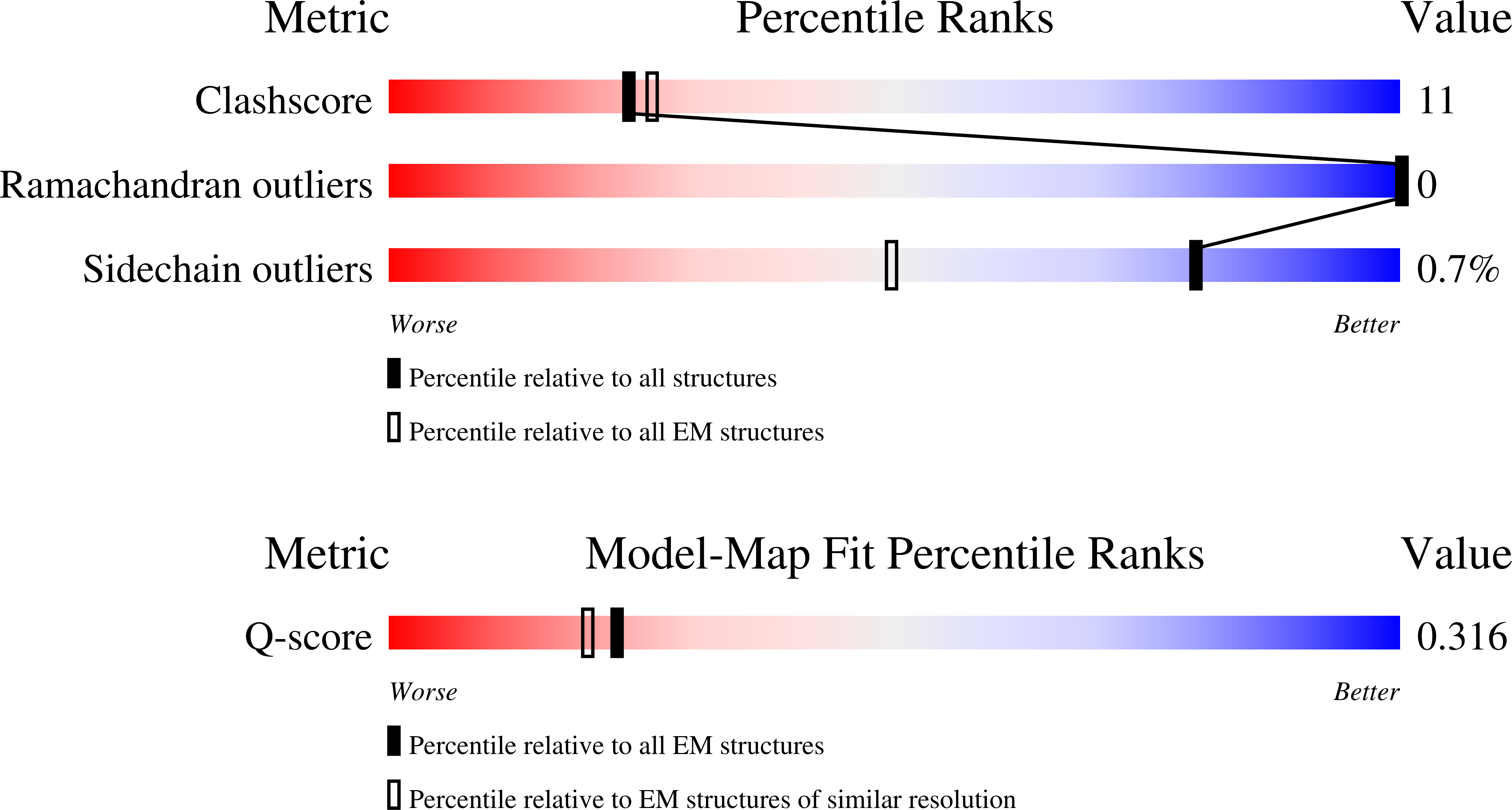
Macromolecular Entities
Polymer Type:polypeptide(L)
Molecule:Serum albumin
Gene (Uniprot):ALB
Chain IDs:A
Chain Length:585
Number of Molecules:1
Biological Source:Homo sapiens
Polymer Type:polypeptide(L)
Molecule:N33
Chain IDs:B
Chain Length:131
Number of Molecules:1
Biological Source:Lama glama
Polymer Type:polypeptide(L)
Molecule:nb139
Chain IDs:C
Chain Length:125
Number of Molecules:1
Biological Source:Lama glama
Polymer Type:polypeptide(L)
Molecule:nb194
Chain IDs:D (auth: E)
Chain Length:126
Number of Molecules:1
Biological Source:Lama glama
Ligand Molecules
Primary Citation
Repertoire-scale antibody structural prediction informs therapeutic design.
Sci Adv 12 eaef7163 eaef7163 (2026)
PMID: 42030385 DOI: 10.1126/sciadv.aef7163

Abstact

We present AF3-TurboAb, a scalable framework that makes a repertoire-scale antibody-antigen complex structural decoding routine for antibody engineering. By eliminating preprocessing bottlenecks, AF3-TurboAb enables end-to-end complex modeling in 0.5 minutes per seed on a single GPU while preserving near-experimental interface fidelity, as validated on ~1000 posttraining Protein Data Bank (PDB) benchmarks and 12 experimentally determined cryo-electron microscopy nanobody-antigen structures. Applying this capability to 275,371 immunization-derived antigen-specific nanobodies produced 28,013 high-confidence complex predictions, substantially expanding the structural landscape of antibody recognition. The resulting atlas reveals hundreds of previously unmapped epitopes, extensive coverage of solvent-exposed surfaces, and recurrent affinity hotspots enriched in aromatic and charged residues. Despite wide sequence diversity, we observe structural convergence at shared epitopes and consistent physicochemical and geometric features that complement and extend existing PDB entries. We demonstrate translational utility by (i) designing durable (escape-proof), multiepitope neutralizers against highly evolved viruses, (ii) identifying cross-species and glycoform-specific binders to a cancer checkpoint, and (iii) enabling near-real-time in silico binder triage. The models and metadata will be shared for community use, establishing repertoire-scale structural decoding as a practical design modality that transforms the scale and speed of structure-guided antibody engineering.

Legend

Protein

Chemical

Disease

Primary Citation of related structures
Feedback Form
Name
Email
Institute
Feedback