

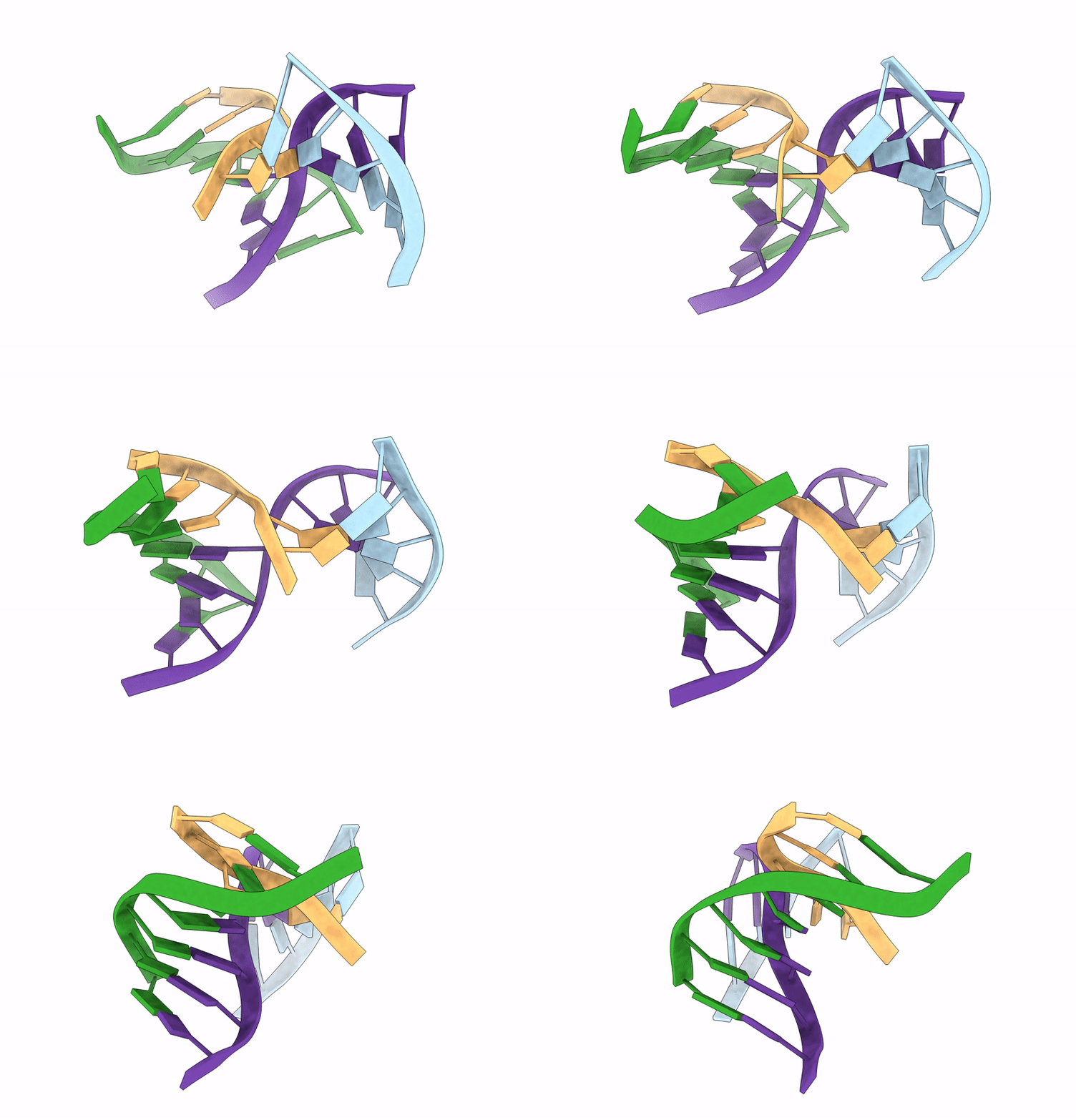
9Q5J image
Deposition Date 2025-08-20
Release Date 2025-12-03
Last Version Date 2026-05-13
Entry Detail
PDB ID:
9Q5J
Keywords:
Title:
[12-5B G|A] 12 bp tensegrity triangle that propagates via blunt-end stacking with G stacking on A at the interface
Biological Source:
Source Organism(s):
Method Details:
Experimental Method:
Resolution:
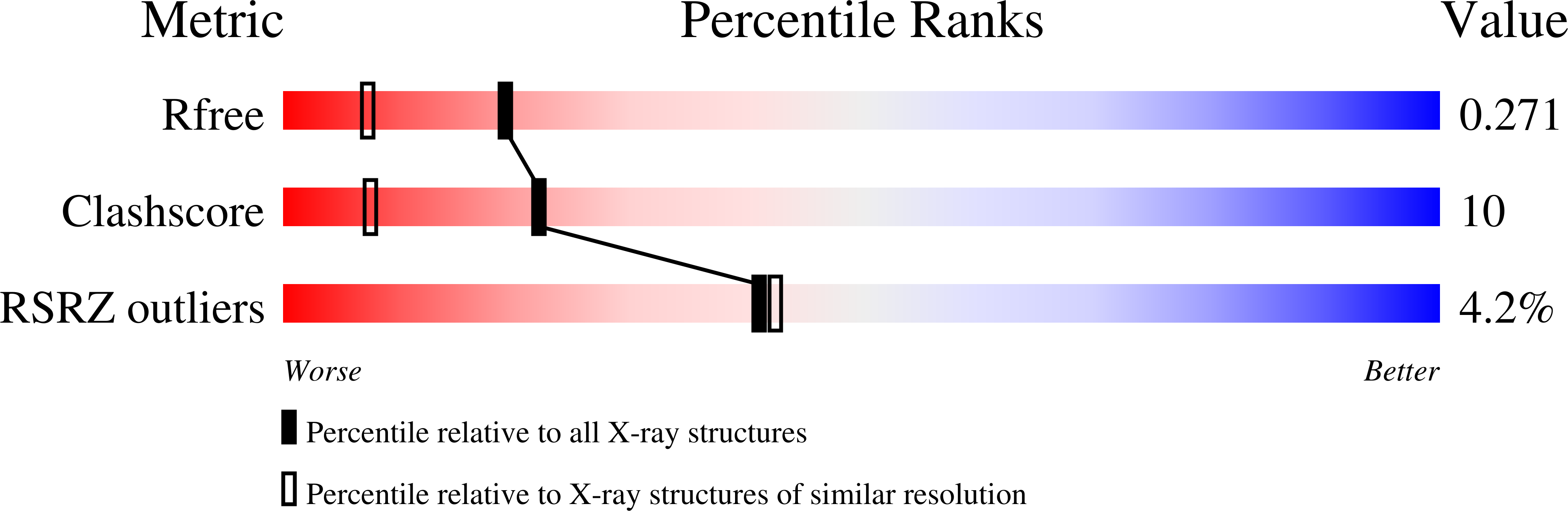
1.87 Å
R-Value Free:
0.27
R-Value Work:
0.27
R-Value Observed:
0.27
Space Group:
P 32
Macromolecular Entities
Polymer Type:polydeoxyribonucleotide
Molecule:DNA (5'-D(P*GP*TP*CP*TP*G)-3'
Chain IDs:A
Chain Length:5
Number of Molecules:1
Biological Source:synthetic construct
Polymer Type:polydeoxyribonucleotide
Molecule:DNA (5'-D(P*AP*GP*GP*AP*CP*TP
Chain IDs:B
Chain Length:7
Number of Molecules:1
Biological Source:synthetic construct
Polymer Type:polydeoxyribonucleotide
Molecule:DNA (5'-D(P*CP*AP*CP*CP*T)-3'
Chain IDs:C
Chain Length:5
Number of Molecules:1
Biological Source:synthetic construct
Polymer Type:polydeoxyribonucleotide
Molecule:DNA (5'-D(P*TP*AP*GP*TP*GP*AP
Chain IDs:D
Chain Length:7
Number of Molecules:1
Biological Source:synthetic construct
Primary Citation
Blunt-force assembly of programmable DNA architectures using pi-pi stacking.
Nat Commun 17 ? ? (2026)
PMID: 41735315 DOI: 10.1038/s41467-026-69973-1

Abstact

Sticky-ended cohesion has been the driving force for DNA self-assembly and has enabled model and design programmability in DNA nanotechnology for over 40 years. Traditional units within self-assembled crystals have rationally-designed sticky ends to avoid unpredictable packing behavior, but in doing so, the surprising variety of contact flavors available to natural nucleic acids remains unexploited. Here, we employ composable DNA tiles to form complex 3D architectures using blunt-ended motifs with single duplex interfaces, thereby leveraging the geometry of the tile and the terminal nucleobase identity to control self-assembly outcomes. These crystals yielded X-ray diffraction at resolutions between 10.0 and 1.86 A. We establish programmability and tunable packing, including translational and inversion symmetries, 5'-3' and 5'-5' stacking, and both positive and negative helical twist values. Finally, we establish the ability of racemic mixtures of L- and D-DNA motifs to perform programmable co-assembly driven by terminal pi-pi interactions, demonstrating molecular recognition and coexistence between mirror molecular systems.

Legend

Protein

Chemical

Disease

Primary Citation of related structures
Feedback Form
Name
Email
Institute
Feedback