

9PZK image
Deposition Date 2025-08-11
Release Date 2026-07-01
Last Version Date 2026-08-12
Entry Detail
PDB ID:
9PZK
Keywords:
Title:
Crystal structure of Petunia x hybrida benzaldehyde synthase in complex with NADP
Biological Source:
Source Organism(s):
Expression System(s):
Method Details:
Experimental Method:
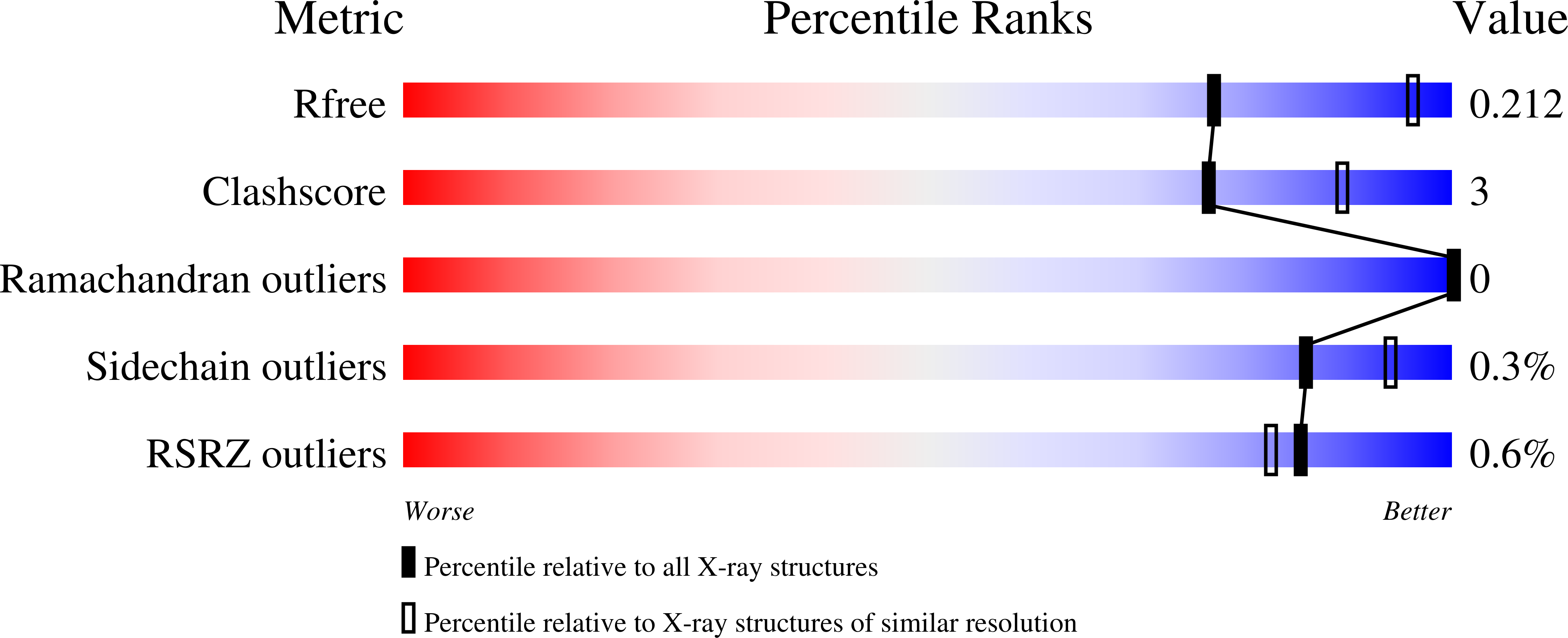
Resolution:
2.51 Å
R-Value Free:
0.21
R-Value Work:
0.16
R-Value Observed:
0.16
Space Group:
P 1
Macromolecular Entities
Polymer Type:polypeptide(L)
Molecule:Benzaldehyde synthase, alpha
Chain IDs:A, C, E, G
Chain Length:290
Number of Molecules:4
Biological Source:Petunia x hybrida
Polymer Type:polypeptide(L)
Molecule:Benzaldehyde synthase, beta s
Chain IDs:B, D, F, H
Chain Length:266
Number of Molecules:4
Biological Source:Petunia x hybrida
Ligand Molecules
Primary Citation
Structural and mechanistic basis for the heterotetrameric benzaldehyde synthase from petunia.
Sci Adv 12 eaec7733 eaec7733 (2026)
PMID: 42525737 DOI: 10.1126/sciadv.aec7733

Abstact

Benzaldehyde is a widespread volatile compound produced by plants. Its final biosynthetic step is catalyzed by benzaldehyde synthase (BS), a peroxisomal enzyme composed of alpha and beta subunits, both belonging to the short-chain dehydrogenase/reductase (SDR) family. Here, we report the crystal structure of Petunia hybrida BS, which reveals an alpha(2)beta(2) heterotetrameric arrangement. Structural and biochemical analyses show that the alpha subunits contain the canonical catalytic site, whereas the beta subunits have lost catalytic activity but are essential for heterotetramer assembly. Notably, the C terminus of the beta subunit extends into the diagonally positioned alpha subunit, contributing to the formation of the composite benzoyl-CoA substrate-binding pocket. Site-directed mutagenesis and subunit-mixing experiments support noncooperative, additive contributions of protomers within the heterotetramer. This work establishes BS as a rare heterotetrameric plant SDR and demonstrates how subunit specialization and intersubunit arrangement enable function, providing principles for understanding and engineering multimeric enzyme complexes.

Legend

Protein

Chemical

Disease

Primary Citation of related structures
Feedback Form
Name
Email
Institute
Feedback