

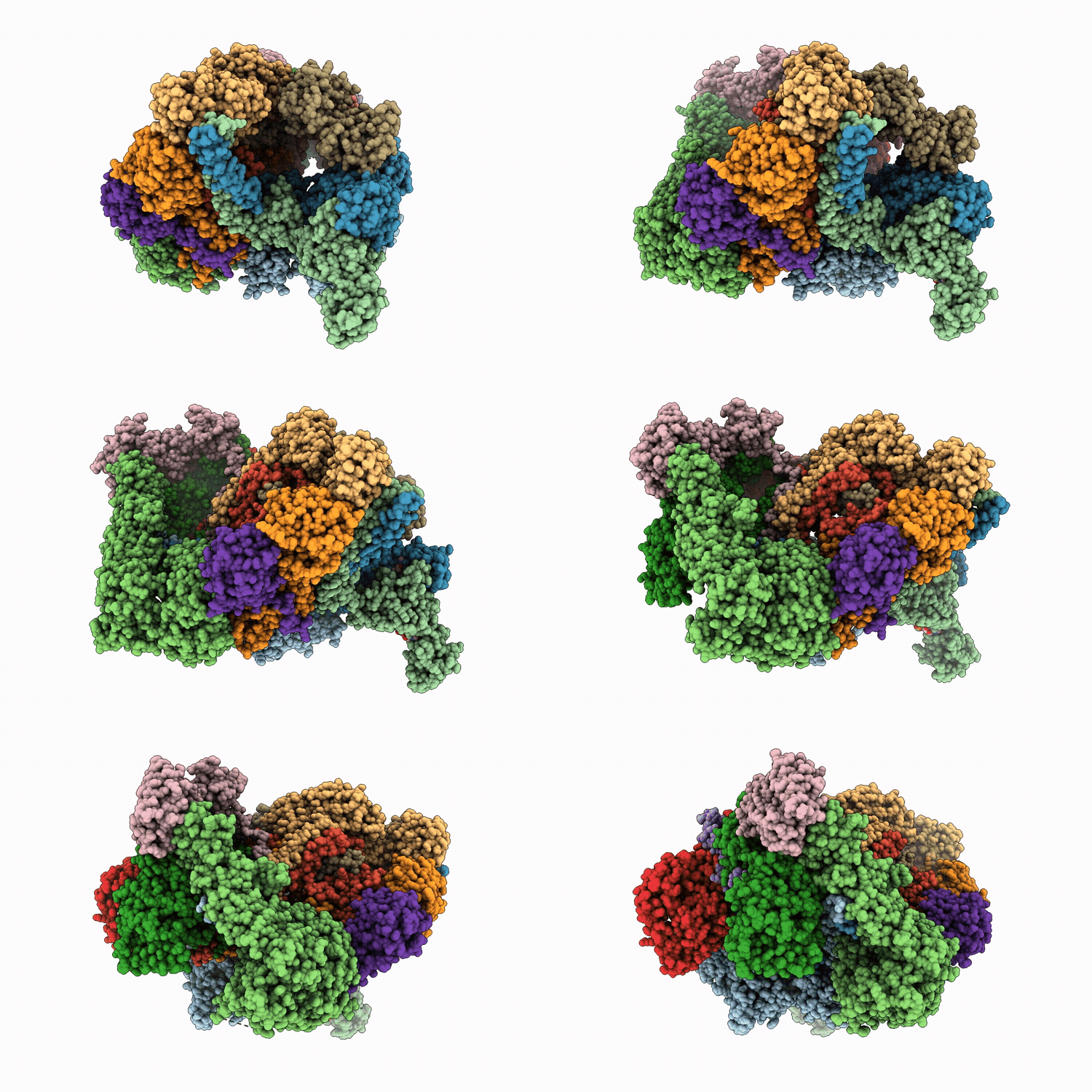
9PRT image
Deposition Date 2025-07-24
Release Date 2026-07-01
Last Version Date 2026-08-19
Entry Detail
PDB ID:
9PRT
Keywords:
Title:
Human 19S proteasome bound to TXNL1 PITH domain but with low density for RPT1, RPT2, and RPN1
Biological Source:
Source Organism(s):
Homo sapiens (Taxon ID: 9606)
Expression System(s):
Method Details:
Experimental Method:
Resolution:
3.02 Å
Aggregation State:
PARTICLE
Reconstruction Method:
SINGLE PARTICLE
Macromolecular Entities
Polymer Type:polypeptide(L)
Molecule:RPT6
Chain IDs:A (auth: C)
Chain Length:310
Number of Molecules:1
Biological Source:Homo sapiens
Polymer Type:polypeptide(L)
Molecule:RPT3
Chain IDs:B (auth: D)
Chain Length:350
Number of Molecules:1
Biological Source:Homo sapiens
Polymer Type:polypeptide(L)
Molecule:RPT4
Chain IDs:C (auth: E)
Chain Length:70
Number of Molecules:1
Biological Source:Homo sapiens
Polymer Type:polypeptide(L)
Molecule:RPT5
Chain IDs:D (auth: F)
Chain Length:439
Number of Molecules:1
Biological Source:Homo sapiens
Polymer Type:polypeptide(L)
Molecule:RPN2
Chain IDs:E (auth: U)
Chain Length:953
Number of Molecules:1
Biological Source:Homo sapiens
Polymer Type:polypeptide(L)
Molecule:RPN3
Chain IDs:F (auth: V)
Chain Length:534
Number of Molecules:1
Biological Source:Homo sapiens
Polymer Type:polypeptide(L)
Molecule:RPN5
Chain IDs:G (auth: W)
Chain Length:456
Number of Molecules:1
Biological Source:Homo sapiens
Polymer Type:polypeptide(L)
Molecule:RPN6
Chain IDs:H (auth: X)
Chain Length:422
Number of Molecules:1
Biological Source:Homo sapiens
Polymer Type:polypeptide(L)
Molecule:RPN7
Chain IDs:I (auth: Y)
Chain Length:389
Number of Molecules:1
Biological Source:Homo sapiens
Polymer Type:polypeptide(L)
Molecule:RPN8
Chain IDs:J (auth: Z)
Chain Length:324
Number of Molecules:1
Biological Source:Homo sapiens
Polymer Type:polypeptide(L)
Molecule:RPN9
Chain IDs:K (auth: a)
Chain Length:376
Number of Molecules:1
Biological Source:Homo sapiens
Polymer Type:polypeptide(L)
Molecule:RPN10
Chain IDs:L (auth: b)
Chain Length:377
Number of Molecules:1
Biological Source:Homo sapiens
Polymer Type:polypeptide(L)
Molecule:RPN11
Chain IDs:M (auth: c)
Chain Length:310
Number of Molecules:1
Biological Source:Homo sapiens
Polymer Type:polypeptide(L)
Molecule:RPN12
Chain IDs:N (auth: d)
Chain Length:350
Number of Molecules:1
Biological Source:Homo sapiens
Polymer Type:polypeptide(L)
Molecule:DSS1
Chain IDs:O (auth: e)
Chain Length:70
Number of Molecules:1
Biological Source:Homo sapiens
Polymer Type:polypeptide(L)
Molecule:TXNL1
Chain IDs:P (auth: g)
Chain Length:289
Number of Molecules:1
Biological Source:Homo sapiens
Primary Citation
Structures of dynamic interactors at native proteasomes by PhIX-MS and cryo-electron microscopy.
Mol.Cell 86 3067 ? (2026)
PMID: 42476128 DOI: 10.1016/j.molcel.2026.06.032

Abstact

Molecular machines rely on dynamic, low-affinity interactions to perform their functional roles. We developed PhIX-MS (photo-induced in situ crosslinking-mass spectrometry), a structural proteomics workflow to capture topological information for such transient interactions in cells by UV-activated crosslinking. Applying PhIX-MS with cryo-electron microscopy (cryo-EM) to proteasomes, we mapped the redox sensor TXNL1 at the proteasome regulatory particle (RP), including its dynamic thioredoxin-like domain near RPN2/PSMD1 and RPN13/ADRM1, where it is ideal for reducing substrates prior to proteolysis. RPs without the proteolytic core particle (CP) were structurally resolved while bound to TXNL1 and/or the chaperone PSMD5/S5b, which inserts its C terminus into the ATPase pore, causing extensive structural rearrangements. Additionally, PhIX-MS and AlphaFold identified the ubiquitin ligase UBE3C/Hul5 at RPN2, RPN3, and a dynamic RPN10 region, tethering UBE3C above the substrate entry channel. Our integrative approach enables the localization of native, low-affinity protein interactions and is broadly applicable to dynamic macromolecular assemblies.

Legend

Protein

Chemical

Disease

Primary Citation of related structures
Feedback Form
Name
Email
Institute
Feedback