

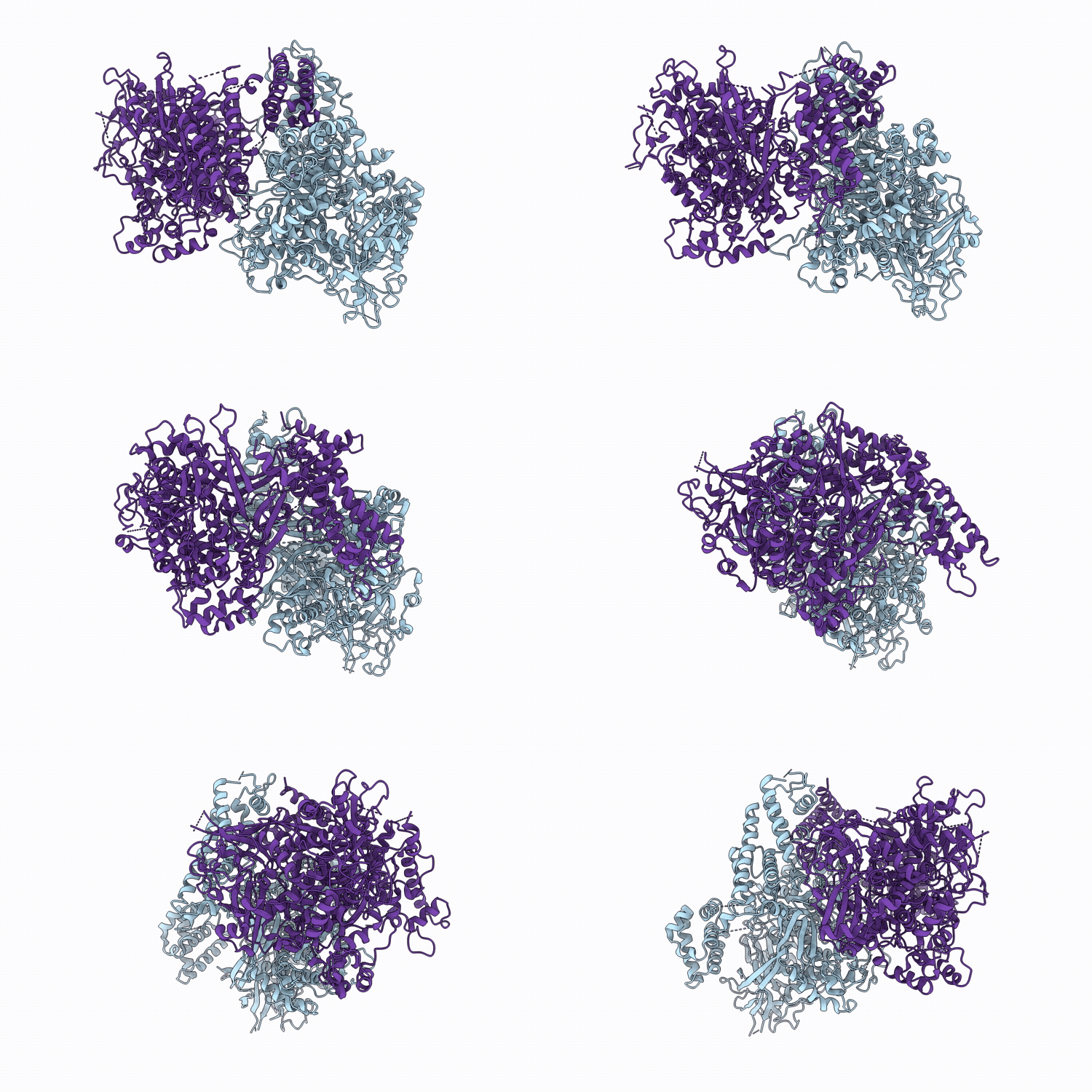
9PI3 image
Deposition Date 2025-07-10
Release Date 2026-04-15
Last Version Date 2026-05-20
Entry Detail
PDB ID:
9PI3
Title:
Single stranded DNA-binding protein (ICP8) from Herpes simplex virus-1, apo form. Mutations: C254S, C455S, K769A, E770A
Biological Source:
Source Organism(s):
Expression System(s):
Method Details:
Experimental Method:
Resolution:
2.75 Å
R-Value Free:
0.26
R-Value Work:
0.18
Space Group:
P 1 21 1

Macromolecular Entities
Structures with similar UniProt ID
Protein Blast
Polymer Type:polypeptide(L)
Molecule:Major DNA-binding protein
Gene (Uniprot):DBP
Mutagens:C254S, C455S, K769A, E770A
Chain IDs:A, B
Chain Length:1136
Number of Molecules:2
Biological Source:Human alphaherpesvirus 1
Ligand Molecules
Primary Citation
The crystal structure of the herpes virus ICP8 protein in complex with single-stranded DNA reveals the molecular determinants of nucleotide recognition.
J.Biol.Chem. 302 111366 111366 (2026)
PMID: 41833734 DOI: 10.1016/j.jbc.2026.111366

Abstact

The HSV-1 single-strand annealing protein ICP8 (UL29) is essential for viral DNA replication and recombination. Although its overall architecture has been described, the molecular basis of single-stranded DNA (ssDNA) recognition was unknown. We report crystal structures of C-terminally truncated ICP8 (ICP8Delta60) bound to poly(dT)(25) or poly(dA)(25) ssDNA at 3.0 to 3.1 A resolution, along with higher-resolution apo structures of surface-entropy-reduction variants. ssDNA binds within the neck region between the head and shoulder domains, contacting conserved OB-fold residues via base-specific hydrogen bonds, pi-stacking and phosphate backbone interactions. In the poly(dT)(25) complex, coordination of a Zn(2+) ion stabilizes the zinc finger motif; whereas, in the poly(dA)(25) complex, Zn(2+) displacement promotes disulfide bond formation that effectively locks the protein into an altered conformation. Microscale thermophoresis and label-free differential scanning fluorimetry reveal a strong preference for pyrimidine-rich sequences, with nanomolar affinity for poly(dT)(25) and micromolar for poly(dA)(25). Structural modeling identified Y543, R576, R772, R793, Y988, and F998 as key DNA-contact residues. Alanine substitutions caused severe replication defects, particularly for R772A, Y988A, and F998A. ssDNA binding induces approximately 26 A displacement and approximately 35 degree rotation of the C-terminal domain and ordering of flexible loops, suggesting a mechanism for cooperative filament assembly. These structures define the molecular determinants of ICP8-ssDNA recognition, reveal thymidine bias and provide a framework for targeting ICP8-mediated functions in herpesvirus replication.

Legend

Protein

Chemical

Disease

Primary Citation of related structures
Feedback Form
Name
Email
Institute
Feedback