

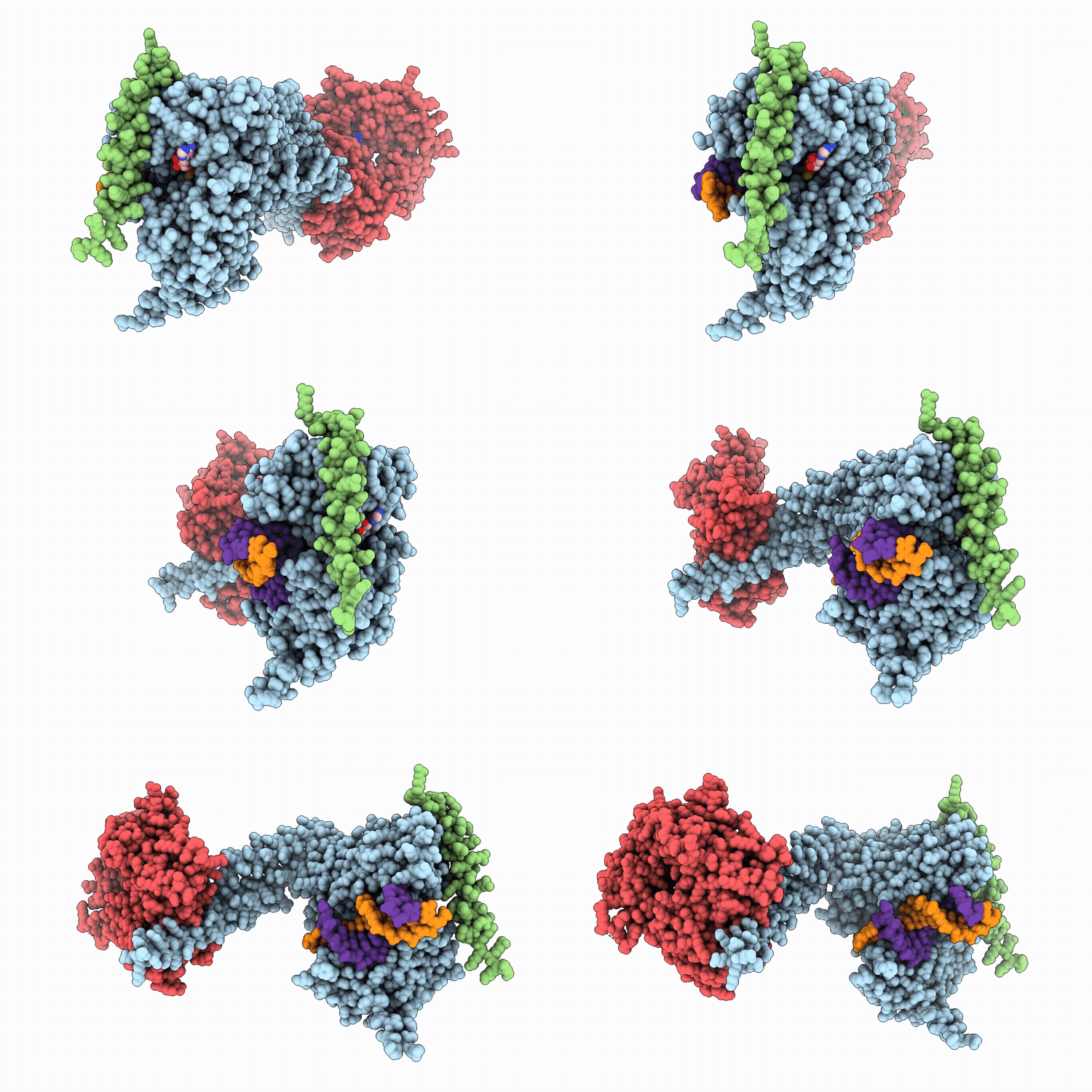
9PGC image
Deposition Date 2025-07-07
Release Date 2026-07-22
Last Version Date 2026-08-12
Entry Detail
PDB ID:
9PGC
Keywords:
Title:
Trident submodule from human SRCAP-nucleosome complex in the fully-engaged state (focused refinement)
Biological Source:
Source Organism(s):
Method Details:
Experimental Method:
Resolution:
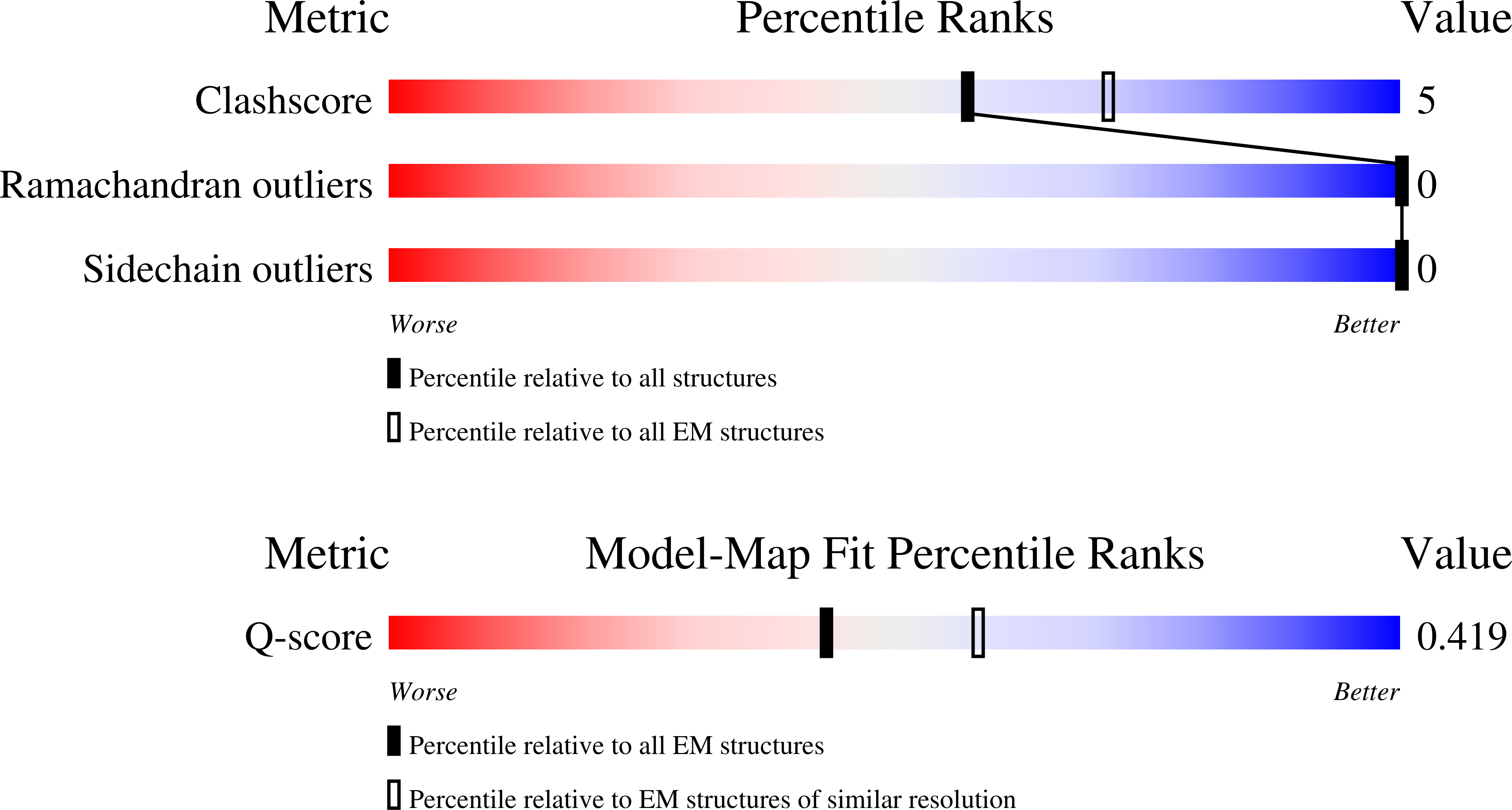
3.80 Å
Aggregation State:
PARTICLE
Reconstruction Method:
SINGLE PARTICLE
Macromolecular Entities
Polymer Type:polypeptide(L)
Molecule:Helicase SRCAP
Gene (Uniprot):SRCAP
Chain IDs:A
Chain Length:3230
Number of Molecules:1
Biological Source:Homo sapiens
Polymer Type:polypeptide(L)
Molecule:Vacuolar protein sorting-asso
Gene (Uniprot):VPS72
Chain IDs:B
Chain Length:364
Number of Molecules:1
Biological Source:Homo sapiens
Polymer Type:polypeptide(L)
Molecule:Actin-like protein 6A
Gene (Uniprot):ACTL6A
Chain IDs:C (auth: K)
Chain Length:429
Number of Molecules:1
Biological Source:Homo sapiens
Polymer Type:polydeoxyribonucleotide
Molecule:DNA
Chain IDs:D (auth: Y)
Chain Length:285
Number of Molecules:1
Biological Source:synthetic construct
Polymer Type:polydeoxyribonucleotide
Molecule:DNA
Chain IDs:E (auth: Z)
Chain Length:285
Number of Molecules:1
Biological Source:synthetic construct
Primary Citation
Structural mechanism of histone H2A.Z exchange by human SRCAP-CFDP1 holoenzyme.
Sci Adv 12 eaei7728 eaei7728 (2026)
PMID: 42536744 DOI: 10.1126/sciadv.aei7728

Abstact

The conserved yeast SWR1 and human SRCAP chromatin remodeling complexes catalyze exchange of nucleosomal histone H2A for H2A.Z, but the underlying mechanism has remained obscure. Here, we show that histone exchange by SRCAP requires the transient activator CFDP1 and resolve nine cryo-electron microscopy structures of the SRCAP-CFDP1 holoenzyme that define the stepwise exchange mechanism. CFDP1 recognizes the conformation of the fully engaged SRCAP-nucleosome complex through interactions with multiple subunits-including direct contact with the ATPase domain-and induces conformational transitions that drive extensive DNA unwrapping, eviction of the H2A-H2B dimer, and insertion of the H2A.Z-H2B dimer, all without necessarily requiring hydrolysis of bound ATP. Collectively, these findings provide unprecedented insight into the mechanism of activator- and nucleotide-driven histone exchange from nucleosomal H2A to H2A.Z.

Legend

Protein

Chemical

Disease

Primary Citation of related structures
Feedback Form
Name
Email
Institute
Feedback