

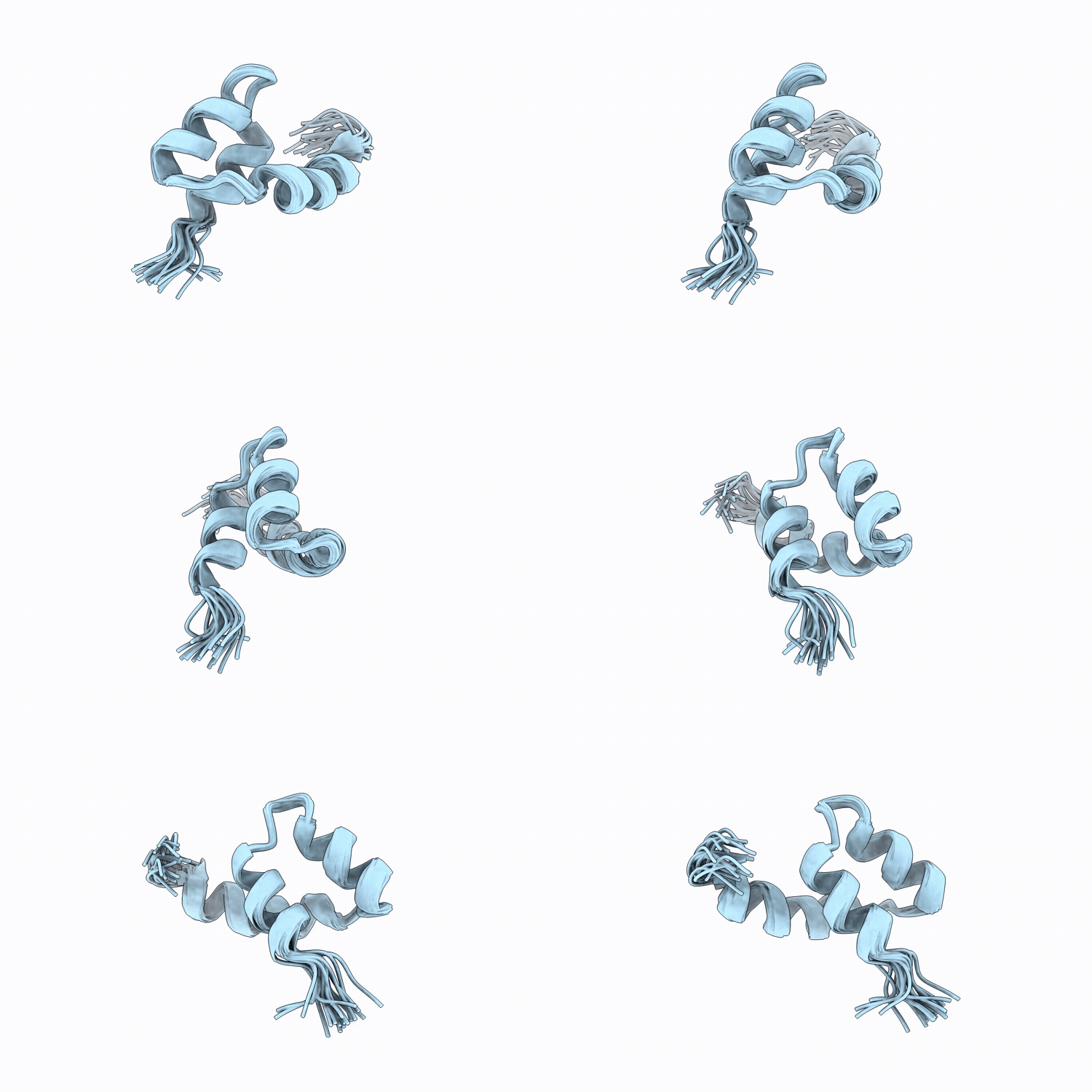
9PFE image
Deposition Date 2025-07-04
Release Date 2026-05-13
Last Version Date 2026-06-24
Entry Detail
PDB ID:
9PFE
Title:
NMR structure of slow skeletal Myosin Binding Protein-C M-domain tri-helix bundle
Biological Source:
Source Organism(s):
Homo sapiens (Taxon ID: 9606)
Expression System(s):
Method Details:
Experimental Method:
Conformers Calculated:
200
Conformers Submitted:
20
Selection Criteria:
structures with the least restraint violations

Macromolecular Entities
Structures with similar UniProt ID
Protein Blast
Polymer Type:polypeptide(L)
Molecule:Isoform 4 of Myosin-binding p
Gene (Uniprot):MYBPC1
Chain IDs:A
Chain Length:45
Number of Molecules:1
Biological Source:Homo sapiens
Ligand Molecules
Primary Citation
From bedside to bench: A multimodal approach uncovering the molecular basis of the MYBPC1 -linked Myotrem myopathy.
Proc.Natl.Acad.Sci.USA 123 e2529897123 e2529897123 (2026)
PMID: 42224599 DOI: 10.1073/pnas.2529897123

Abstact

Myotrem is an untreatable, early-onset, congenital myopathy characterized by hypotonia, muscle weakness, skeletal deformities, dysmorphia, respiratory insufficiency, and myogenic tremor (V. Shashi et al., Hum Mutat, 2019 and J. Stavusis et al., Ann. Neurol., 2019). It is associated with dominant variants in the pivotal M-domain of slow-skeletal Myosin Binding Protein-C (sMyBP-C) that modulates the dynamic binding to myosin and actin filaments and thereby crossbridge formation and kinetics. Herein, we report a nonmissense Myotrem variant, c.795_803dup p.(Leu266_Arg268dup), referred to as LKR-duplication. Our comprehensive studies, integrating clinical findings with biophysical, structural, and computational approaches, uncover the previously unreported structure and properties of the slow-skeletal M-domain, while elucidating the impact of the LKR-duplication. We show that the LKR-duplication stabilizes local helicity but alters global domain dynamics, leading to increased myosin binding, while impairing myosin-ATPase activity and crossbridge cycling. Critically, we pinpoint the specific amino acid residues facilitating the M-domain/myosin interaction and demonstrate that the LKR-duplicated residues not only directly contribute to myosin binding but also enhance the myosin interacting capability of neighboring and distant residues. Our multimodal approach sheds light on aspects of the pathobiology of the slow-skeletal M-domain-the Myotrem hotspot-by unveiling underlying pathogenic etiologies thereby paving the way for the development of targeted treatments.

Legend

Protein

Chemical

Disease

Primary Citation of related structures
Feedback Form
Name
Email
Institute
Feedback