

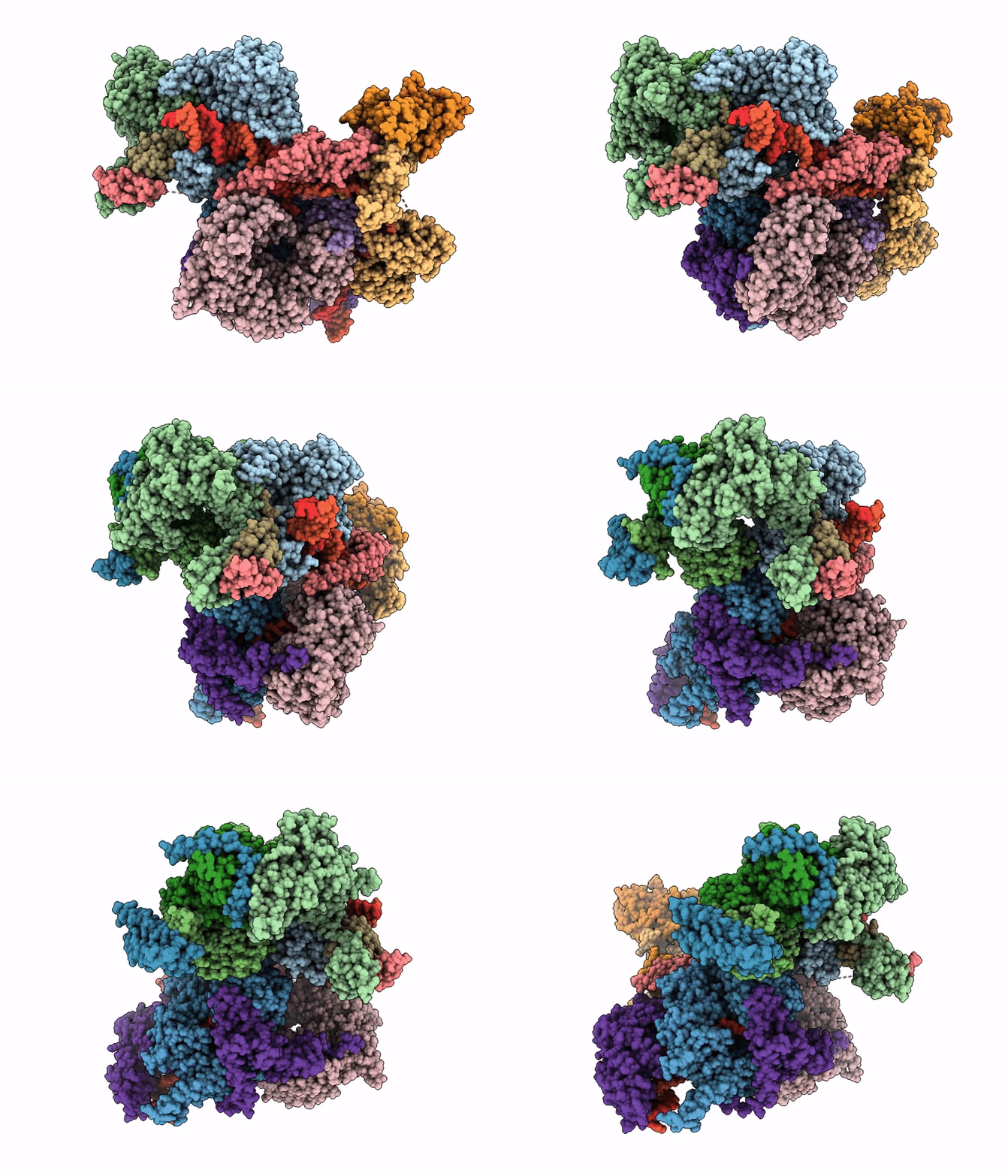
9PD4 image
Deposition Date 2025-06-30
Release Date 2026-02-18
Last Version Date 2026-05-06
Entry Detail
PDB ID:
9PD4
Title:
NER dual incision complex - DuIM
Biological Source:
Source Organism(s):
Method Details:
Experimental Method:
Resolution:
3.40 Å
Aggregation State:
PARTICLE
Reconstruction Method:
SINGLE PARTICLE
Macromolecular Entities
Structures with similar UniProt ID
Protein Blast
Polymer Type:polypeptide(L)
Molecule:TFIIH basal transcription fac
Gene (Uniprot):ERCC3
Chain IDs:A
Chain Length:782
Number of Molecules:1
Biological Source:Homo sapiens
Structures with similar UniProt ID
Protein Blast
Polymer Type:polypeptide(L)
Molecule:General transcription and DNA
Gene (Uniprot):ERCC2
Chain IDs:B
Chain Length:768
Number of Molecules:1
Biological Source:Homo sapiens
Structures with similar UniProt ID
Protein Blast
Polymer Type:polypeptide(L)
Molecule:General transcription factor
Gene (Uniprot):GTF2H1
Chain IDs:C
Chain Length:548
Number of Molecules:1
Biological Source:Homo sapiens
Structures with similar UniProt ID
Protein Blast
Polymer Type:polypeptide(L)
Molecule:General transcription factor
Gene (Uniprot):GTF2H4
Chain IDs:D
Chain Length:462
Number of Molecules:1
Biological Source:Homo sapiens
Structures with similar UniProt ID
Protein Blast
Polymer Type:polypeptide(L)
Molecule:General transcription factor
Gene (Uniprot):GTF2H2
Chain IDs:E
Chain Length:395
Number of Molecules:1
Biological Source:Homo sapiens
Structures with similar UniProt ID
Protein Blast
Polymer Type:polypeptide(L)
Molecule:General transcription factor
Gene (Uniprot):GTF2H3
Chain IDs:F
Chain Length:308
Number of Molecules:1
Biological Source:Homo sapiens
Structures with similar UniProt ID
Protein Blast
Polymer Type:polypeptide(L)
Molecule:General transcription factor
Gene (Uniprot):GTF2H5
Chain IDs:G
Chain Length:71
Number of Molecules:1
Biological Source:Homo sapiens
Structures with similar UniProt ID
Protein Blast
Polymer Type:polypeptide(L)
Molecule:DNA repair protein complement
Gene (Uniprot):XPA
Chain IDs:K
Chain Length:273
Number of Molecules:1
Biological Source:Homo sapiens
Polymer Type:polydeoxyribonucleotide
Molecule:DNA (Cy5)
Chain IDs:L
Chain Length:93
Number of Molecules:1
Biological Source:synthetic construct
Polymer Type:polydeoxyribonucleotide
Molecule:DNA
Chain IDs:M
Chain Length:94
Number of Molecules:1
Biological Source:synthetic construct
Structures with similar UniProt ID
Protein Blast
Polymer Type:polypeptide(L)
Molecule:Replication protein A 70 kDa
Gene (Uniprot):RPA1
Chain IDs:N
Chain Length:616
Number of Molecules:1
Biological Source:Homo sapiens
Structures with similar UniProt ID
Protein Blast
Polymer Type:polypeptide(L)
Molecule:Replication protein A 32 kDa
Gene (Uniprot):RPA2
Chain IDs:O
Chain Length:270
Number of Molecules:1
Biological Source:Homo sapiens
Structures with similar UniProt ID
Protein Blast
Polymer Type:polypeptide(L)
Molecule:Replication protein A 14 kDa
Gene (Uniprot):RPA3
Chain IDs:P
Chain Length:121
Number of Molecules:1
Biological Source:Homo sapiens
Structures with similar UniProt ID
Protein Blast
Polymer Type:polypeptide(L)
Molecule:DNA repair endonuclease XPF
Gene (Uniprot):ERCC4
Chain IDs:I (auth: Q)
Chain Length:916
Number of Molecules:1
Biological Source:Homo sapiens
Structures with similar UniProt ID
Protein Blast
Polymer Type:polypeptide(L)
Molecule:DNA excision repair protein E
Gene (Uniprot):ERCC1
Chain IDs:J (auth: R)
Chain Length:295
Number of Molecules:1
Biological Source:Homo sapiens
Structures with similar UniProt ID
Protein Blast
Polymer Type:polypeptide(L)
Molecule:DNA excision repair protein E
Gene (Uniprot):ERCC5
Mutagens:D812N
Chain IDs:H (auth: S)
Chain Length:1186
Number of Molecules:1
Biological Source:Homo sapiens
Primary Citation
Pre-incision structures reveal principles of DNA nucleotide excision repair.
Nature 652 1060 1067 (2026)
PMID: 41673165 DOI: 10.1038/s41586-026-10122-5

Abstact

Nucleotide excision repair (NER) removes bulky adducts from genomic DNA and prevents the ultraviolet light-sensitivity disease xeroderma pigmentosum, cancer and premature ageing(1). After initial lesion recognition by XPC in global genome repair or by stalled RNA polymerases in transcription-coupled repair, a lesion and surrounding DNA duplex are unwound by TFIIH, which includes the ATPases XPB and XPD, and additional NER factors XPA, XPF, XPG and RPA, to form a DNA bubble(2) comprising around 27 nucleotides. The double strand-single strand (ds-ss) junction-specific endonucleases XPF and XPG cleave DNA on the 5' and 3' sides of the lesion, respectively. Here we report the functional steps and atomic structures of the ATPase-driven and lesion-dependent DNA bubble formation and arrangement of the complete NER factors for dual incision. The unwinding of nearly 30 base pairs of DNA depends mainly on the double strand DNA translocase XPB and the duplex dividers XPA and XPF. XPD binds the lesion strand with XPF at the 5' ds-ss junction. XPF cuts the lesion strand only after XPG binds the 3' ds-ss junction. The ERCC1 subunit of XPF facilitates DNA strand separation and recruitment of RPA to the non-lesion strand. These findings provide insights on the causes of human diseases and potential targets for enhancing chemotherapeutic efficacy.

Legend

Protein

Chemical

Disease

Primary Citation of related structures
Feedback Form
Name
Email
Institute
Feedback