

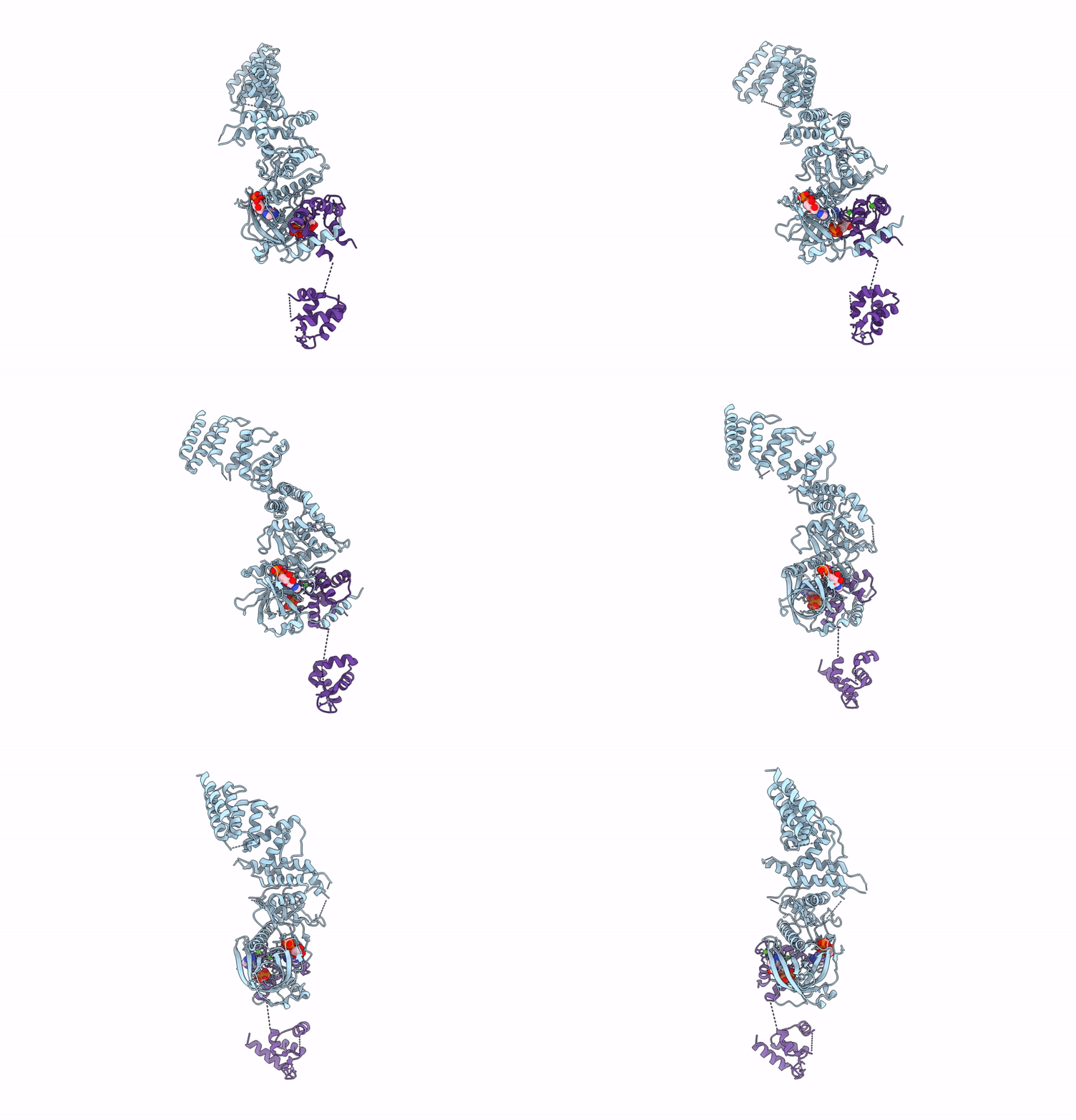
9PCQ image
Deposition Date 2025-06-28
Release Date 2026-03-04
Last Version Date 2026-03-04
Entry Detail
PDB ID:
9PCQ
Keywords:
Title:
Phosphorylation of a Conserved Aspartate at the Eukaryotic Elongation Factor 2 Kinase Catalytic Site
Biological Source:
Source Organism(s):
Homo sapiens (Taxon ID: 9606)
Expression System(s):
Method Details:
Experimental Method:
Resolution:
2.30 Å
R-Value Free:
0.24
R-Value Work:
0.21
R-Value Observed:
0.21
Space Group:
P 21 21 21

Macromolecular Entities
Structures with similar UniProt ID
Protein Blast
Polymer Type:polypeptide(L)
Molecule:Eukaryotic elongation factor
Gene (Uniprot):EEF2K
Chain IDs:A
Chain Length:531
Number of Molecules:1
Biological Source:Homo sapiens
Structures with similar UniProt ID
Protein Blast
Polymer Type:polypeptide(L)
Molecule:Calmodulin-1
Gene (Uniprot):CALM1
Chain IDs:B (auth: B00A)
Chain Length:147
Number of Molecules:1
Biological Source:Homo sapiens
Modified Residue
Compound ID Chain ID Parent Comp ID Details 2D Image
PHD A ASP modified residue
TPO A THR modified residue
Primary Citation
Phosphorylation of a conserved aspartate in the catalytic site of eukaryotic elongation factor 2 kinase.
Protein Sci. 35 e70442 e70442 (2026)
PMID: 41432361 DOI: 10.1002/pro.70442

Abstact

Eukaryotic elongation factor 2 kinase (eEF-2K) is a member of the alpha-kinase family of atypical serine/threonine kinases. eEF-2K, the only calmodulin-activated alpha-kinase, phosphorylates the ribosome-associated GTPase, eukaryotic elongation factor 2 (eEF-2), suppressing translational elongation. alpha-kinases, including eEF-2K, possess catalytic site geometries that are distinct from those of typical kinases, suggesting possible divergence in their phospho-transfer mechanisms. Unlike typical protein kinases, where chemistry is known to proceed through a sequential mechanism involving a ternary kinase-substrate-ATP*Mg(2+) complex, the nature of the chemical step catalyzed by alpha-kinases remains poorly defined. Here, multiple orthogonal lines of evidence, including a crystal structure and solution-state mass spectrometry data, suggest phosphorylation of a catalytically essential aspartate residue (D284) at the eEF-2K active site. Previous crystallographic evidence of the presence of a phospho-aspartate at an equivalent position (D766) in the related Dictyostelium alpha-kinase MHCK-A strongly suggests that this species represents a conserved active-site feature in alpha-kinase family members, despite their disparate modes of activation. This observation, together with existing kinetics data on eEF-2K, raises the possibility that phospho-transfer chemistry in alpha-kinases occurs via an ordered stepwise mechanism involving a phospho-enzyme intermediate, contrasting with typical protein kinases.

Legend

Protein

Chemical

Disease

Primary Citation of related structures
Feedback Form
Name
Email
Institute
Feedback