

9PAX image
Deposition Date 2025-06-25
Release Date 2026-03-11
Last Version Date 2026-03-11
Entry Detail
PDB ID:
9PAX
Keywords:
Title:
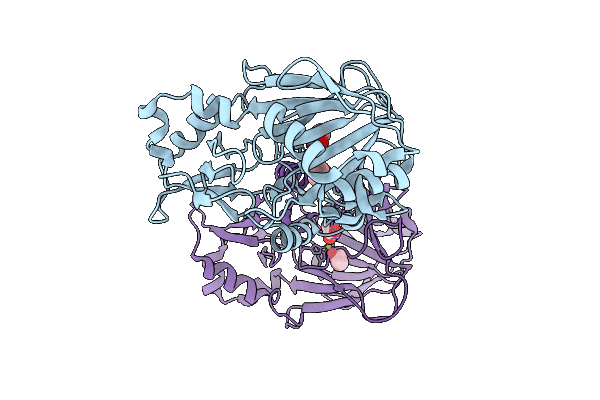
Crystal structure of Rv0097 F102W variant in apo state
Biological Source:
Source Organism(s):
Expression System(s):
Method Details:
Experimental Method:
Resolution:
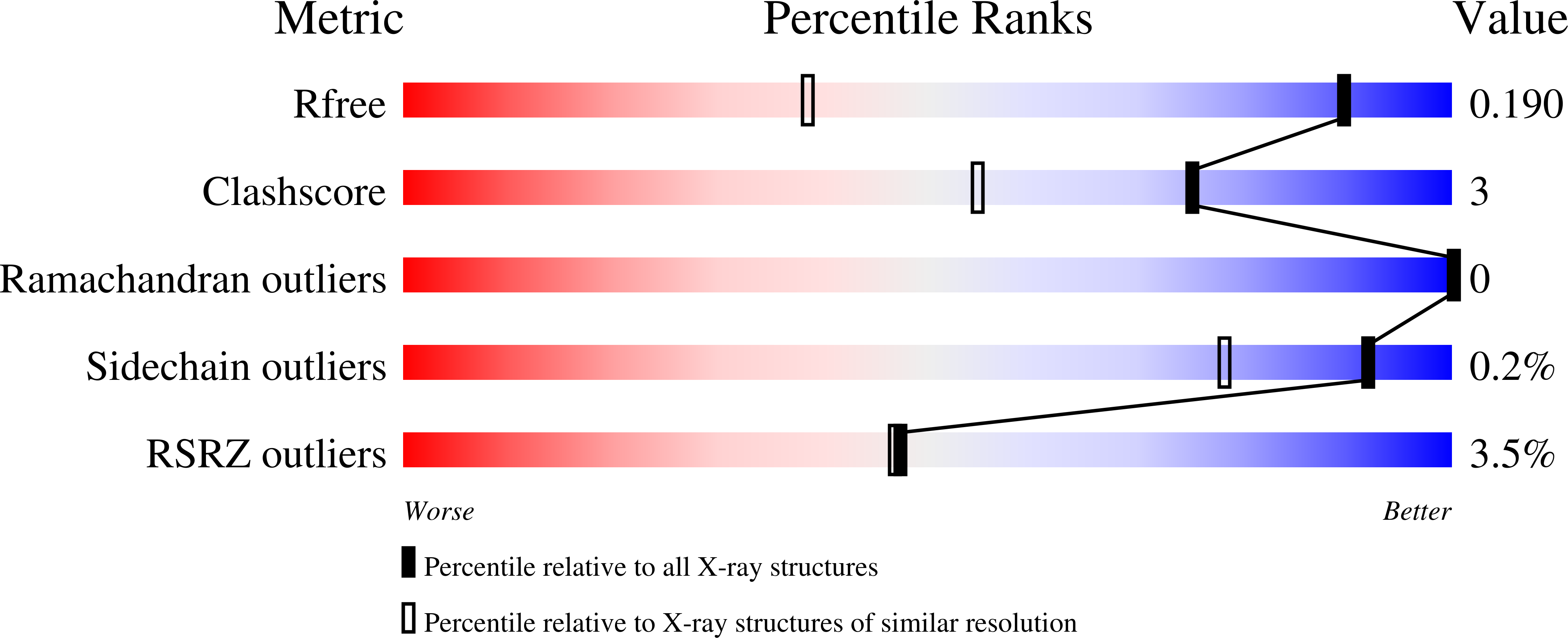
1.25 Å
R-Value Free:
0.19
R-Value Work:
0.17
R-Value Observed:
0.17
Space Group:
P 1 21 1
Macromolecular Entities
Structures with similar UniProt ID
Protein Blast
Polymer Type:polypeptide(L)
Molecule:(3R)-3-[(carboxymethyl)amino]
Gene (Uniprot):MTCY251.16
Mutagens:F102W
Chain IDs:A, B
Chain Length:302
Number of Molecules:2
Biological Source:Mycobacterium tuberculosis
Primary Citation
A highly dynamic mononuclear non-heme iron enzyme for the two-step isonitrile biosynthesis.
Nat Commun 17 ? ? (2026)
PMID: 41587996 DOI: 10.1038/s41467-026-68588-w

Abstact

The recent discovery of the isonitrile biosynthetic enzyme ScoE expanded the catalytic repertoire of the Fe(II)/alphaKG-dependent dioxygenase enzyme family. ScoE synthesizes an isonitrile functional group from a glycyl-fatty acid adduct, with both the isonitrile nitrogen and carbon atoms coming from the glycyl moiety. This challenging chemistry cannot be performed in a single step. Instead, the mechanism appears to require two half reactions, each involving alphaKG cleavage to generate a highly reactive iron-oxygen species. Here, we report sixteen crystal structures that provide snapshots along the reaction trajectory of Rv0097, a ScoE homolog from Mycobacterium tuberculosis. These structures, which are both of wild-type and Rv0097 variants, include a substrate 3-((carboxymethyl)amino)decanoic acid (CADA)-bound structure, an alphaKG-bound structure, and a structure with both CADA and alphaKG bound. These structural data reveal how Rv0097 employs conformational rearrangements to protect the unstable CADA-reaction intermediate that is formed in the first half reaction while swapping out alphaKG cleavage products for a second molecule of alphaKG. Additionally, these structures, together with data from site-directed mutagenesis, provide insight into Rv0097's preference for substrates with long alkyl chains, potentially facilitating efforts to re-engineer ScoE/Rv0097 to synthesize isonitrile functional groups on a wider range of small molecules.

Legend

Protein

Chemical

Disease

Primary Citation of related structures
Feedback Form
Name
Email
Institute
Feedback