

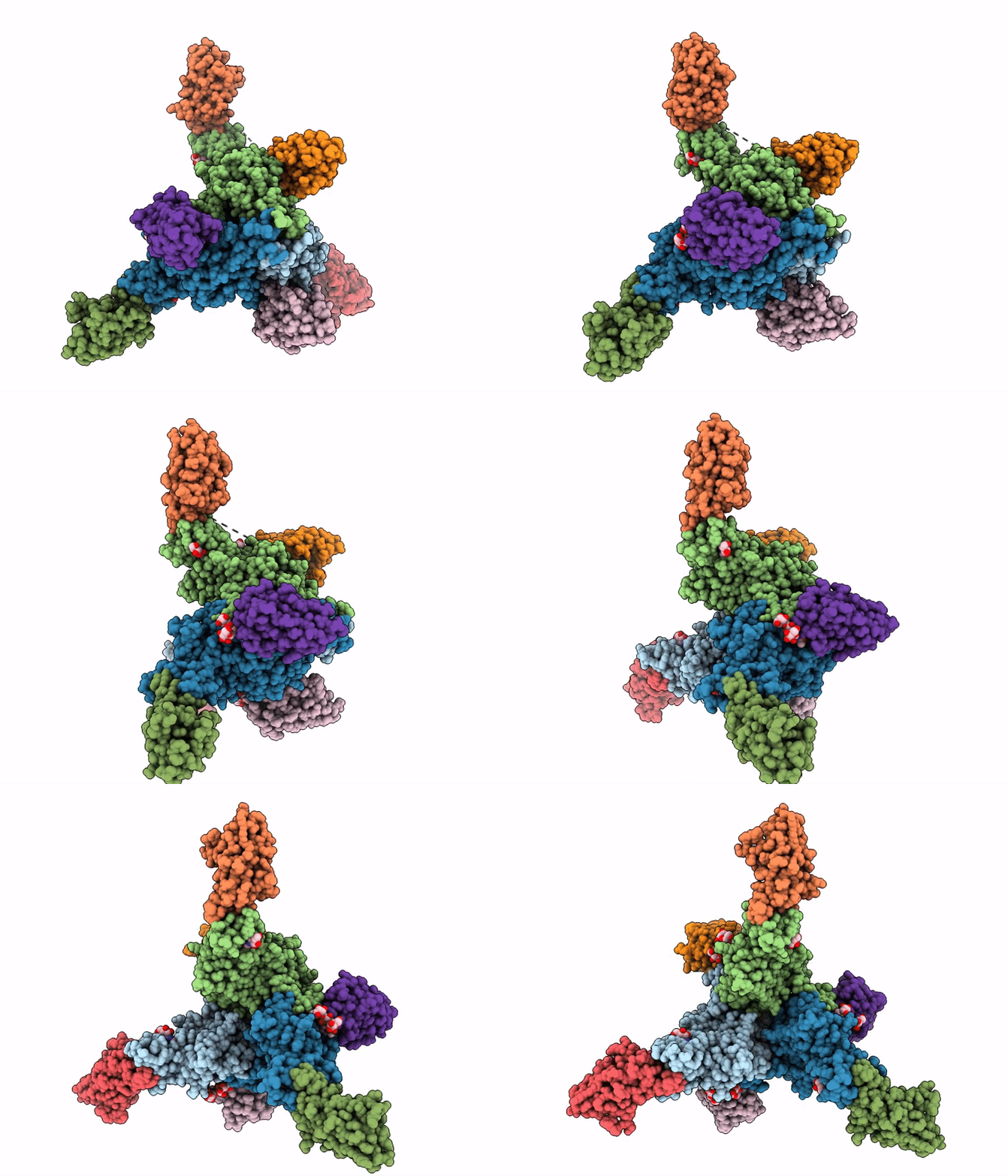
9P6X image
Deposition Date 2025-06-20
Release Date 2026-01-21
Last Version Date 2026-04-29
Entry Detail
PDB ID:
9P6X
Keywords:
Title:
Structure of EBOV glycoprotein in complex with Nanosota-EB1 and EB2
Biological Source:
Source Organism(s):
Ebola virus (Taxon ID: 1570291)
Vicugna pacos (Taxon ID: 30538)
Expression System(s):
Method Details:
Experimental Method:
Resolution:
2.92 Å
Aggregation State:
PARTICLE
Reconstruction Method:
SINGLE PARTICLE
Macromolecular Entities
Structures with similar UniProt ID
Protein Blast
Polymer Type:polypeptide(L)
Molecule:Envelope glycoprotein
Gene (Uniprot):GP
Chain IDs:A, B, C
Chain Length:509
Number of Molecules:3
Biological Source:Ebola virus
Protein Blast
Polymer Type:polypeptide(L)
Molecule:Nanosota-EB1
Chain IDs:D, E, F
Chain Length:143
Number of Molecules:3
Biological Source:Vicugna pacos
Protein Blast
Polymer Type:polypeptide(L)
Molecule:Nanosota-EB2
Chain IDs:G, H, I
Chain Length:143
Number of Molecules:3
Biological Source:Vicugna pacos
Ligand Molecules
Primary Citation
A highly potent and broadly accessible bispecific nanobody for the treatment of ebola virus infections.
Plos Pathog. 22 e1013878 e1013878 (2026)
PMID: 41592114 DOI: 10.1371/journal.ppat.1013878

Abstact

Ebola virus (EBOV) causes recurring outbreaks, with a case fatality rate of about 40%. Currently approved vaccine and antibody therapies face major limitations, including only modest reductions in mortality and restricted accessibility due to their reliance on injection-based delivery and cold-chain transport and storage. To address these challenges, we developed a bispecific nanobody, Nanosota-EB1/EB2-Fc, composed of two nanobodies (camelid-derived single-domain antibodies, Nanosota-EB1 and Nanosota-EB2) that target distinct epitopes on the EBOV glycoprotein (GP) and are fused to a human Fc domain. Through cooperative contributions from both nanobodies, this bispecific nanobody strongly inhibits GP function and effectively overcomes the virus's decoy mechanism. A single dose provided strong protection in EBOV-infected mice, including when administered at late stages of infection. It was also effective when administered intranasally, offering a needle-free delivery option. Furthermore, its high in vitro stability indicates that it can be deployed without refrigeration. Taken together, this novel bispecific nanobody represents a promising next-generation therapeutic for EBOV, combining high potency with broad accessibility.

Legend

Protein

Chemical

Disease

Primary Citation of related structures
Feedback Form
Name
Email
Institute
Feedback