

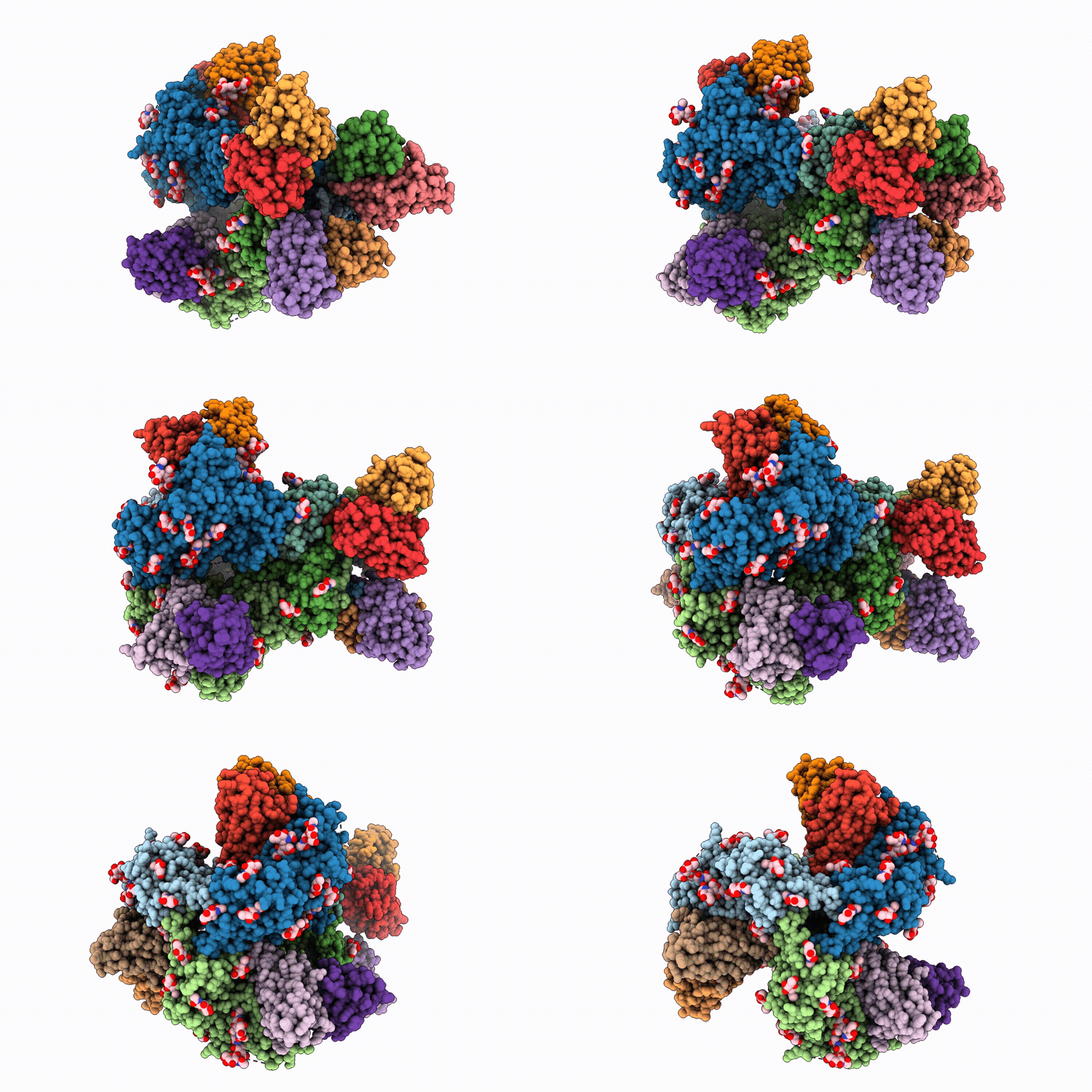
9P6G image
Deposition Date 2025-06-19
Release Date 2026-04-29
Last Version Date 2026-04-29
Entry Detail
PDB ID:
9P6G
Keywords:
Title:
eN49P7-FRv1-23 Fab in complex with BG505 MD39 SOSIP and RM20A3 Fab
Biological Source:
Source Organism(s):
Expression System(s):
Method Details:
Experimental Method:
Resolution:
2.70 Å
Aggregation State:
PARTICLE
Reconstruction Method:
SINGLE PARTICLE
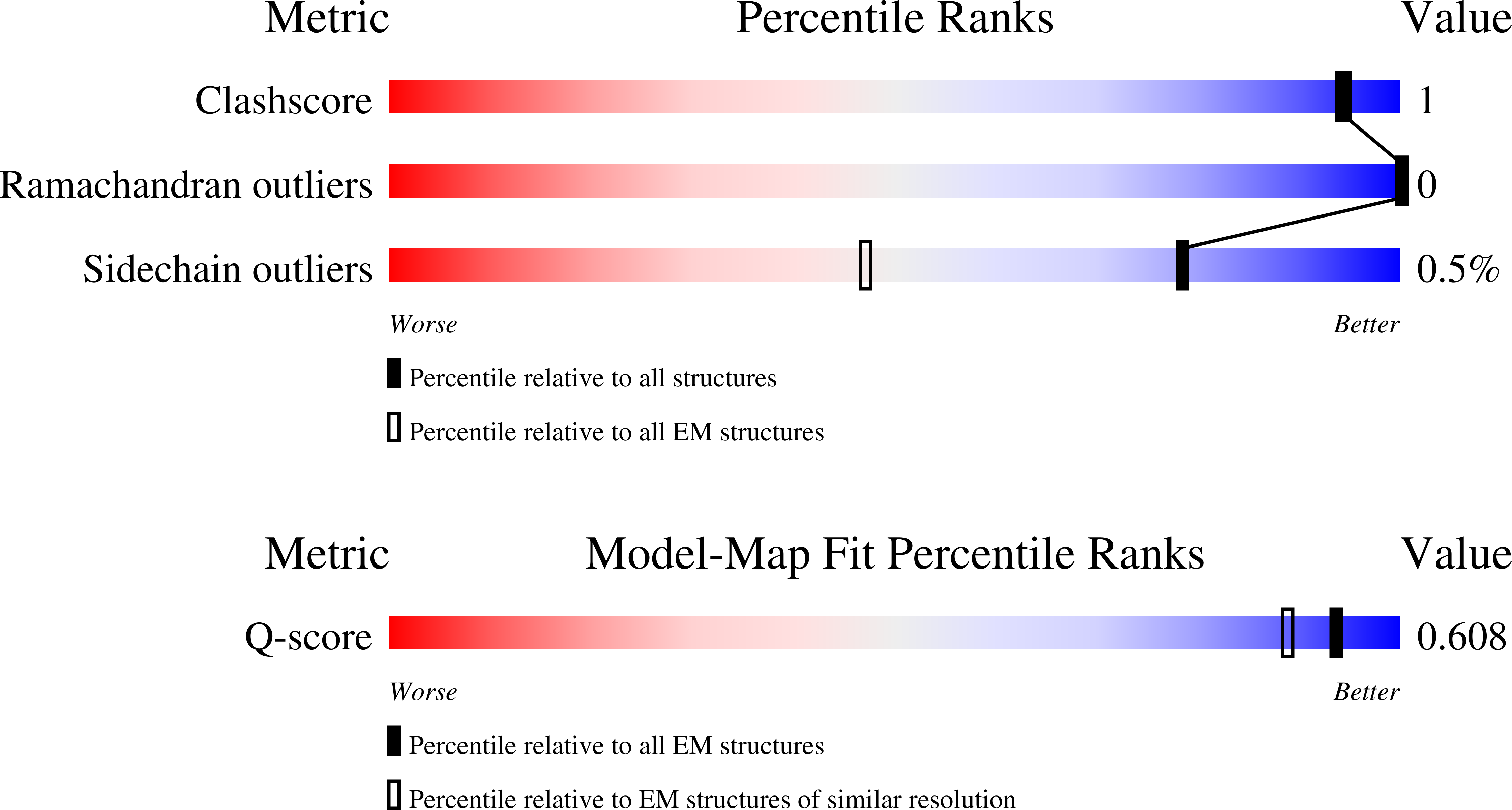
Macromolecular Entities
Structures with similar UniProt ID
Protein Blast
Polymer Type:polypeptide(L)
Molecule:Envelope glycoprotein gp120
Gene (Uniprot):env
Mutagens:T105E, M270I, F287L, R303V, A316Y, T330N, N361Q, A498C, E506R, K507R, A509R, V510R
Chain IDs:A, G (auth: C), M (auth: E)
Chain Length:481
Number of Molecules:3
Biological Source:Human immunodeficiency virus 1
Structures with similar UniProt ID
Protein Blast
Polymer Type:polypeptide(L)
Molecule:Envelope glycoprotein gp41
Gene (Uniprot):env
Mutagens:F516S, I556P, S558P, L565D, V567H, R582H, T602C
Chain IDs:B, H (auth: D), N (auth: F)
Chain Length:153
Number of Molecules:3
Biological Source:Human immunodeficiency virus 1
Protein Blast
Polymer Type:polypeptide(L)
Molecule:RM20A3 heavy chain
Chain IDs:C (auth: G), I (auth: J), O
Chain Length:125
Number of Molecules:3
Biological Source:Macaca mulatta
Protein Blast
Polymer Type:polypeptide(L)
Molecule:eN49P7-FRv1-23 heavy chain
Chain IDs:E (auth: H), K, Q (auth: P)
Chain Length:134
Number of Molecules:3
Biological Source:Homo sapiens
Protein Blast
Polymer Type:polypeptide(L)
Molecule:RM20A3 light chain
Chain IDs:D (auth: I), J (auth: M), P (auth: Q)
Chain Length:109
Number of Molecules:3
Biological Source:Macaca mulatta
Protein Blast
Polymer Type:polypeptide(L)
Molecule:eN49P7-FRv1-23 light chain
Chain IDs:F (auth: L), L (auth: N), R
Chain Length:101
Number of Molecules:3
Biological Source:Homo sapiens
Ligand Molecules
Primary Citation

Abstact

Broadly neutralizing antibodies (bnAbs) against HIV hold promise as therapeutic and prophylactic agents, but realizing this potential requires antibodies that function across the antigenic heterogeneity of the HIV envelope glycoprotein (Env). Although numerous bnAbs have been isolated from infected individuals, their breadth and potency may not be sufficient to tackle global viral diversity, motivating efforts to further improve their neutralization capacity. Here, we address this challenge using a multistate antibody engineering approach integrating deep mutational scanning with combinatorial library screening across diverse Env variants. This strategy enables identification of mutation patterns that confer improved binding across antigenically distinct targets. Starting from one of the best-in-class CD4-binding site bnAbs, we performed iterative optimization to increase binding affinity across diverse Env variants. The resulting lead candidate exhibited improved breadth and up to 100-fold higher potency against pseudoviruses from large cross-clade historical and contemporary panels while maintaining biophysical and pharmacokinetic profiles conducive to clinical development. Structural and molecular dynamics analyses revealed a unique tri-tyrosine aromatic triad and reinforced electrostatic contacts that stabilized the bnAb/Env interface. These findings demonstrate that systematic in vitro engineering can generate bnAbs with enhanced breadth and potency, providing a generalizable strategy for developing therapeutic antibodies against highly diverse pathogens.

Legend

Protein

Chemical

Disease

Primary Citation of related structures
Feedback Form
Name
Email
Institute
Feedback