

9P2U image
Deposition Date 2025-06-12
Release Date 2026-06-03
Last Version Date 2026-06-10
Entry Detail
PDB ID:
9P2U
Keywords:
Title:
Structure of radical S-adenosylmethionine methyltransferase, NocN, from Nocardia with two AzaSAM and [4Fe-4S] cluster bound
Biological Source:
Source Organism(s):
Expression System(s):
Method Details:
Experimental Method:
Resolution:
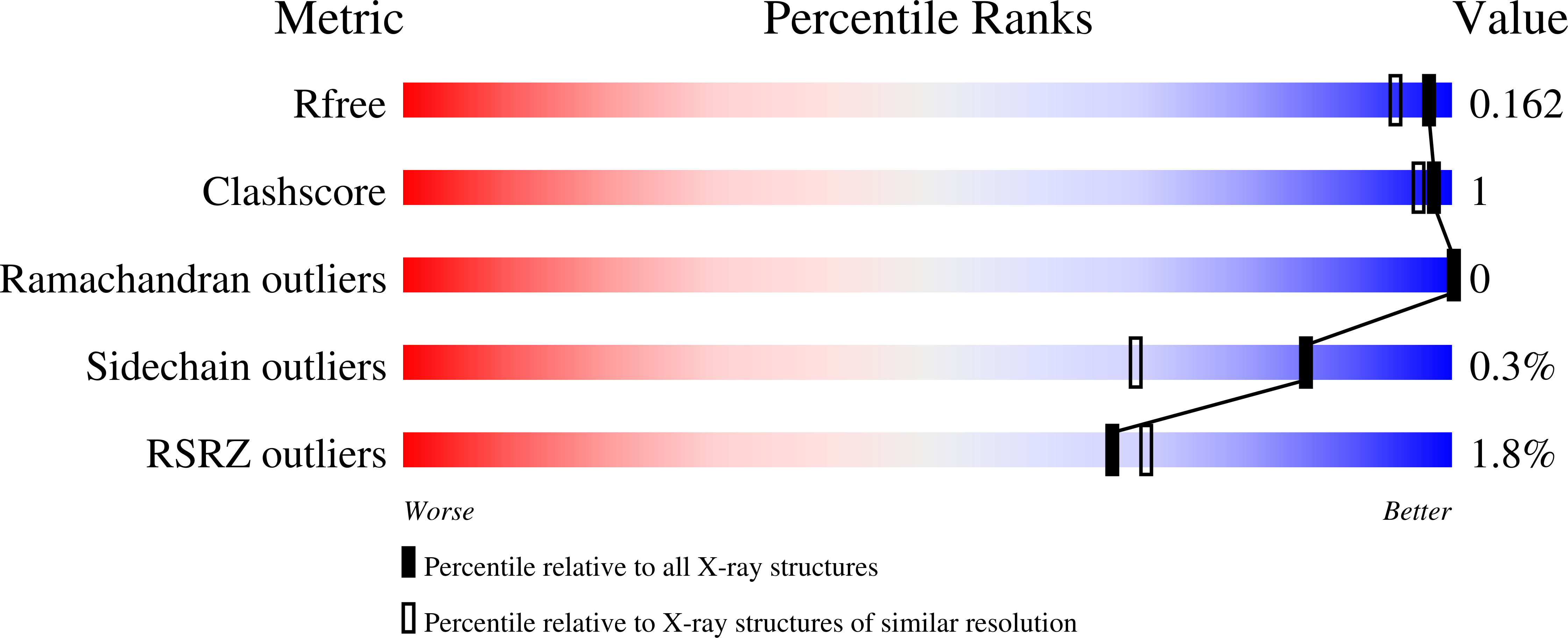
1.40 Å
R-Value Free:
0.16
R-Value Work:
0.13
R-Value Observed:
0.13
Space Group:
P 1 21 1
Macromolecular Entities
Structures with similar UniProt ID
Protein Blast
Polymer Type:polypeptide(L)
Molecule:Radical S-adenosylmethionine
Gene (Uniprot):nocN
Chain IDs:A
Chain Length:420
Number of Molecules:1
Biological Source:Nocardia sp. ATCC 202099
Primary Citation
Structural and Spectroscopic Basis for Catalysis by a Class C Radical S -Adenosylmethionine Methylase Involved in Nosiheptide/Nocathiacin Biosynthesis.
J.Am.Chem.Soc. ? ? ? (2026)
PMID: 42200415 DOI: 10.1021/jacs.6c03999

Abstact

Nosiheptide (NOS) is a ribosomally synthesized and post-translationally modified peptide natural product that exhibits potent antibiotic activity against multiple bacterial pathogens. NOS features a core macrocyclic peptide containing thiazoles, dehydrated serine and threonine residues, and a 3-hydroxypyridine ring. In addition to the macrocycle, NOS possesses a side-ring system formed by a 3-methyl-2-indolic acid (MIA) bridge that connects to glutamyl and cysteinyl residues on the core peptide via ester and thioester linkages. This unique side-ring is installed by the class C radical S-adenosylmethionine (SAM) methylase NosN. Here, we report three X-ray crystal structures of the NosN homologue, NocN, at resolutions of 1.40 A, 1.84 A, and 1.78 A under anaerobic conditions, representing the first structural characterization of a class C radical SAM methylase. The structures reveal clear electron density for two bound SAM molecules. Remarkably, the C5' atom of SAM(I), which coordinates to the [Fe(4)S(4)] cluster, lies 3.5 A from the methyl group of SAM(II) and is properly positioned for direct hydrogen atom abstraction. A structure containing a product mimic illustrates how NocN engages its substrate and identifies Tyr276 as a key catalytic residue. The structure further suggests that the sulfonium center of SAM(II) may undergo epimerization to facilitate radical attack. Finally, electron paramagnetic resonance spectroscopy identifies a paramagnetic species consistent with the addition of the SAM(II)-derived methylene radical to the MIA substrate.

Legend

Protein

Chemical

Disease

Primary Citation of related structures
Feedback Form
Name
Email
Institute
Feedback