

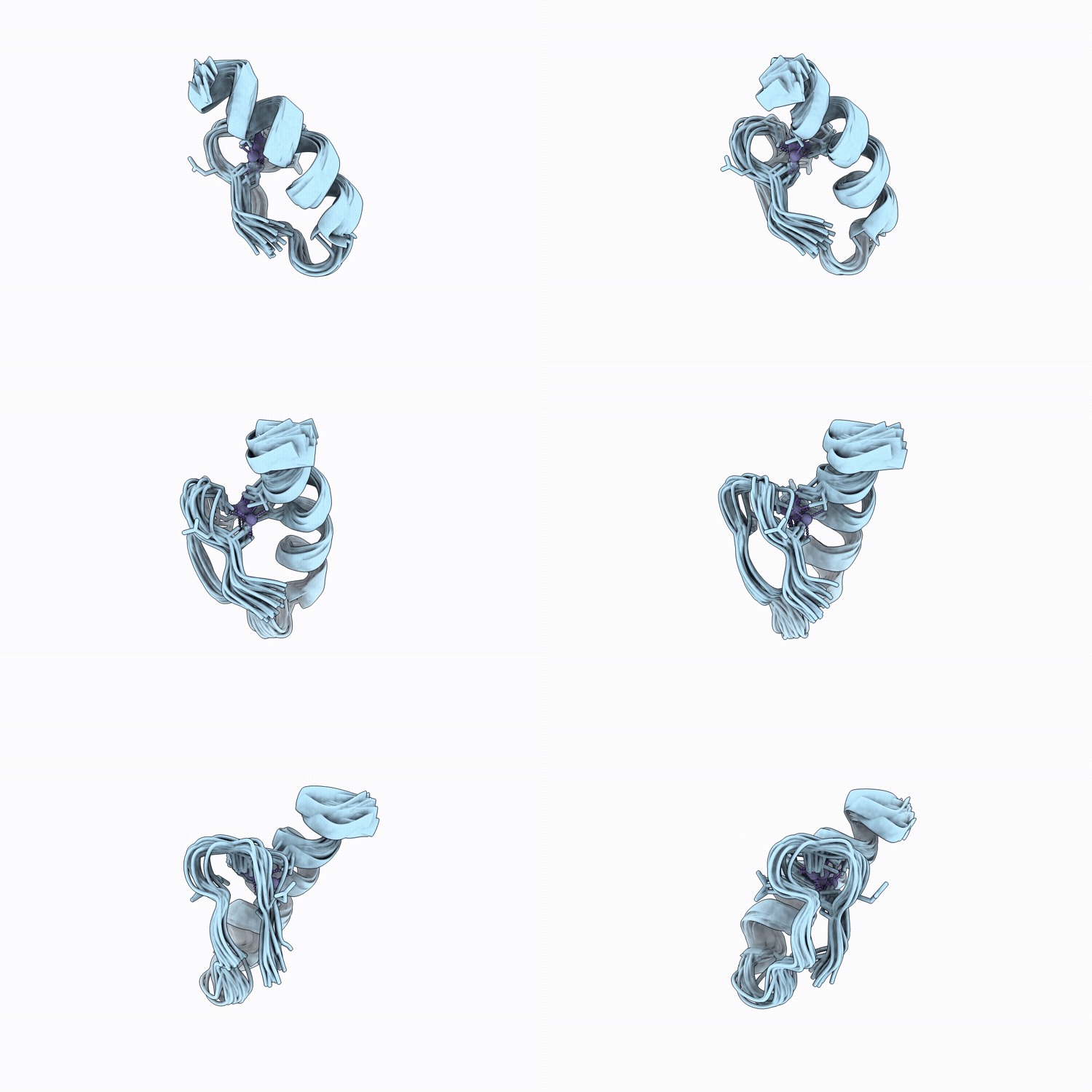
9P2Q image
Deposition Date 2025-06-12
Release Date 2026-03-18
Last Version Date 2026-03-25
Entry Detail
PDB ID:
9P2Q
Title:
Solution NMR Structure of the Novel CH Zinc Finger from Makorin-3
Biological Source:
Source Organism(s):
Homo sapiens (Taxon ID: 9606)
Method Details:
Experimental Method:
Conformers Calculated:
200
Conformers Submitted:
20
Selection Criteria:
structures with the lowest energy

Macromolecular Entities
Structures with similar UniProt ID
Protein Blast
Polymer Type:polypeptide(L)
Molecule:E3 ubiquitin-protein ligase m
Gene (Uniprot):MKRN3
Chain IDs:A
Chain Length:31
Number of Molecules:1
Biological Source:Homo sapiens
Ligand Molecules
Primary Citation
Solution structure of the novel CH-domain zinc finger from the puberty regulator Makorin-3.
Biochem.Biophys.Res.Commun. 811 153579 153579 (2026)
PMID: 41819749 DOI: 10.1016/j.bbrc.2026.153579

Abstact

The makorin (MKRN) family of ubiquitin ligases regulates diverse biological processes, including reproduction, neurogenesis, and immune function. The first identified member, MKRN3, is an inhibitor of sexual development that is the site of inherited mutations linked to central precocious puberty (CPP). All makorin proteins share a distinctive cysteine/histidine-rich (CH) domain. In MKRN3, the CH domain lies between the second C3H zinc finger and the RING domain. Using CD and NMR spectroscopy, we show that the CH domain folds upon coordination of a single Zn(2+) ion with picomolar affinity. Spectroscopic and NMR pH-titration analyses identify a CCHC-type metal-binding site, typical of zinc fingers with protein-interaction functions. The NMR structure reveals the CH-domain adopts a canonical betabetaalpha zinc finger fold, despite atypical ligand spacing and the absence of conserved hydrophobic residues that usually stabilize this type of structure. Thermal denaturation monitored by multiple spectroscopic probes indicates sequential unfolding, with side-chain packing becoming disordered near 33  degrees C but zinc-stabilized secondary structure persisting to approximately 63  degrees C, consistent with a molten-globule conformation at high temperature. Guided by sequence homology to a zinc finger in FAAP20 and Alpha Fold modeling, NMR chemical shift perturbation studies were used to demonstrate the CH-domain binds ubiquitin. In analogous E3-ubiquitin ligases like TRAF6 that contain RING and CCHC-type zinc fingers, the CCHC-type zinc finger interacts with ubiquitin to modulate ligase activity.

Legend

Protein

Chemical

Disease

Primary Citation of related structures
Feedback Form
Name
Email
Institute
Feedback