

9OZL image
Deposition Date 2025-06-05
Release Date 2026-03-11
Last Version Date 2026-03-25
Entry Detail
PDB ID:
9OZL
Keywords:
Title:
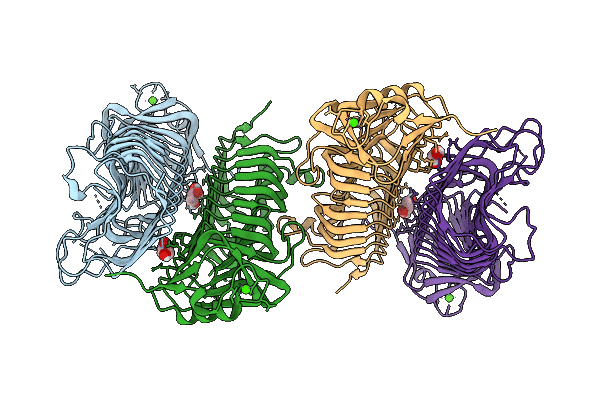
Crystal structure of the polysaccharide lyase RbmB from Vibrio cholerae
Biological Source:
Source Organism(s):
Expression System(s):
Method Details:
Experimental Method:
Resolution:
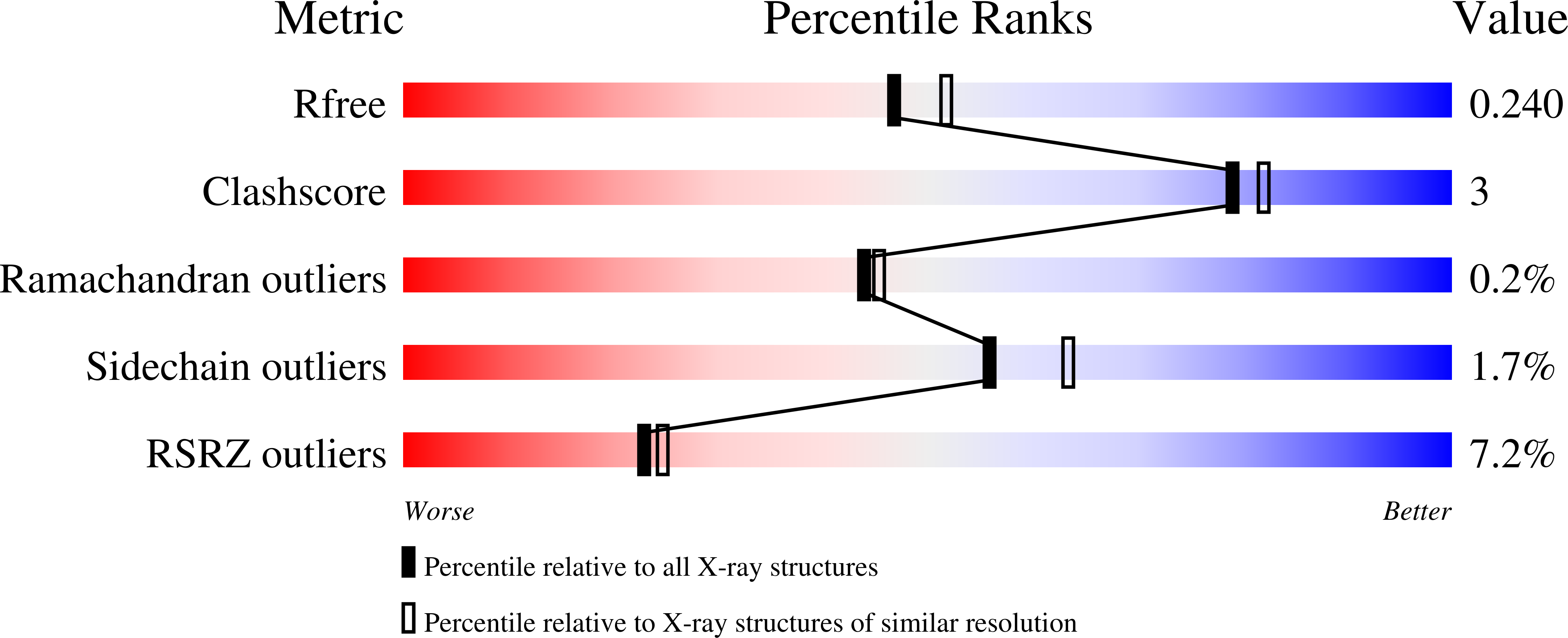
2.10 Å
R-Value Free:
0.24
R-Value Work:
0.19
R-Value Observed:
0.19
Space Group:
P 1 21 1
Macromolecular Entities
Structures with similar UniProt ID
Protein Blast
Polymer Type:polypeptide(L)
Molecule:Polysaccharide lyase
Chain IDs:A (auth: B), B (auth: C), C (auth: D), D (auth: A)
Chain Length:380
Number of Molecules:4
Biological Source:Vibrio cholerae C6706
Primary Citation
Crystal structure of Vibrio cholerae polysaccharide lyase RbmB bound to Vibrio polysaccharide (VPS) fragments provides insights into substrate recognition and cleavage.
Proc. Natl. Acad. Sci. U.S.A. 123 e2534280123 e2534280123 (2026)
PMID: 41805565 DOI: 10.1073/pnas.2534280123

Abstact

Exopolysaccharides are carbohydrate polymers secreted by bacteria to perform various roles including adhesion to surfaces, protection from environmental stressors, and as key components in the production of biofilms. The human pathogen Vibrio cholerae produces an exopolysaccharide called VPS, which is essential for the formation of its biofilm matrix through crosslinking interactions with a series of secreted accessory proteins. VPS consists of a repeating tetrasaccharide unit consisting of a uniquely modified alpha-L-gulose moiety (with N-acetyl, O-acetyl, and amide-linked glycine modifications). Encoded within the cluster containing the biofilm-production genes is a glycoside lyase called RbmB, which cleaves VPS and has been implicated in biofilm dispersal. Here we describe the ~2 A X-ray structure of RbmB bound to tetrameric and octameric fragments of VPS representing 10 total monosaccharides of an enzyme-product complex. The structure, along with molecular dynamics simulations and complementary functional analyses of mutant proteins in vitro and in vivo, illustrates how recognition and cleavage of VPS relies on salt-bridging interactions between arginine residues in RbmB and the amide-linked glycine moiety uniquely found on the VPS L-gulose and a ~30 degrees bend near the cleavage site that strains the scissile bond. We further present results regarding the localization of RbmB in V. cholerae cells, suggesting that cleavage of VPS by RbmB likely takes place in the periplasm. Sequence conservation suggests that homologous biofilm systems found in many Vibrio species likely utilize a similar VPS cleavage mechanism suggesting that RbmB could be an effective tool for dispersing biofilms across the Vibrio genus and beyond.

Legend

Protein

Chemical

Disease

Primary Citation of related structures
Feedback Form
Name
Email
Institute
Feedback